
Fragmentation of molecular ions
The molecular ion formed by electron ionisation has energy to spare and breaks apart. It does not do so at random: the bonds that break preferentially are those giving the most stable cations. A few rules (cleavage next to branches, α-cleavage at heteroatoms, benzylic ions and the McLafferty rearrangement) explain most of the peaks.
How a molecular ion breaks
The molecular ion, M+•, is a radical cation. When a bond breaks, the charge and the unpaired electron are shared out:
M+• → A+ + B• or M+• → C+• + D
In the first case a cation and a radical form; in the second, a radical cation and a neutral molecule (water, an alkene, CO…). The detector only sees charged fragments: radicals and neutral molecules are lost and can only be deduced from the mass difference with the molecular ion. Of the two possible ways a bond can break, the one that leaves the charge on the fragment best able to stabilise it predominates.
Hydrocarbons: cleavage next to branches
Straight-chain alkanes give series of CnH2n+1+ carbocations 14 units apart (one CH2): m/z 29, 43, 57, 71… In branched ones, cleavage concentrates next to the branch, because it gives secondary or tertiary carbocations, which are more stable. That is why the molecular ion of highly branched alkanes is weak or absent.
We can see it in isooctane (2,2,4-trimethylpentane), the reference compound for the octane rating of petrol:
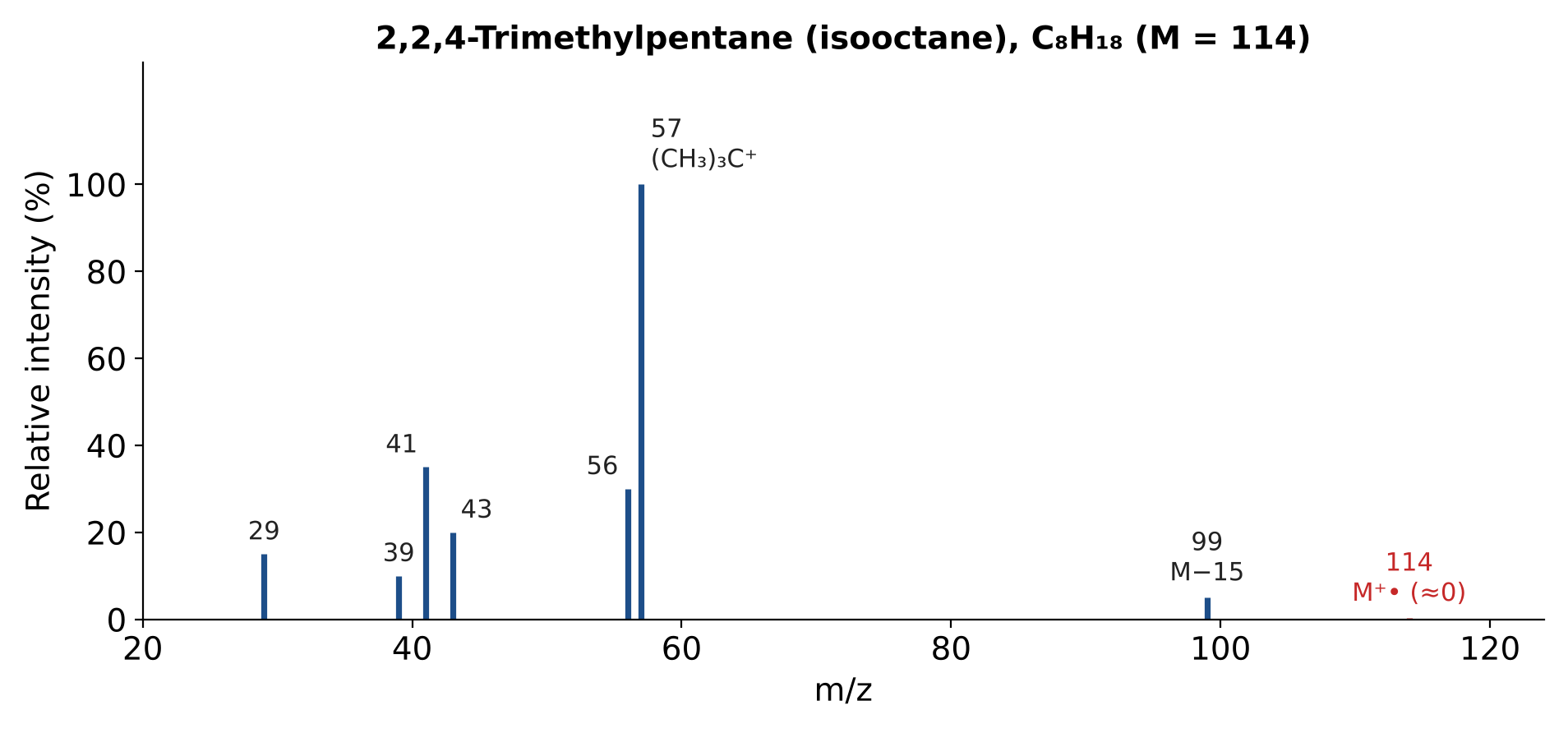
The molecular ion (114) is not seen: cleavage next to the quaternary carbon gives the tert-butyl cation, (CH3)3C+, a tertiary carbocation, at m/z 57, which is the base peak. Compare it with straight-chain hexane, whose molecular ion does appear.
α-Cleavage next to a heteroatom
If the molecule contains an oxygen or a nitrogen, the electron lost on ionisation is usually one of its lone-pair electrons. The C–C bond next to the carbon bearing the heteroatom, the α bond, breaks easily, because the resulting cation is stabilised by resonance with the heteroatom's lone pair:
- Amines: R–CH2–NH2+• → CH2=NH2+ (m/z 30) + R•. Iminium ions (30, 44, 58…) are often the base peak of amines.
- Alcohols and ethers: R–CH2–OH+• → CH2=OH+ (m/z 31) + R•. Alcohols also lose water easily (M − 18).
- Ketones, aldehydes and esters: cleavage on either side of the carbonyl gives very stable acylium ions, R–C≡O+: CH3CO+ (43), C2H5CO+ (57), C6H5CO+ (105).
Let us see it in butanone, CH3–CO–CH2CH3:
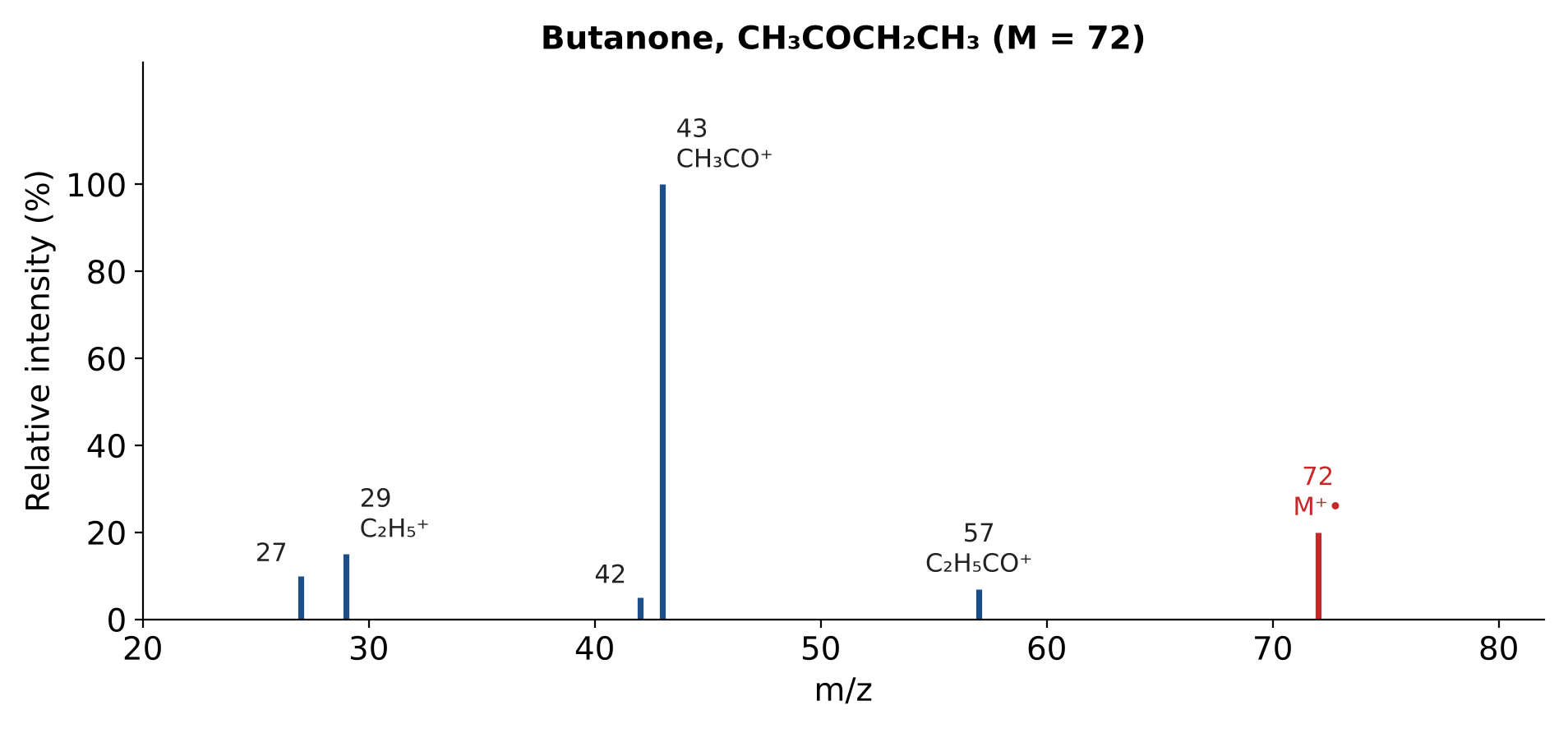
The two α-cleavages of the carbonyl give the acetyl ion, CH3CO+ (m/z 43, loss of an ethyl, 72 − 29), and the propanoyl ion, C2H5CO+ (m/z 57, loss of a methyl, 72 − 15). The first dominates: the larger radical, ethyl, which is more stable than methyl, is lost preferentially. The acylium ion can also lose CO to give the C2H5+ at m/z 29.
Aromatic compounds: the tropylium ion
Compounds with a benzyl group (C6H5CH2–R) break the benzylic bond and give a C7H7+ cation that rearranges to the tropylium ion, a very stable seven-membered aromatic ring with 6 π electrons. Its peak at m/z 91 is characteristic of alkylbenzenes, as we saw with toluene. The phenyl cation, C6H5+ (77), and its fragment at 51 also reveal a benzene ring.
The McLafferty rearrangement
It was studied by Fred W. McLafferty in the late 1950s. Carbonyl compounds with a hydrogen on the γ carbon undergo a rearrangement through a six-membered transition state. The carbonyl oxygen picks up the γ hydrogen, the bond between the α and β carbons breaks, and a neutral alkene is eliminated. What remains is the radical cation of an enol, with an even mass.
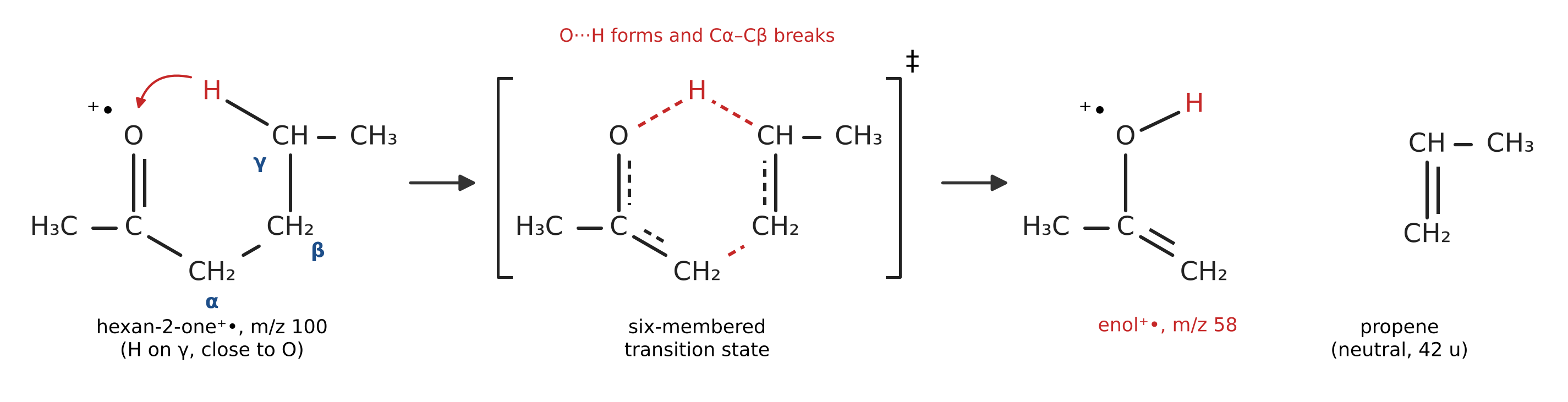
CH3–CO–CH2–CH2–CH2–CH3+• → CH2=C(OH)–CH3+• (m/z 58) + CH2=CH–CH3
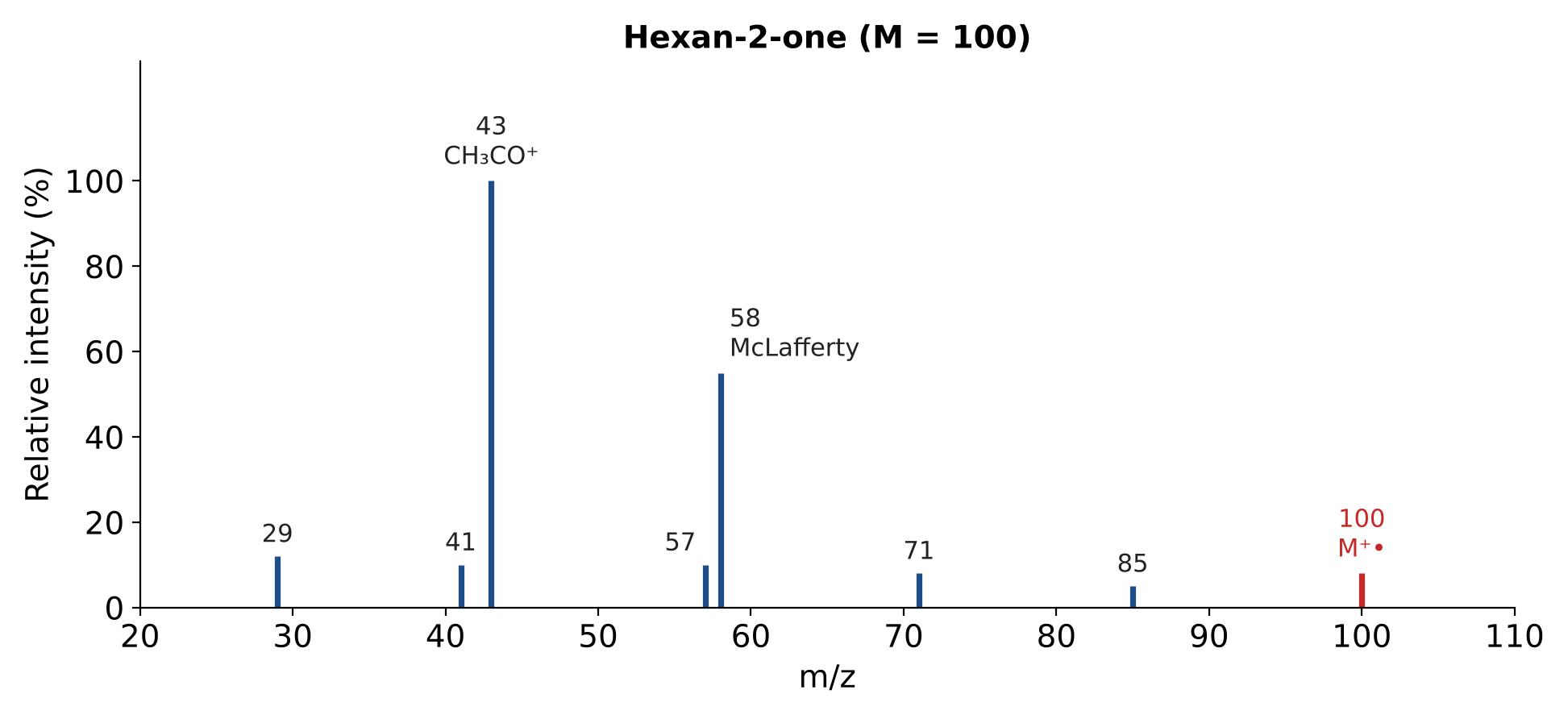
In hexan-2-one, the McLafferty ion appears at m/z 58 (loss of propene, 42). Butanone has no γ hydrogens and shows no such peak. Methyl ketones with a γ hydrogen always give the peak at 58, and methyl esters the one at 74; they are very useful signs for recognising the family.
Common losses and ions
| Loss from M | Fragment lost | Suggests |
|---|---|---|
| M − 1 | H• | aldehydes, some aromatics |
| M − 15 | CH3• | methyl, especially on a branched carbon |
| M − 18 | H2O | alcohols |
| M − 28 | CO or C2H4 | cyclic ketones, phenols; ethyl (McLafferty) |
| M − 29 | C2H5• or CHO• | ethyl; aldehydes |
| M − 31 | CH3O• | methyl esters |
| M − 35/37 | Cl• | chlorides |
| M − 43 | C3H7• or CH3CO• | propyl; methyl ketones |
| M − 45 | C2H5O• | ethyl esters |
| m/z | Ion | Suggests |
|---|---|---|
| 29, 43, 57, 71 | CnH2n+1+ | alkyl chains |
| 30 | CH2=NH2+ | primary amines |
| 31 | CH2=OH+ | primary alcohols, ethers |
| 43 | CH3CO+ (or C3H7+) | methyl ketones, acetates |
| 58 | CH2=C(OH)CH3+• | methyl ketones (McLafferty) |
| 77 | C6H5+ | benzene ring |
| 91 | C7H7+ | benzyl (tropylium) |
| 105 | C6H5CO+ | benzoyl derivatives |
To interpret fragmentation, calculate the differences between the molecular ion and the main peaks and ask which neutral fragment has been lost. Then look for the characteristic ions: 30 and 31 for amines and alcohols, 43 and 58 for methyl ketones, 77 and 91 for aromatics.