
Examples of mass spectra
Six mass spectra from different families (an alkane, an alcohol, an amine, an ester, a bromide and an aromatic chloride) show how the rules are applied: find the molecular ion, check the isotopes and the nitrogen rule, and explain the main peaks by their typical cleavages.
All the spectra are electron ionisation spectra at 70 eV. They are drawn schematically, with only the main peaks and approximate intensities; next to each one is the real spectrum from the SDBS database of Japan's National Institute of Advanced Industrial Science and Technology (AIST). The spectra of hundreds of thousands of compounds can be consulted free of charge in the NIST Chemistry WebBook (of the US National Institute of Standards and Technology) and in SDBS, which also holds NMR, IR and Raman spectra.
Hexane, C6H14
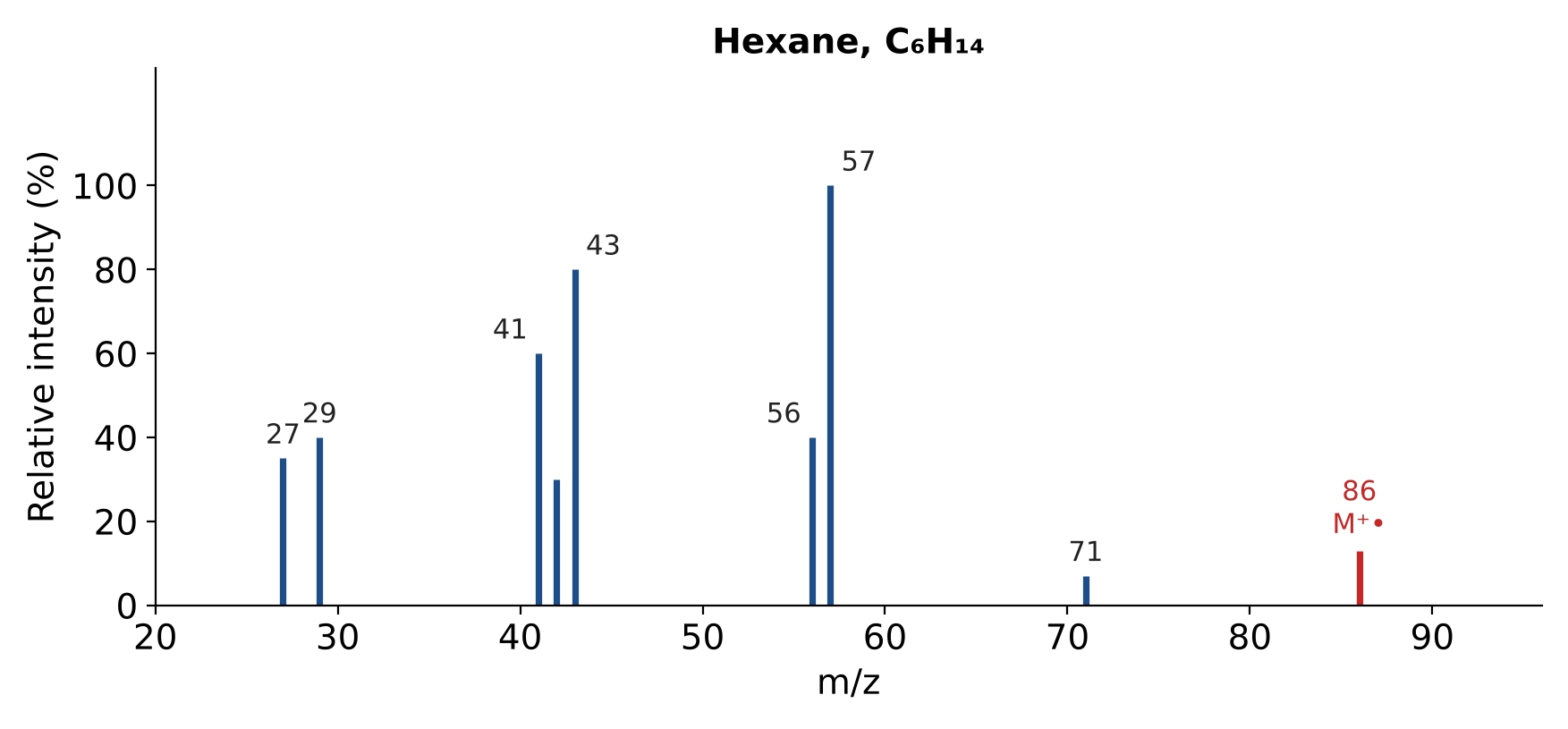
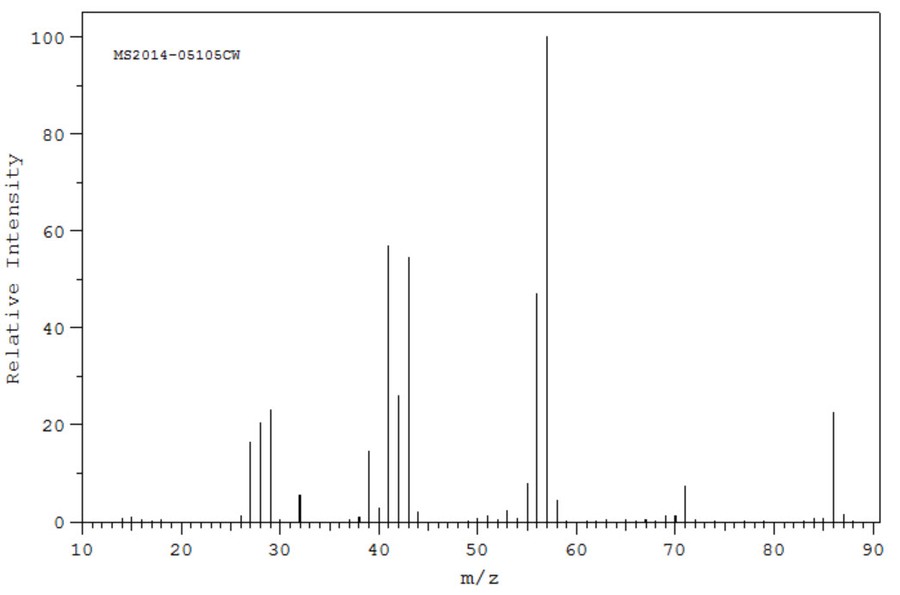
The molecular ion (86) is weak. The main peaks form the series of alkyl carbocations, 14 units apart: 71 (loss of CH3), 57 (loss of C2H5, base peak), 43 and 29. Next to each one are peaks one or two units lower (56, 42, 41…), which have also lost one or two hydrogens. This is the typical pattern of a straight chain.
Butan-1-ol, C4H9OH
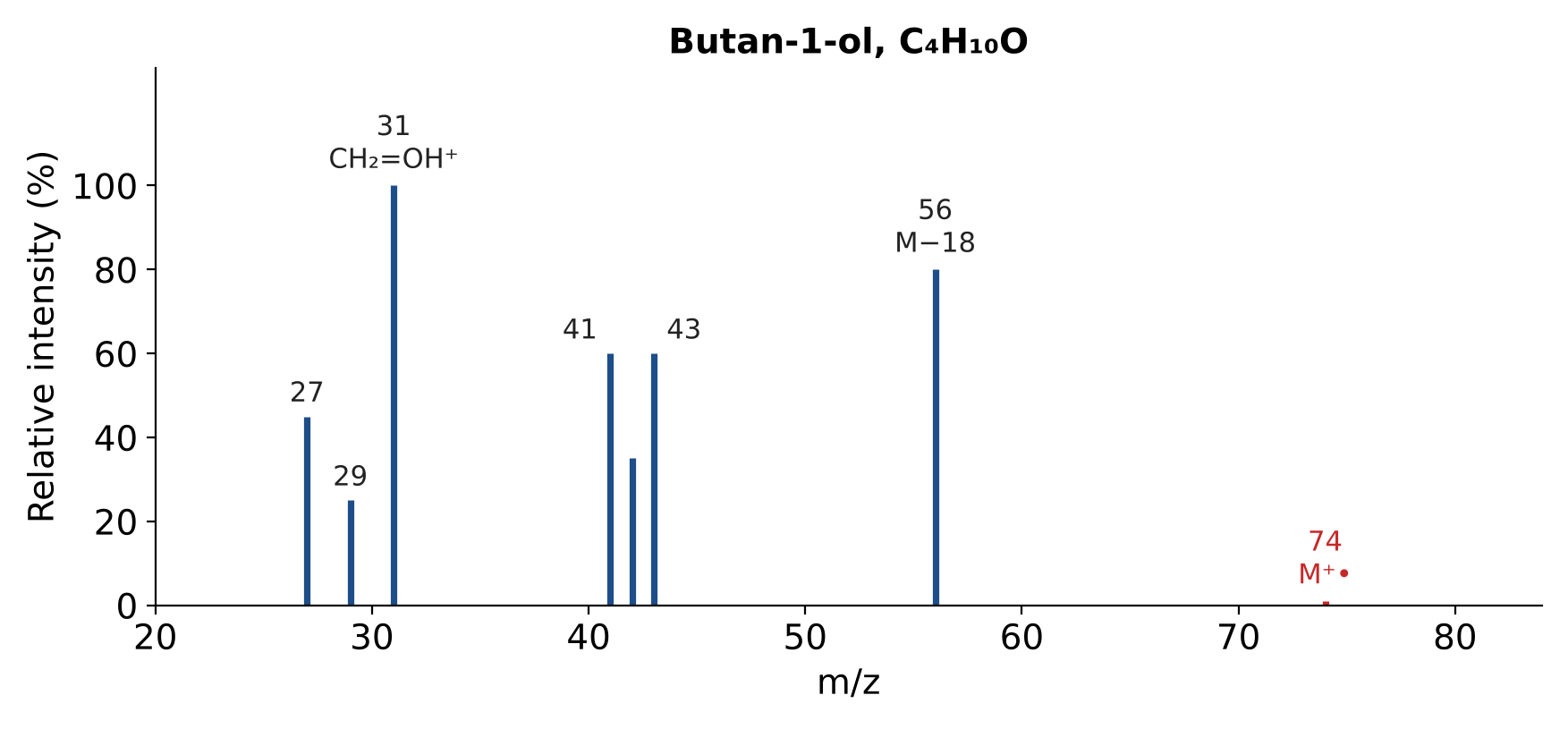
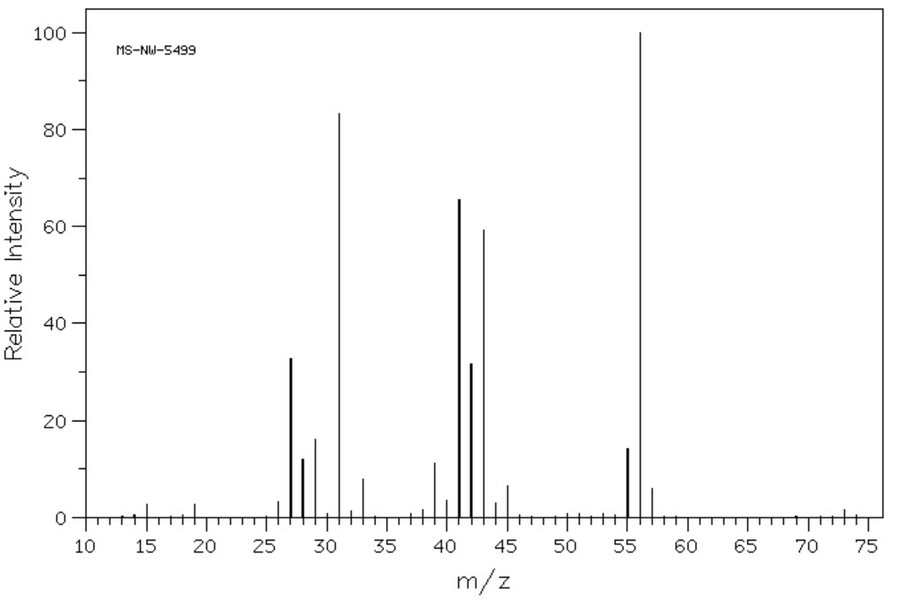
The molecular ion (74) is barely visible, as in many alcohols. The peak at 56 corresponds to the loss of water (74 − 18). The base peak, at 31, is the CH2=OH+ ion, formed by α-cleavage with loss of the propyl radical: it is the signature of a primary alcohol. The peaks at 41 and 43 are chain fragments.
Diethylamine, (C2H5)2NH
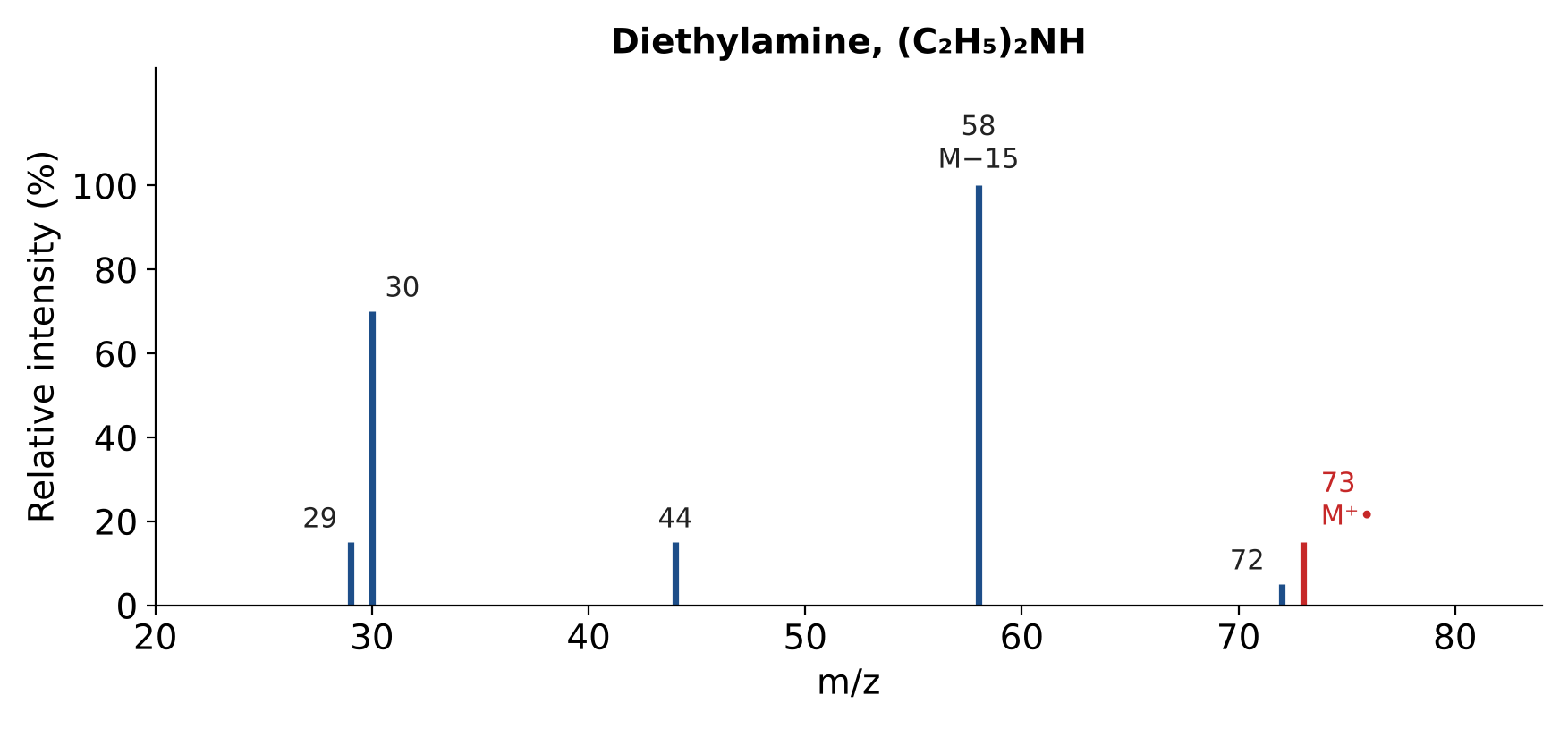
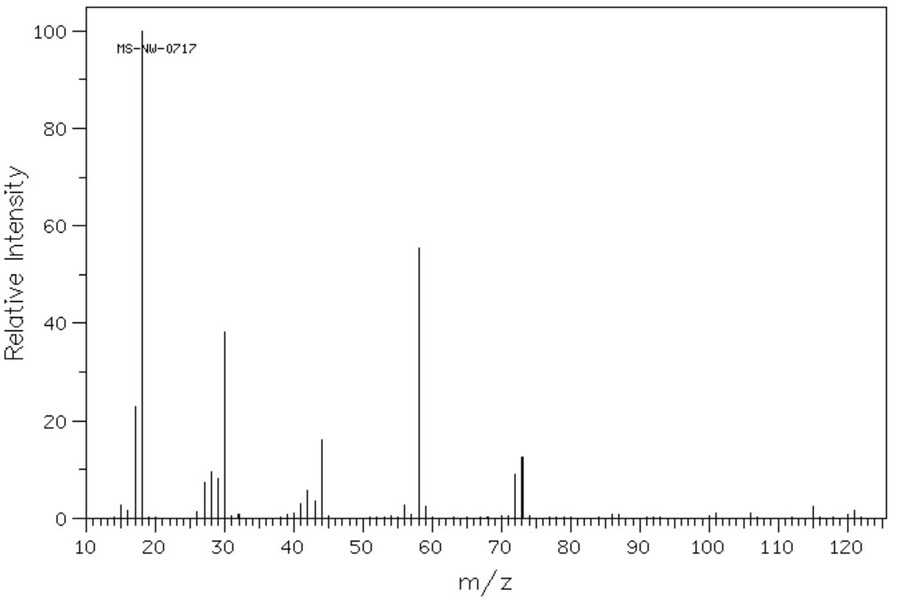
The molecular ion is at m/z 73, an odd number: according to the nitrogen rule, the molecule has an odd number of nitrogens. The base peak, at 58, forms by α-cleavage: the ion loses a methyl radical (73 − 15), leaving the iminium ion CH2=NH+–CH2CH3. This in turn can lose ethylene to give CH2=NH2+ at m/z 30.
Ethyl acetate, CH3COOC2H5
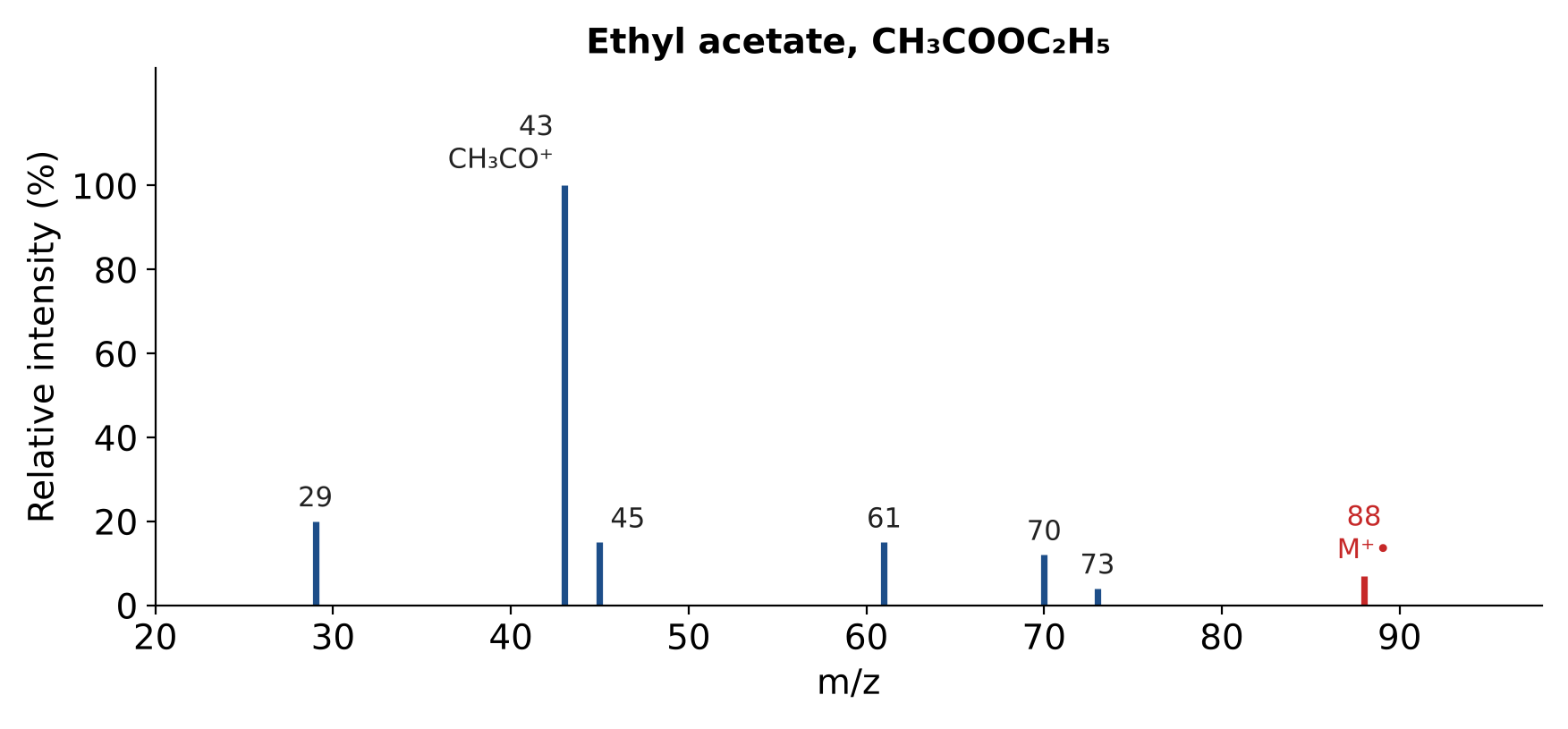
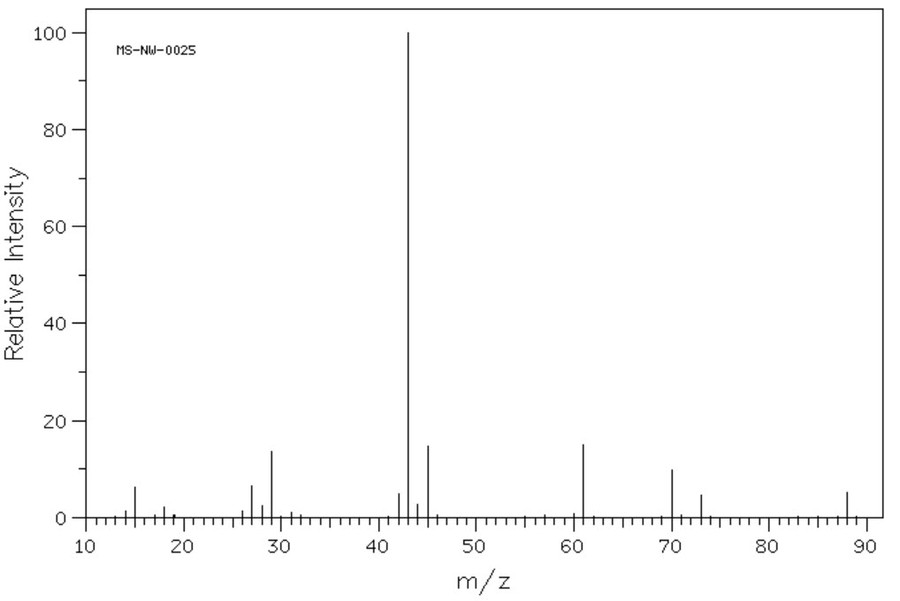
The molecular ion (88) is weak. The base peak, at 43, is the acetyl ion, CH3CO+, from α-cleavage with loss of the ethoxy group (88 − 45). The peak at 45 is the ethoxy ion itself, C2H5O+, and the one at 29 the ethyl ion. The peak at 61 comes from a rearrangement in which two hydrogens of the ethyl group are transferred and protonated acetic acid forms; it is typical of acetates.
1-Bromopropane, CH3CH2CH2Br
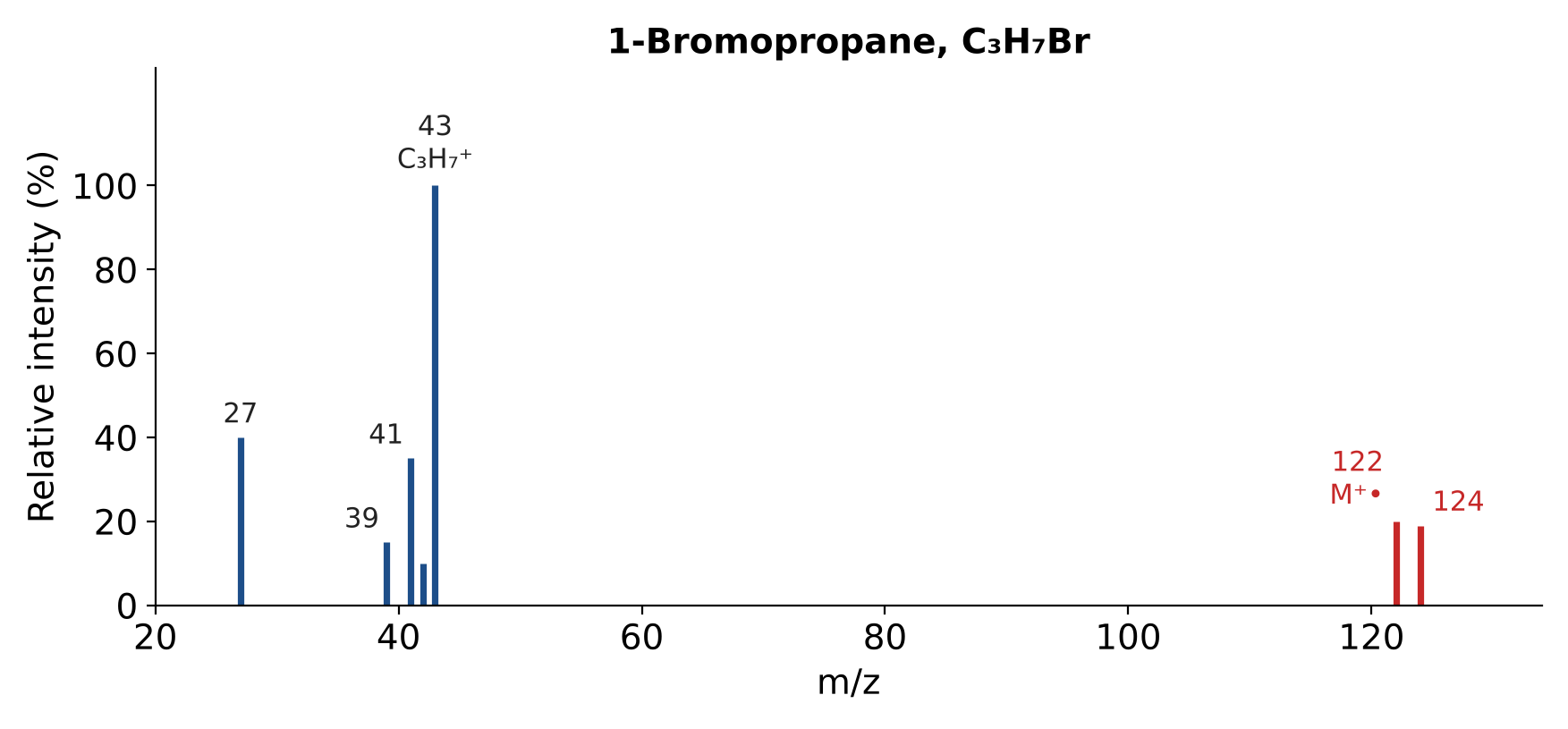
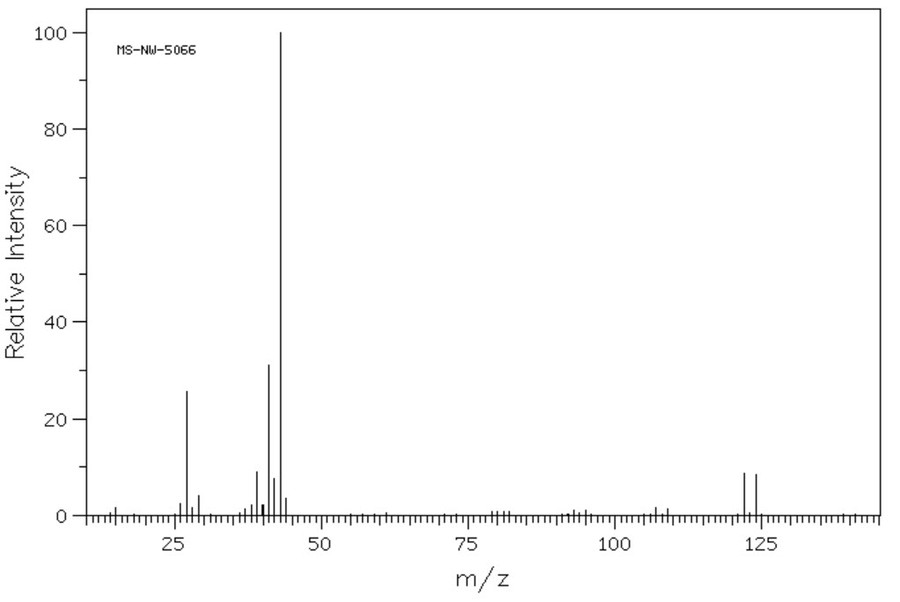
The molecular ion is a pair of peaks of almost equal intensity, 122 and 124, the signature of one bromine. The base peak, at 43, is the propyl cation, C3H7+, which has lost the bromine atom (122 − 79 or 124 − 81). This peak has no partner at +2: the fragment does not keep the bromine. The peaks at 41 and 27 are fragments of the propyl group.
Chlorobenzene, C6H5Cl
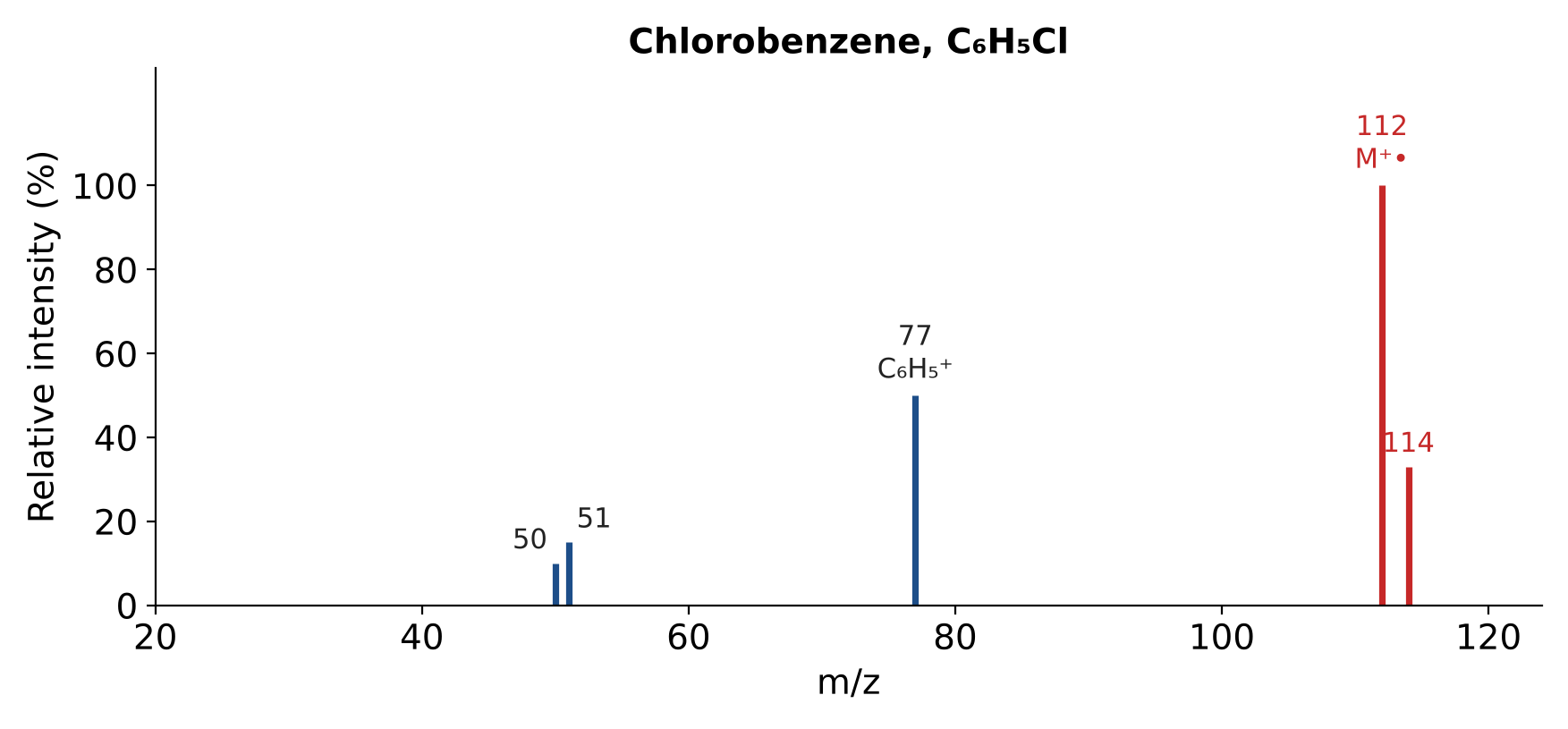
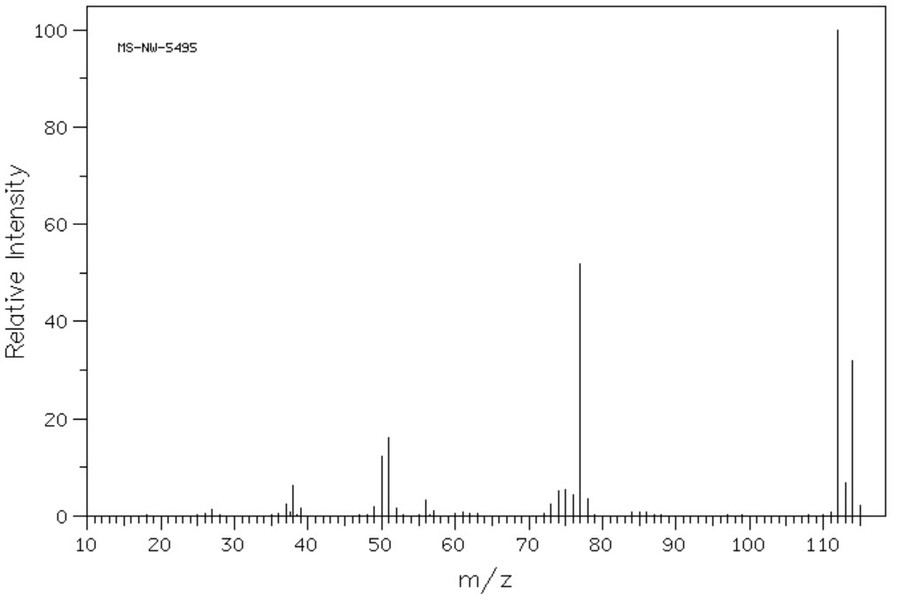
In aromatic compounds the molecular ion is very stable, and here it is the base peak (112). Its partner at 114, with one third of the intensity, indicates one chlorine. Loss of chlorine gives the phenyl cation, C6H5+ (77), which in turn loses acetylene to give the peak at 51.
The molecular ion is intense in aromatic compounds, weak in alkanes, esters and amines, and almost absent in alcohols. Its intensity is already a clue to the compound's family.