
Analysers and detectors
The analyser separates ions by their m/z. There are several types, based on different physical principles: magnetic fields, oscillating electric fields, flight times or rotation frequencies. Their most important quality is resolution, the ability to tell apart ions of very similar mass.
Magnetic sector
This is the classic design we saw in the first section. The accelerated ions enter a magnetic field that bends their path with a radius that depends on m/z. Adding an electric sector (double-focusing instruments) corrects the small energy differences between ions and achieves high resolution. They are large, expensive instruments, less common today.
Quadrupole
Four parallel metal rods, carrying a direct voltage and a radiofrequency voltage, create an oscillating electric field. For given voltages, only ions of one m/z follow stable paths and pass through the quadrupole to the detector; the rest hit the rods. Varying the voltages scans through all m/z values.
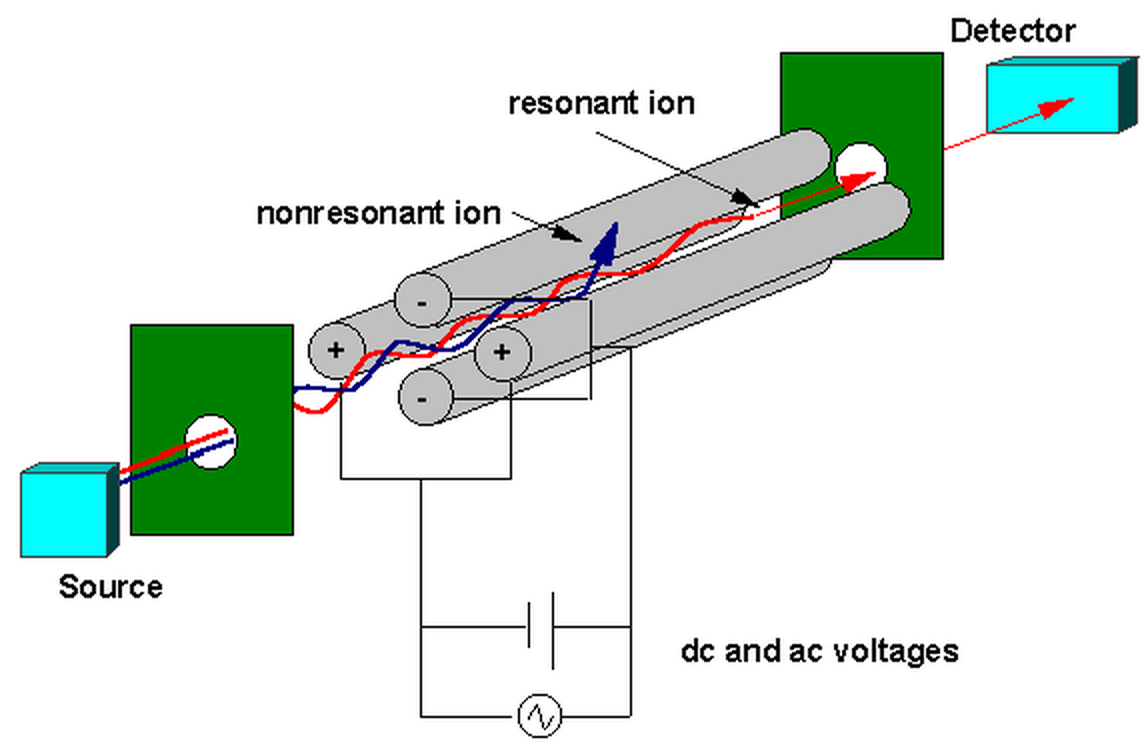
It is a compact, robust and cheap mass filter, the most common in routine GC-MS instruments. Its resolution is modest: it distinguishes whole masses (m/z 100 from 101), but not exact masses. Three quadrupoles in series (triple quadrupole) allow tandem mass spectrometry, which we will see below.
Time of flight (TOF)
All the ions receive the same electric push and therefore the same kinetic energy, zeV = ½mv2. Light ones leave faster. They then travel through a field-free tube, one or two metres long, and reach the detector at different times: the flight time is proportional to √(m/z).
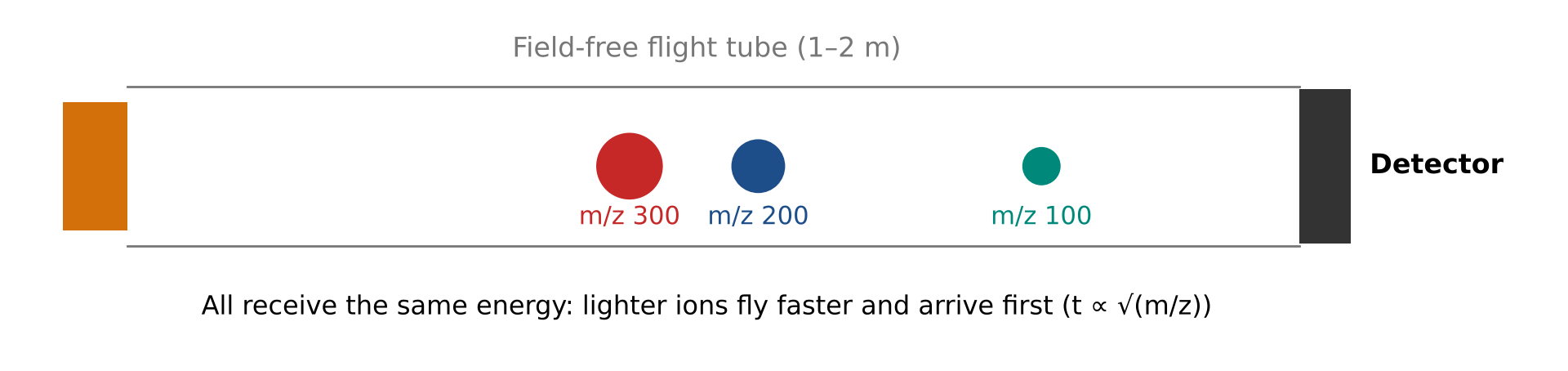
A TOF records the whole spectrum in microseconds, has no upper mass limit and reaches good resolution, especially with a reflectron, an electric mirror that lengthens the path and compensates for energy differences. It is the natural partner of MALDI.
Ion traps, Orbitrap and FT-ICR
Other analysers trap the ions and measure the frequency at which they move, which depends on m/z:
- In the ion trap, a radiofrequency field keeps the ions trapped and then ejects them towards the detector in order of m/z.
- In the Orbitrap, the ions orbit around a spindle-shaped central electrode and oscillate along it. The frequency of this oscillation depends on m/z and is measured by Fourier transform, as in NMR.
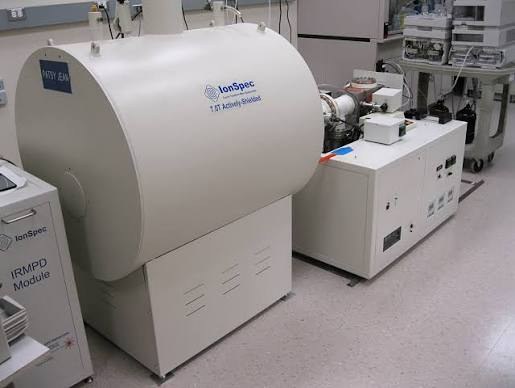
- In FT-ICR (ion cyclotron resonance), the ions circle in a very strong magnetic field at a frequency f = zeB/(2πm), also measured by Fourier transform. It is the highest-resolution analyser.
Resolution
Resolution is defined as R = m/Δm, where Δm is the smallest mass difference that can be distinguished at mass m. Consider three ions of nominal mass 28: CO+• (27.9949), N2+• (28.0061) and C2H4+• (28.0313).
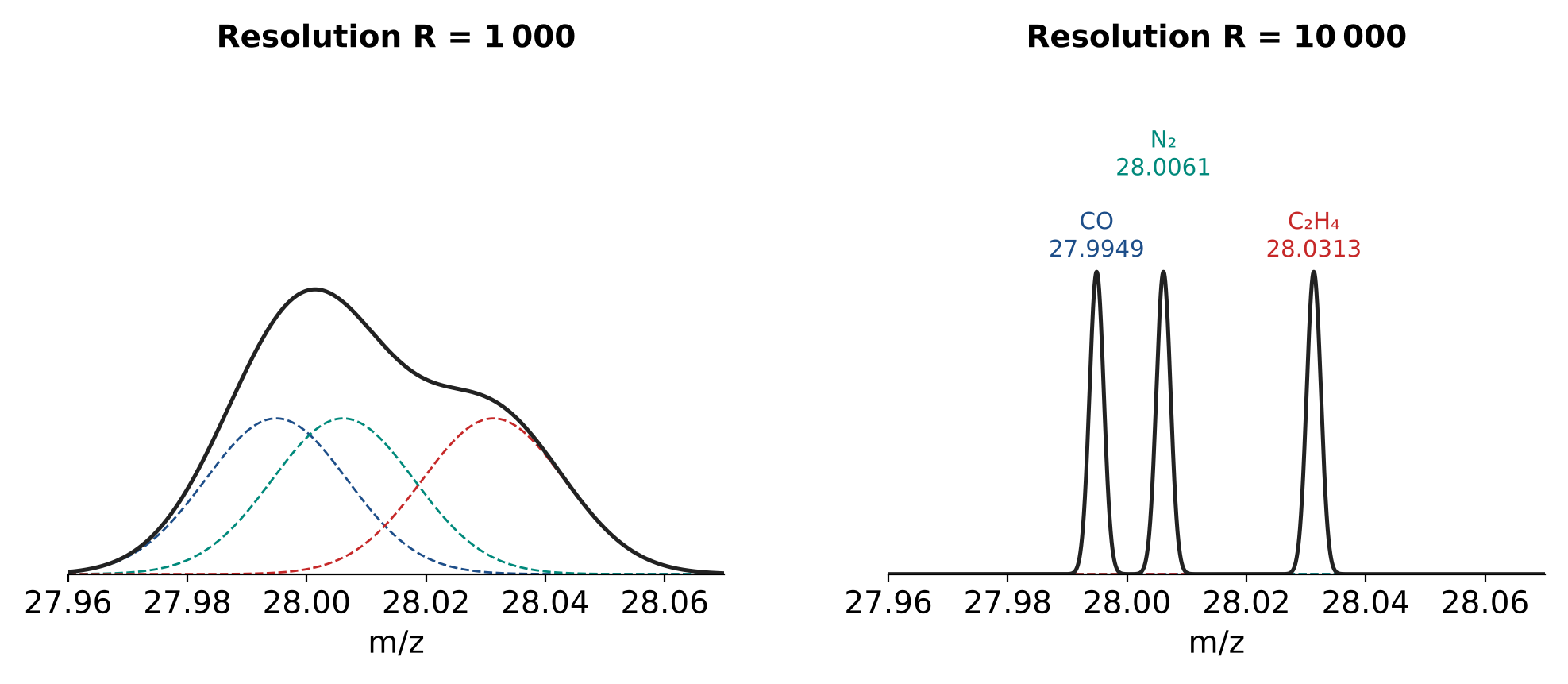
At R = 1000 the three merge into a single signal. To separate CO from N2, which differ by 0.0112, R ≈ 28/0.0112 ≈ 2500 is needed. At R = 10,000 all three are well separated, and the exact mass of each can be measured.
| Analyser | Typical resolution | Uses |
|---|---|---|
| Quadrupole, ion trap | 1000–4000 (nominal mass) | routine GC-MS and LC-MS, quantification |
| Double-focusing magnetic sector | 10,000–100,000 | exact mass (classic) |
| Time of flight (TOF) | 10,000–60,000 | MALDI, high-resolution LC-MS |
| Orbitrap | 100,000–1,000,000 | exact mass, proteomics, metabolomics |
| FT-ICR | over 1,000,000 | very complex mixtures (petroleum, natural organic matter) |
The detector and tandem mass spectrometry
The most common detector is the electron multiplier. Each ion hitting its surface knocks out a few electrons, which are accelerated and knock out more from the next surface, and so on: a cascade that turns a single ion into a million measurable electrons. In the Orbitrap and FT-ICR, by contrast, there is no impact: the small current induced by the ions as they move near some electrodes is measured.
Combining two analysers gives tandem mass spectrometry (MS/MS). The first selects an ion, which fragments by collisions with a gas in a collision cell, and the second analyses the fragments. This shows which fragments come from which ion, and makes it possible to sequence peptides or to quantify a drug in blood with great selectivity.
A quadrupole measures whole masses; a TOF, an Orbitrap or an FT-ICR measures masses to four or five decimal places. That precision is what makes it possible to deduce the molecular formula.