
Degrees of unsaturation
Once the molecular formula is known, the number of degrees of unsaturation tells how many rings and π bonds the molecule has in total. It is a simple calculation that greatly narrows down the possible structures before looking at any spectrum.
The idea
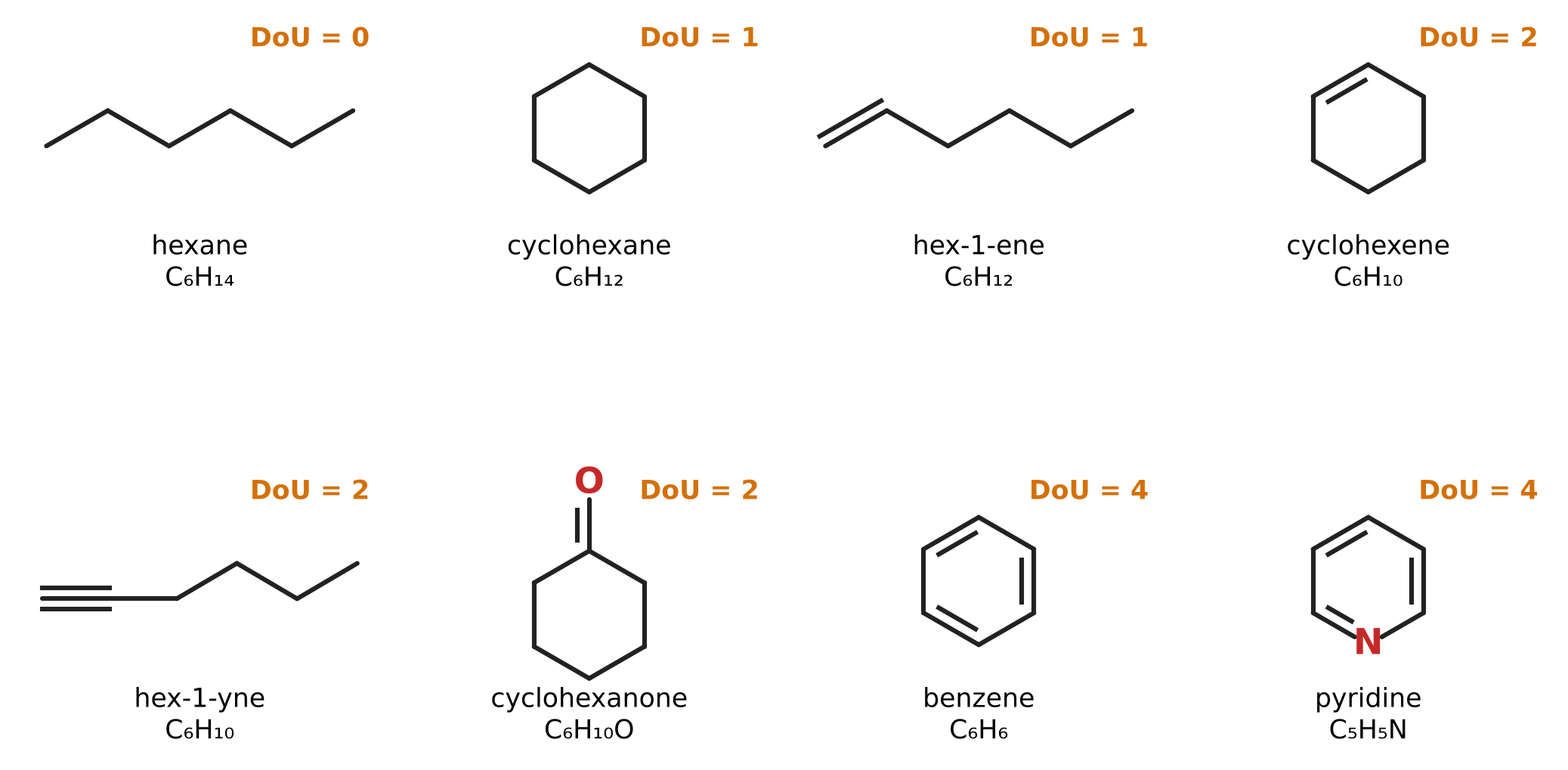
An open-chain hydrocarbon with no multiple bonds, an alkane, has the largest possible number of hydrogens: CnH2n+2. Each time a ring or a π bond forms, two hydrogens are lost. Thus hexane is C6H14; cyclohexane and hex-1-ene, C6H12; benzene, C6H6.
The degree of unsaturation (DoU), also called the index of hydrogen deficiency or the number of double-bond equivalents, is the number of pairs of hydrogens that the molecule is missing compared with the alkane having the same number of carbons:
- Each ring counts 1.
- Each double bond (C=C, C=O, C=N…) counts 1.
- Each triple bond (C≡C, C≡N) counts 2.
The formula
For a compound with formula CcHhNnOoXx (X = halogen):
DoU = (2c + 2 + n − h − x) / 2
Each term has a simple explanation:
- Oxygen and sulfur do not appear: they are divalent and can be inserted into a chain (C–O–C) or into a C–H bond (C–O–H) without changing the number of hydrogens. Methane, CH4, and methanol, CH4O, both have DoU = 0.
- Halogens are monovalent and take the place of a hydrogen, so they are counted as hydrogens. CH3Cl has DoU = 0, just like CH4.
- Each trivalent nitrogen brings one extra hydrogen: methylamine, CH5N, is saturated (DoU = 0).
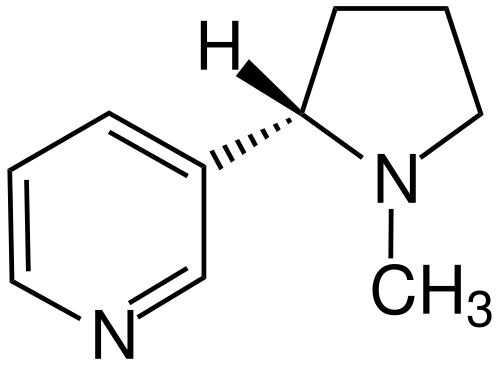
For example, nicotine, C10H14N2, has DoU = (20 + 2 + 2 − 14)/2 = 5: a pyridine ring (4) and a pyrrolidine ring (1).
The DoU must be a whole, non-negative number. If it comes out fractional or negative, the formula is wrong, or the molecule is an ion or a radical.
How it is used
The DoU does not say which unsaturations are present, but it greatly limits the possibilities. Some useful guidelines:
| DoU | What it suggests |
|---|---|
| 0 | Acyclic, saturated compound: alkane, alcohol, ether, amine, alkyl halide |
| 1 | One ring or one double bond (C=C, C=O, C=N) |
| 2 | One triple bond, two double bonds, two rings, or one ring and one double bond |
| 4 or more | Possible benzene ring (one ring and three double bonds), especially if there are few hydrogens for the number of carbons |
The spectra then decide between the options. A compound C6H12 (DoU = 1) can be an alkene or a cycloalkane: if the IR shows a C=C band and =C–H stretches above 3000 cm−1, it is an alkene; if not, a cycloalkane. In the 13C spectrum, each sp2 carbon appears above 100 ppm, so counting those signals tells how many of the unsaturations are π bonds and, by difference, how many are rings.
For compounds containing other elements, the general rule is to count each atom according to its valence: monovalent atoms (H, halogens) subtract, divalent ones (O, S) do not count, trivalent ones (N, P) add one and tetravalent ones (C, Si) add two. In the formula, Si counts as C and P as N.