The problem of structure determination
Determining the structure of a compound means finding out which atoms it contains, how they are bonded and how they are arranged in space. Until the middle of the twentieth century this required years of degradations and syntheses; today, with a few milligrams and spectroscopic techniques, a few days are usually enough.
What “knowing a structure” means
The structure of a molecule is described at three levels, each finer than the last:
- Constitution (or connectivity): which atoms are present and how they are bonded to each other. Two compounds with the same molecular formula and different constitutions are constitutional isomers, such as ethanol and dimethyl ether.
- Configuration: the spatial arrangement of atoms that cannot change without breaking bonds, such as that of the substituents on a stereocentre (R or S) or on a double bond (E or Z). It can be relative (that of some centres with respect to others) or absolute.
- Conformation: the arrangements that interconvert by rotation about single bonds, such as the chairs of a cyclohexane.
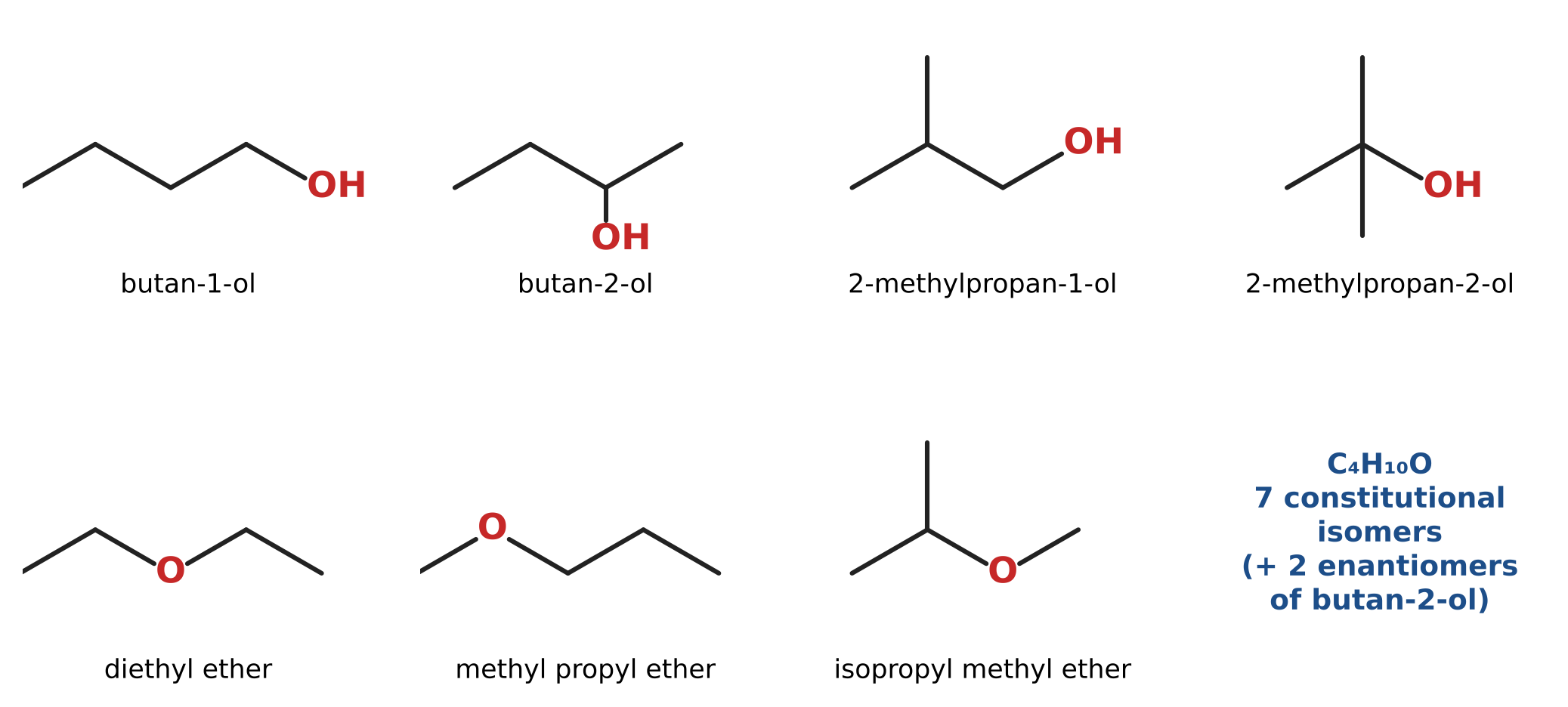
The first question, and almost always the hardest, is the constitution. The number of possibilities grows very quickly with size: the formula C4H10O already has seven constitutional isomers, four alcohols and three ethers; C10H22 has 75 different alkanes.
Before spectroscopy
During the nineteenth century and the first half of the twentieth, structures were determined by chemical methods. The molecule was broken into smaller, known fragments (by oxidation, ozonolysis, hydrolysis or alkali fusion), those fragments were identified and the puzzle was put back together. The final proposal was only accepted once the compound had been synthesized and shown to be identical to the natural one.
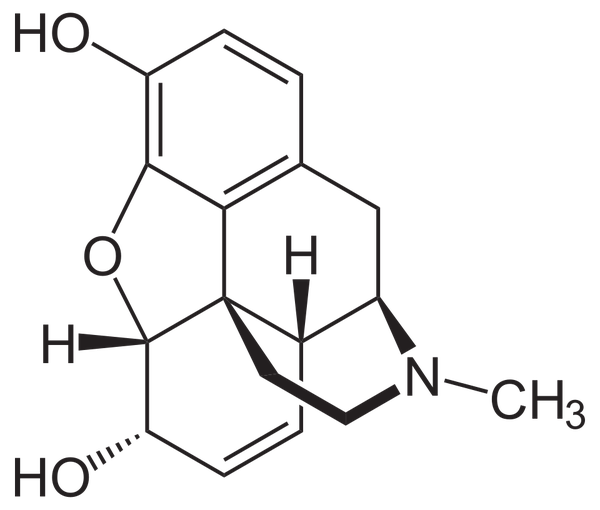
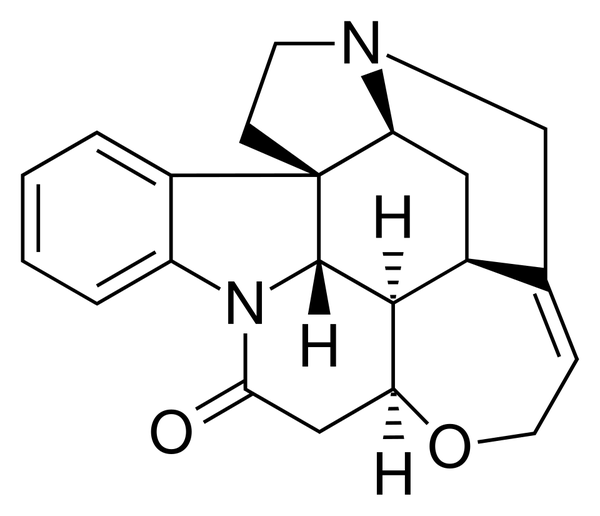
The method worked, but it was very slow and needed large amounts of sample. The structure of morphine, isolated in 1805, was not established until 1925 (Robinson) and was not confirmed by synthesis until 1952; that of strychnine kept several research groups busy for more than forty years. Moreover, degradations could cause rearrangements that led to wrong structures. Strychnine, with seven rings in only 21 carbons, was not synthesized until 1954 (Woodward).
Today's tools
From the 1950s onwards, spectroscopy completely changed the way of working. Each technique provides one kind of information, and none is enough on its own:
| Technique | What it tells | Sample |
|---|---|---|
| Elemental analysis | Proportion of C, H, N and S: empirical formula | 1–3 mg, destroyed |
| Mass spectrometry | Molecular mass and molecular formula (high resolution); fragments | µg or less, destroyed |
| Infrared | Functional groups | ~1 mg, recovered |
| UV-visible | Conjugated systems and chromophores | µg, recovered |
| NMR (1H, 13C, 2D) | Environment of each atom, connectivity, relative stereochemistry | 0.1–20 mg, recovered |
| Chiroptical methods (polarimetry, circular dichroism) | Optical activity, absolute configuration | mg, recovered |
| Solid-state NMR | Environment of the atoms in the solid: polymorphs, insoluble compounds | 10–100 mg, recovered |
| X-ray diffraction | Complete three-dimensional structure | a single crystal |
Of all of them, NMR gives the most information about the constitution of an organic molecule, which is why it takes up most of this course. X-ray diffraction gives the most complete answer, but only if a good-quality single crystal can be obtained.
The usual path
Although every problem is different, the work usually follows a logical order: first make sure the sample is pure; then establish the molecular formula and the degrees of unsaturation; next identify the functional groups, determine how the atoms are connected and, finally, the stereochemistry.
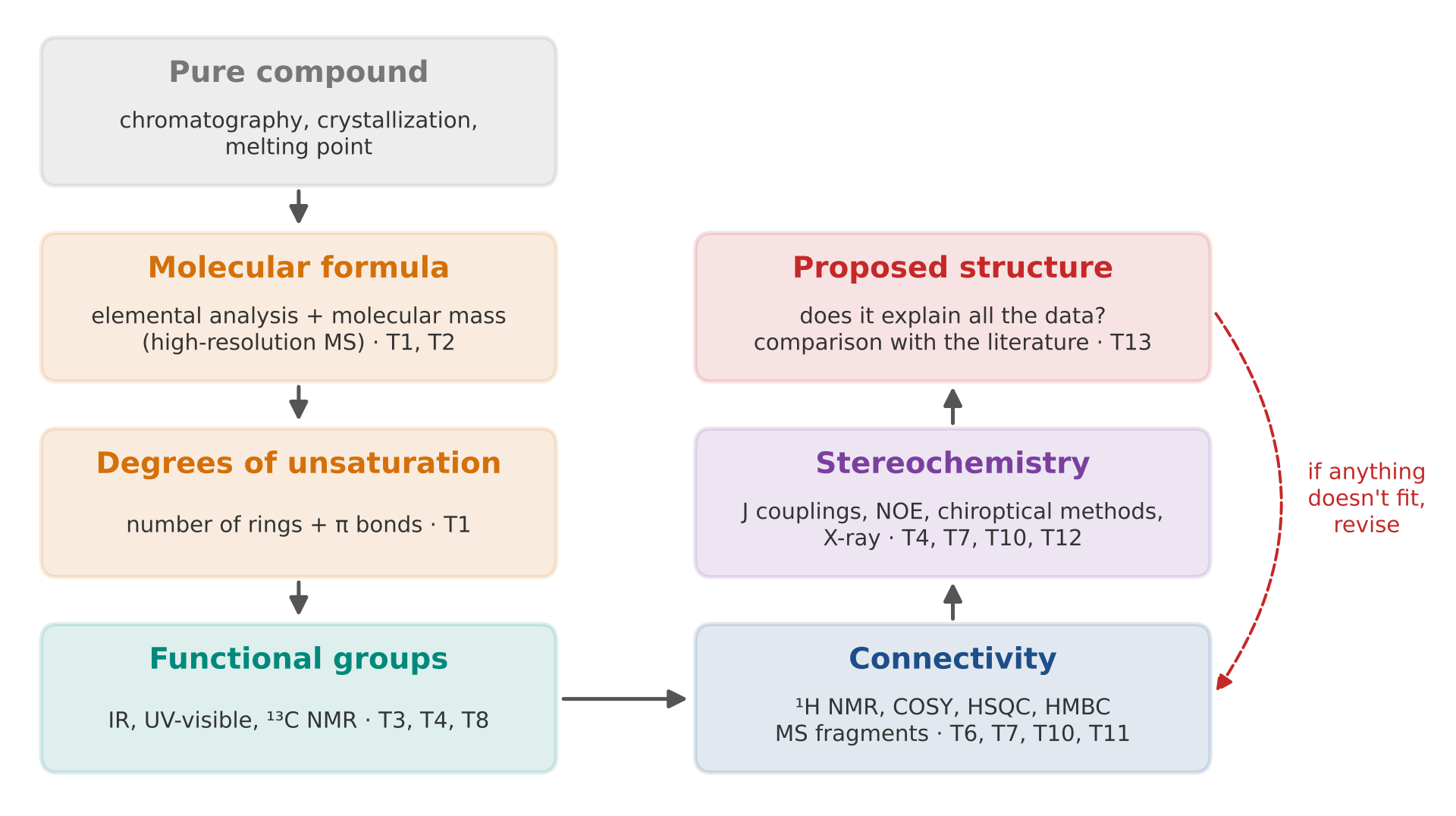
The proposed structure must explain all the data. A single datum that does not fit (an unassigned signal, an IR band that does not match) means going back. In practice the path is not linear: the NMR spectrum often suggests the functional groups before the IR does, and the structure is refined as data are gathered. Topic 13 (A strategy for solving structures) returns to this process with complete examples.
A structure that explains all the data is still a hypothesis. It is worth comparing it with published data for similar compounds and, if the problem warrants it, confirming it by synthesis or by X-ray diffraction.