
Functional Groups
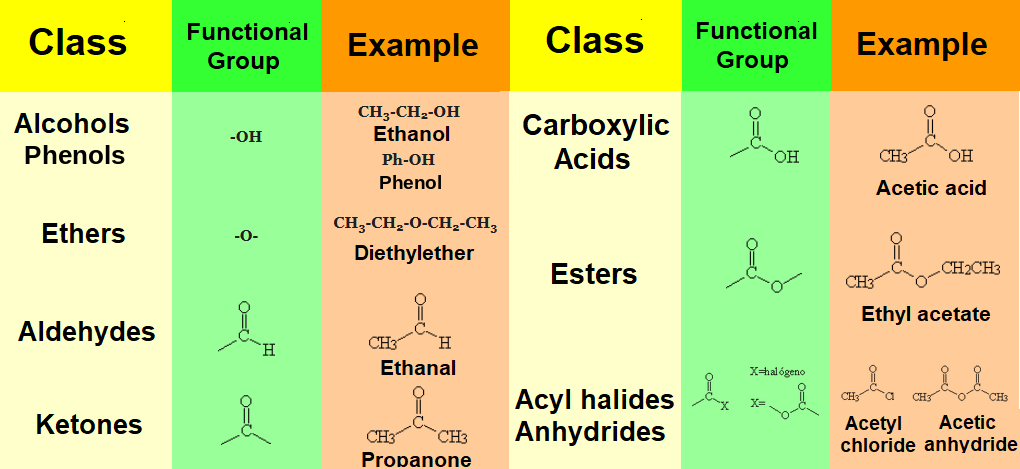
Organic molecules consist of a hydrocarbon chain into which, or to which, certain special groups of atoms are inserted or attached. These 'special' groups of atoms, which almost always contain atoms other than carbon and hydrogen ('heteroatoms'), are called functional groups.
One of your first tasks in Organic Chemistry is to recognize and identify the various functional groups present in a given molecule.

Click on 'Molecular panel', available on every page, and then on 'FG' ('Functional groups'). You will get a list of functional groups. Click on one of them, then on the blank panel and finally on the arrow pointing to the black panel. You will see the 3D structure of the selected functional group. Draw a hydrocarbon chain and attach functional groups to it. Look at the list below, try to build your own functional groups from it and display them in 3D.
Groups WITHOUT heteroatoms

Groups with Oxygen
Groups with Nitrogen

Groups with other heteroatoms

Once the different functional groups have been identified, one of them becomes the main function and gives its name to the molecule. In simplified form, the order of precedence of functional groups for naming is:
1.- Acids
(carboxylic > sulfonic)
2.- Acid derivatives
(anhydrides > esters > acyl halides > amides > nitriles)
3.- Aldehydes > ketones
4.- Alcohols > phenols > thiols
5.- Amines
6.- Ethers > thioethers
7.- Aromatics > Alkenes > alkynes
The main function determines:
1.- The compound's name.
2.- The main hydrocarbon chain, which must be the longest possible chain containing the main function.
3.- The locant numbers of substituents and/or secondary functions.
Nomenclature of the most common functional groups when they are the principal (P) or a secondary (S) function:
