Quartz decides the chirality
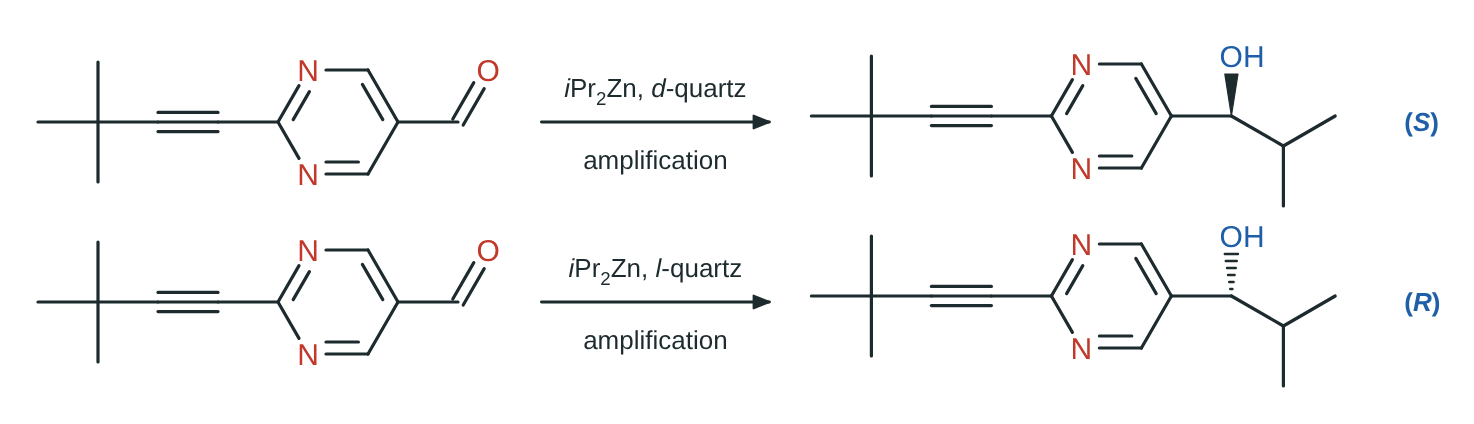
Quartz crystallizes in two enantiomorphic forms, dextrorotatory (d) and laevorotatory (l), both abundant in nature. In 1999 Soai’s group added powder of one or the other quartz to the reaction of the pyrimidine-5-carbaldehyde with diisopropylzinc, with no chiral catalyst.
On the crystal surface a first, minute excess of one enantiomer of the alkanol is formed, and autocatalysis amplifies it: with d-quartz the S alkanol is obtained, and with l-quartz the R, in both cases with high ee. The chiral minerals of the early Earth are therefore a possible origin of the asymmetry of the molecules of life.