
Asymmetric autocatalysis: the Soai reaction
In asymmetric autocatalysis, the chiral product catalyses its own formation with the same configuration. The Soai reaction amplifies a tiny enantiomeric excess to almost 100%, and offers a model of how the homochirality of the molecules of life may have arisen. Henri Kagan and Kensō Soai received the 2026 Nobel Prize in Chemistry for the discovery of nonlinear effects and autocatalysis in asymmetric synthesis.
Nonlinear effects
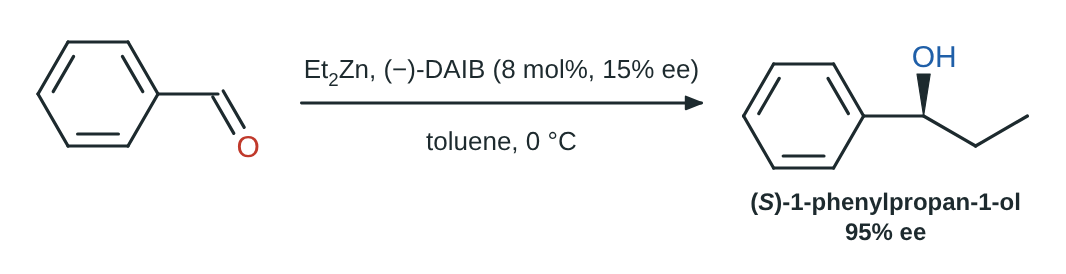
One would expect the ee of the product to be proportional to that of the catalyst. In 1986, Henri Kagan observed that this is not always so: when two or more ligands bind to the same metal, a catalyst prepared with a partially racemic ligand contains homochiral (R,R and S,S) and heterochiral (R,S) complexes with different activities. If the heterochiral complex is more stable and less active, it sequesters the minor enantiomer and the product has a higher ee than the ligand (positive nonlinear effect).
One of the most spectacular examples was described by Noyori in the addition of diethylzinc to benzaldehyde catalysed by the amino alcohol (−)-DAIB (3-exo-(dimethylamino)isoborneol): the zinc alkoxide forms dimers, and the very stable heterochiral dimer does not catalyse the reaction.
The Soai reaction
In 1953, the physicist Charles Frank proposed that a reaction in which each enantiomer catalysed its own formation and inhibited that of the other would amplify any initial imbalance. In 1995, Kensō Soai discovered a real reaction that does this: the addition of diisopropylzinc to pyrimidine-5-carbaldehydes. The zinc alkoxide of the alkanol formed catalyses the addition to the aldehyde with the same configuration, so that the product makes itself.
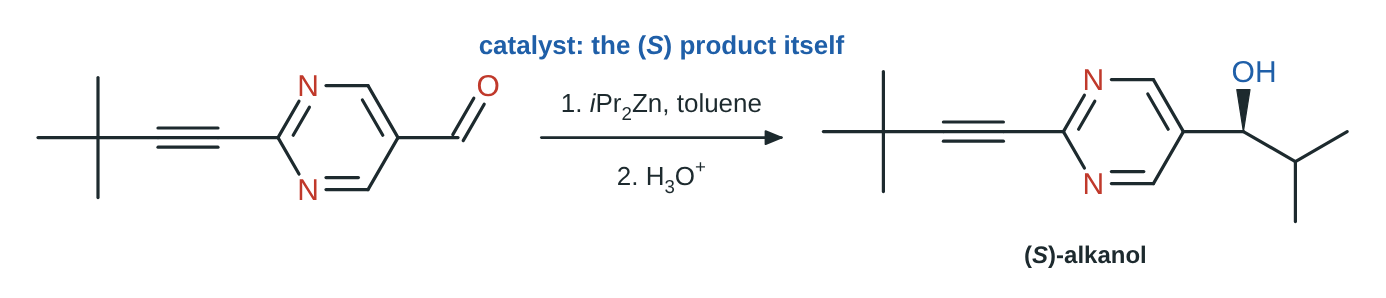
With the alkynyl substituent, the product reaches more than 99.5% ee. Starting from a sample of the alkanol with only 0.00005% ee, an enantiomeric ratio of 50.000025:49.999975, more than 99.5% ee is reached in three successive cycles, in which the product of each cycle is the catalyst of the next. The amplification is explained by the zinc alkoxides forming aggregates, the heterochiral ones being poorly active, as in the nonlinear effect of Kagan and Noyori.
Kensō Soai gave the seminar “Asymmetric Autocatalysis and the Origin of Homochirality” at the Department of Organic Chemistry of the Universidad Autónoma de Madrid on 28 June 2017. Its poster, with the scheme of the amplification from 0.00005% to more than 99.5% ee, appears in the mock newspaper of “Why is organic chemistry important?”, in Organic Chemistry made transparent, next to the news of the 2026 Nobel Prize.
The origin of homochirality
The amino acids of proteins are L and the sugars of nucleic acids are D. How could this imbalance arise on a prebiotic Earth that, in principle, produced racemates? The Soai reaction shows that a minimal asymmetry is enough to decide the outcome: circularly polarized light, a chiral crystal of quartz or sodium chlorate, or even a molecule whose only source of chirality is a deuterium in place of a hydrogen, is enough for the reaction to give a single enantiomer. Without any trigger, the outcome is random: sometimes the S enantiomer predominates and sometimes the R, a spontaneous symmetry breaking.
The Soai reaction is, for now, an almost unique case: it requires a very specific organozinc reagent and aldehyde, which did not exist on the early Earth. Its value lies in showing that the mechanism proposed by Frank works in a real chemical reaction.