Kensō Soai (1950)
Japanese chemist born in Hiroshima. He obtained his doctorate in 1979 at Tokyo University of Science, did postdoctoral work at the University of North Carolina and returned to Tokyo University of Science, where he was full professor from 1991 and is now professor emeritus.
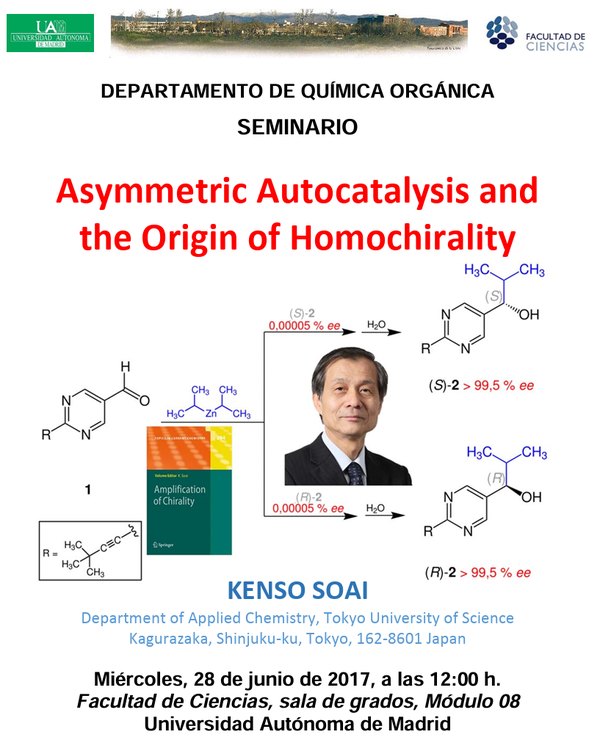
In 1995 he discovered asymmetric autocatalysis in the addition of diisopropylzinc to pyrimidine-5-carbaldehydes, the Soai reaction, and showed that minimal chiral triggers, such as quartz or circularly polarized light, decide which enantiomer is formed. He shared the 2026 Nobel Prize in Chemistry with Henri Kagan.
On 28 June 2017 he gave the seminar “Asymmetric Autocatalysis and the Origin of Homochirality” at the Department of Organic Chemistry of the Universidad Autónoma de Madrid. This is its poster:
More information: en.wikipedia.org