More than 95% of the known substances are carbon compounds and more than half of the world chemists call themselves Organic Chemists.
All life-sustaining compounds (nucleic acids, proteins, enzymes, hormones, carbohydrates, lipids, vitamins, etc) are organic substances, i.e. derived from carbon.
Progress in Organic Chemistry is synonymous with a deeper understanding of vital processes.
The chemical industry (pharmaceuticals, pesticides, herbicides, plastics, etc) plays a decisive role in the world economy and in our everyday life with its different products.
Organic Chemistry is intellectually very stimulant because:
It bears a very logical structure
It makes use of plenty of logical symbols.
It applies the principle of analogy and deductive reasoning.
The molecules and their processes display an unmistakably artistic content.
All these activities and features would give rise to the following breaking news in an imaginary chemical newspaper:
Organic Chemistry breaking news
Breaking news
2026 Nobel Prize in Chemistry for non-linear effects and asymmetric autocatalysis
The Royal Swedish Academy of Sciences has awarded the 2026 Nobel Prize in Chemistry to Henri B. Kagan (Orsay, France) and Kenso Soai (Tokyo University of Science) “for the discovery of non-linear effects and autocatalysis in asymmetric organic synthesis”.
In 1986, Kagan’s group observed that in some reactions with chiral catalysts the enantiomeric excess of the product is not proportional to the optical purity of the catalyst: it can be higher (positive non-linear effect) or lower. A catalyst that is not enantiomerically pure can thus give a product much purer than itself.
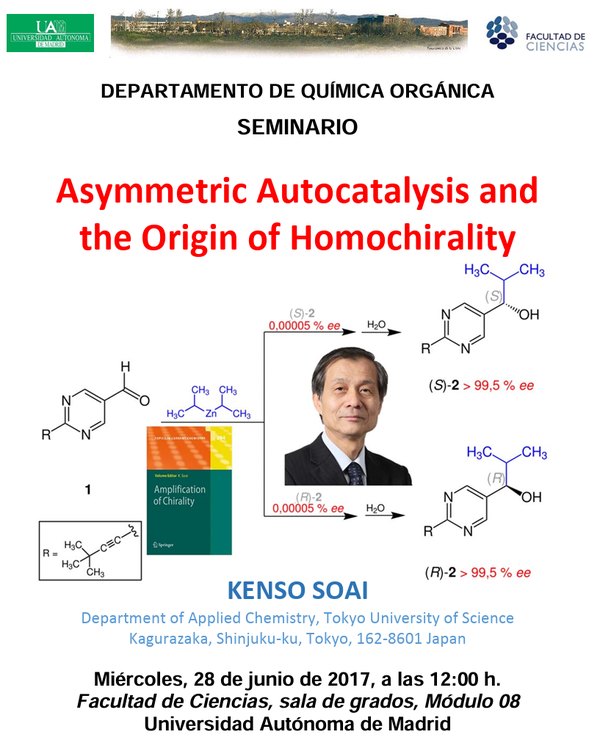
Soai took the idea to the extreme. In 1995 he described a reaction in which the product catalyses its own formation: the addition of diisopropylzinc to a pyrimidine-5-carbaldehyde gives a chiral alcohol that favours the formation of more molecules of itself, with the same configuration. Starting from an enantiomeric excess of only 0.00005 %, more than 99.5 % is reached in a few cycles. It is the best chemical model of how the homochirality of the molecules of life (L-amino acids and D-sugars) could have arisen from a tiny imbalance.
Kenso Soai gave the seminar “Asymmetric Autocatalysis and the Origin of Homochirality” at our Department of Organic Chemistry of the Universidad Autónoma de Madrid on 28 June 2017. We reproduce its poster.
The Fe(IV)=O species is involved in the mechanism of action of an antimalarial drug
Chemists have found the first evidence that a high-valent, non-heme iron atom intervenes in the molecular mechanism of action of artemisinin (J. Am. Chem. Soc. 1995, 117, 5885). This molecule is reduced by the iron-rich malaria parasite to form a cytotoxic free radical and other electrophilic intermediates. Prof. Posner and his co-workers at Johns Hopkins University propose a mechanism to explain how this drug works, in which the Fe(IV)=O species seems to be involved.
On the way to the synthesis of the fullerene ("footballerene or soccerene") molecule...
Chemists at the University of Louisiana have synthesized a "semibuckminsterfullerene" (C30H12) that is exactly one half of the carbon framework of buckminsterfullerene, C60 (J. Am. Chem. Soc. 1995, 117, 6410). It is therefore conceivable that two of these molecules could be "sewn" together to make the complete ball. The synthetic strategy used by Prof. Rabideau is flash pyrolysis. The compound is obtained as a pair of enantiomers.
Total synthesis of the potential drug gypsetin achieved
Scientists at the Sloan-Kettering Institute for Cancer Research (New York) and Columbia University have achieved the total synthesis of gypsetin (J. Am. Chem. Soc. 1995, 117, 7025), a natural product of the fungus Nannizzia gypsea that may prevent the formation of cholesterol plaques in the arteries. The group led by Prof. Danishefsky (Columbia University) used a convergent synthetic plan, with two tryptophan derivatives to build the central heterocyclic core. The overall yield was 40%.
Triplet carbenes, closer to their "bottling"...
For some years now, the laboratory production of a new generation of very stable singlet carbenes (molecules that contain a divalent carbon with two electrons of different spin) has been relatively common. Triplet carbenes, in which the unpaired electrons have parallel spins, are much harder to produce. Even so, the Japanese chemists Tomioka, Takui and Itoh have prepared the longest-lived triplet carbene to date, (2,2′,4,4′,6,6′-hexabromodiphenyl)carbene, which survives for several seconds in solution (J. Am. Chem. Soc. 1995, 117, 6376).
The asymmetric synthesis of (+)-pancratistatin, a potent anticancer agent, achieved
(+)-Pancratistatin inhibits tumour growth in ovarian cancer and leukaemia, but only one synthesis, of the racemic compound, had been described until now. The research group of Prof. Hudlicky (Virginia Polytechnic Institute) has developed a 13-step synthesis with an overall yield of 2%.
Produced in large amounts a natural product that mimics the function of insulin
Screening more than 50,000 synthetic and natural products from the Merck collection, researchers at the pharmaceutical company have discovered a small molecule that lowers blood glucose levels in laboratory mice. The compound seems to mimic the function of insulin but, unlike the polypeptide hormone, it is not destroyed by digestive enzymes, so it could be given to diabetics orally, sparing them the bothersome injections (Science 1999, 284, 974).
Du-Pont establishes a research and production centre in Spain
The powerful multinational chemical company Du Pont is building a large chemical complex in Asturias. The plant is being built with the latest technologies but with great respect for the environment. While Du Pont produces several tonnes a year of the latest generation of polymers and synthetic textile fibres, it is replacing the eucalyptus imported from Australia in the surrounding valleys with native plant species, which will restore the ecological balance of the area.
Identified a general catalyst for the asymmetric Strecker synthesis from a combinatorial library
The Strecker reaction is widely used to prepare α-amino acid derivatives. Enantioselective versions of this reaction have been the goal of much research in asymmetric synthesis, including that carried out in the laboratory of Prof. Eric N. Jacobsen at Harvard University. His research group has shown that the compound shown (X = O; R = C6H5) can catalyse the asymmetric Strecker reaction in solution for a wide range of aromatic and aliphatic imines (Angew. Chem. Int. Ed. 2000, 39, 1279). For many substrates the enantiomeric excesses exceed 90%. A resin-bound analogue (X = S; R = polystyrene) gives somewhat lower enantiomeric excesses, but the catalyst can be recycled up to ten times without loss of activity or enantioselectivity.
Nobel Prize for asymmetric organocatalysis
The Royal Swedish Academy of Sciences has awarded the 2021 Nobel Prize in Chemistry to Benjamin List (Max Planck Institute for Coal Research, Mülheim) and David MacMillan (Princeton University) for the development of asymmetric organocatalysis. In 2000, working independently, both showed that small organic molecules, such as the amino acid proline, can catalyse enantioselective reactions without the need for metals or enzymes. These catalysts are cheap, stable and of low toxicity, and they are now used in the synthesis of drugs and other chiral compounds.