
Asymmetric organocatalysis: List and MacMillan
Organocatalysis uses small metal-free organic molecules as chiral catalysts. Chiral secondary amines activate aldehydes and ketones in two complementary ways: as enamines, which are nucleophiles, or as iminium ions, which are electrophiles. Benjamin List and David MacMillan received the 2021 Nobel Prize in Chemistry for this work.
The catalysts
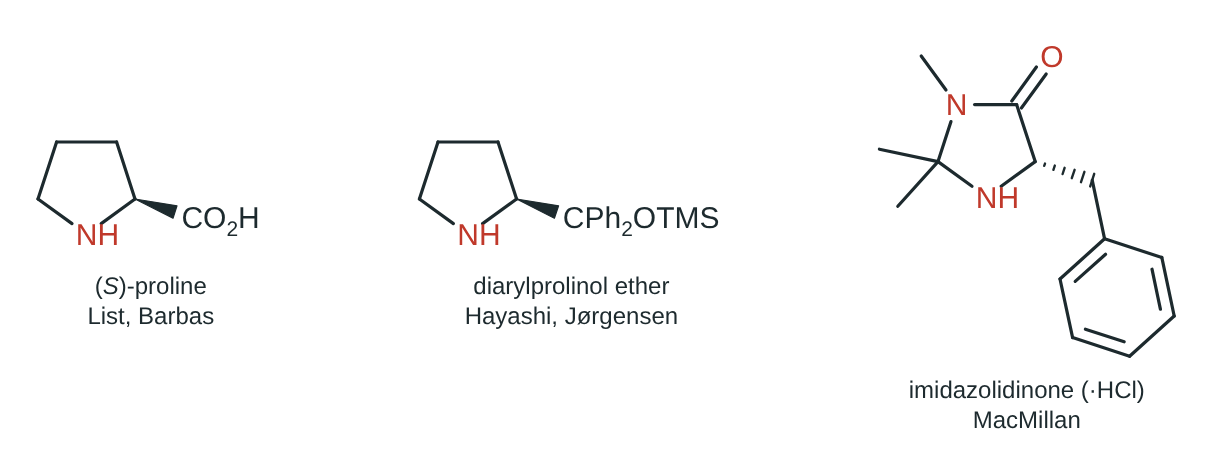
Organocatalysts are cheap, stable to air and water, and leave no metal residues in the product, an advantage in the manufacture of drugs. The most widely used are secondary amines derived from amino acids:
Enamine activation
A secondary amine and an aldehyde or a ketone form an enamine, more nucleophilic than the enol because its HOMO is higher. In 2000, Benjamin List, Richard Lerner and Carlos Barbas showed that (S)-proline catalyses in this way the direct aldol addition of acetone to aldehydes (see chiral catalysis in topic 7). The carboxylic acid of proline directs the electrophile to one face of the enamine through a hydrogen bond; the intramolecular version, the Hajos–Parrish reaction, had been known since 1971.
In 2005, Yujiro Hayashi and Karl Anker Jørgensen introduced the silyl ethers of diarylprolinol. Their bulky group does not form hydrogen bonds but completely blocks one face of the enamine, and they catalyse with ee close to 99% Michael additions, α-functionalizations of aldehydes (amination, halogenation, oxidation) and many cascade reactions.
Iminium activation
With an α,β-unsaturated aldehyde and an acid, the amine forms a conjugated iminium ion. The positive charge lowers the LUMO of the system, as a Lewis acid bound to the oxygen would, and the β carbon becomes much more electrophilic. In 2000, David MacMillan designed an imidazolidinone derived from phenylalanine that catalyses in this way the Diels–Alder reaction of cinnamaldehyde and cyclopentadiene with more than 90% ee. The benzyl group shields one face of the iminium ion, and the E geometry of the iminium exposes the other.
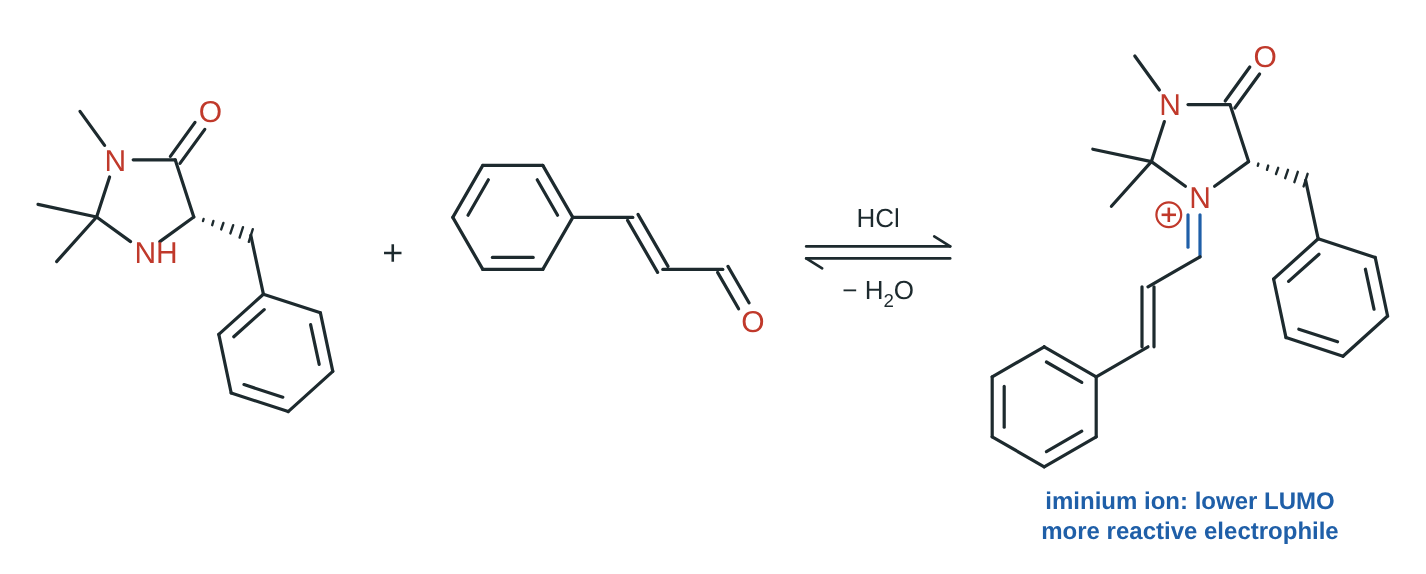
The same activation enables conjugate additions of pyrroles, indoles and nitroalkanes, and the conjugate reduction of enals with the Hantzsch ester, an NADH analogue. After the reaction, hydrolysis of the iminium ion or the enamine releases the product and regenerates the amine: it is a metal-free catalytic cycle.
Other organocatalysts
- Hydrogen-bond donors: chiral thioureas and squaramides (Jacobsen, Takemoto) activate electrophiles as a mild Lewis acid would.
- Chiral phosphoric acids derived from BINOL (Akiyama, Terada, 2004): they protonate imines and form chiral ion pairs.
- Phase-transfer catalysts: quaternary ammonium salts derived from the cinchona alkaloids, which carry enolates from the aqueous to the organic phase in a chiral ion pair.
- N-Heterocyclic carbenes, which reverse the polarity of aldehydes (benzoin condensation and Stetter reaction).