
Chiral catalysis
A chiral catalyst transfers its stereochemical information to many molecules of product. Two types are used in aldol additions: chiral Lewis acids, which activate the aldehyde in the Mukaiyama reaction, and organocatalysts such as proline, which act through an enamine.
Chiral Lewis acids
Many catalysts can bring about enantioselective aldol additions. The reactions generally use enolate equivalents, such as silyl enol ethers, which do not react with the carbonyl on their own but do so when a Lewis acid activates it (Mukaiyama reaction). If the Lewis acid carries chiral ligands, it creates an asymmetric environment around the aldehyde and one of its faces is shielded. Among the best known are the tryptophan-derived oxazaborolidinones (Corey), copper complexes of bis(oxazolines) (Evans) and titanium complexes with BINOL-derived ligands (Mikami, Carreira).
Organocatalysis: proline
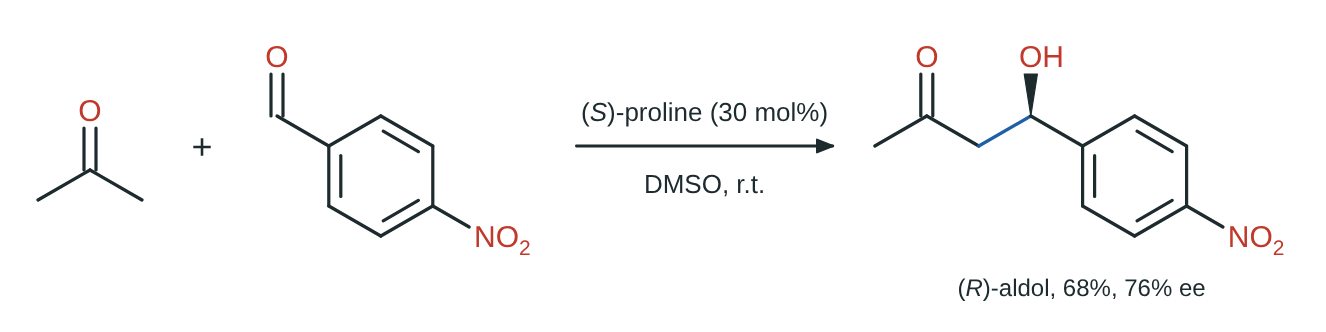
In 2000, Benjamin List, Richard Lerner and Carlos Barbas showed that an amino acid as simple as (S)-proline catalyses the direct aldol addition of acetone to aldehydes, without preforming the enolate:
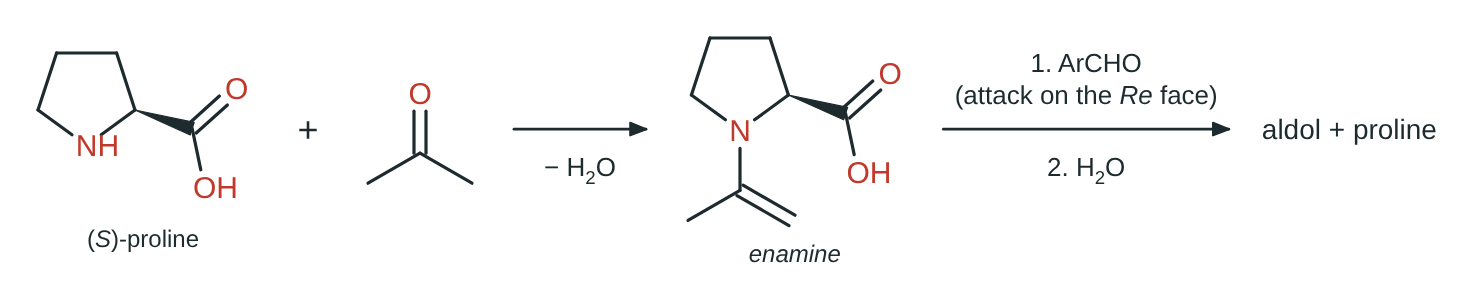
Proline acts like the type I aldolases of living organisms: its secondary amine forms an enamine with the ketone (see the enamines in topic 6), which is the nucleophile, and its carboxyl group forms a hydrogen bond with the aldehyde, activating it and directing it to one face of the enamine:
This work, together with David MacMillan’s on iminium-ion catalysis, launched asymmetric organocatalysis, recognized with the 2021 Nobel Prize in Chemistry. The intramolecular version of the reaction had been known since the 1970s: it is the Hajos–Parrish–Eder–Sauer–Wiechert synthesis of the example.
Asymmetric catalysis in general is studied in topic 11.