
Acylation reactions: Claisen, Dieckmann and others
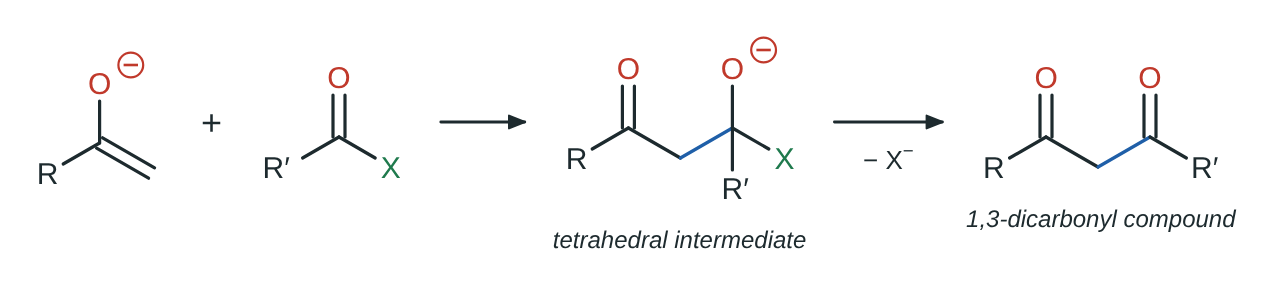
If the electrophile is an acid derivative with a leaving group (an ester, an acid chloride, an anhydride), the tetrahedral intermediate expels that group and the overall result is the acylation of the carbon nucleophile: 1,3-dicarbonyl compounds are obtained.
The addition of a carbon nucleophile to a carbonyl bearing a potential leaving group follows the typical addition–elimination mechanism:
The Claisen condensation
An important group of acylation reactions involves esters, in which the leaving group is an alkoxide or aryloxide. The self-condensation of esters is known as the Claisen condensation:
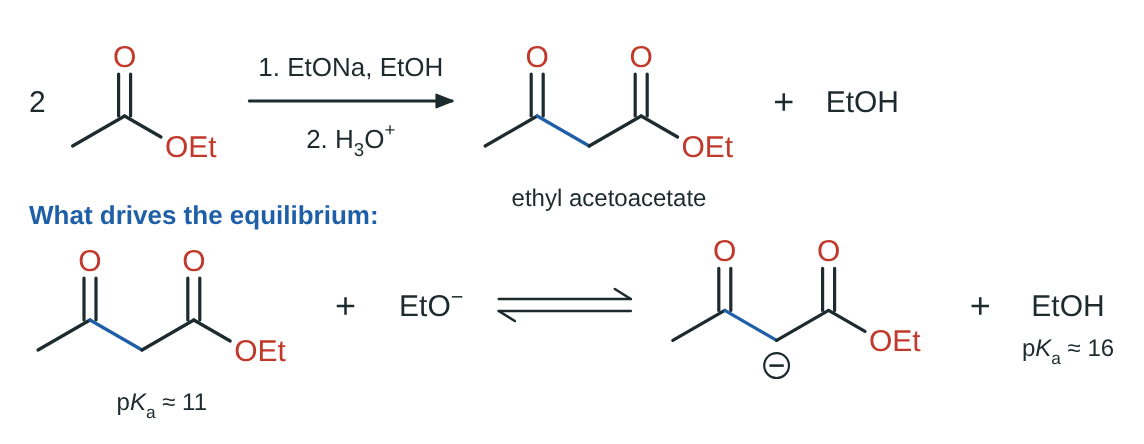
All the steps are reversible and the addition equilibrium is unfavourable. What drives the reaction is the last step: the β-keto ester (pKa ≈ 11) is much more acidic than ethanol (pKa ≈ 16), and ethoxide converts it into its stabilized enolate. That is why a full equivalent of base is needed, and esters with only one α hydrogen, whose product cannot be deprotonated, do not undergo the Claisen condensation under these conditions. Finally, the mixture is acidified to obtain the neutral β-keto ester.
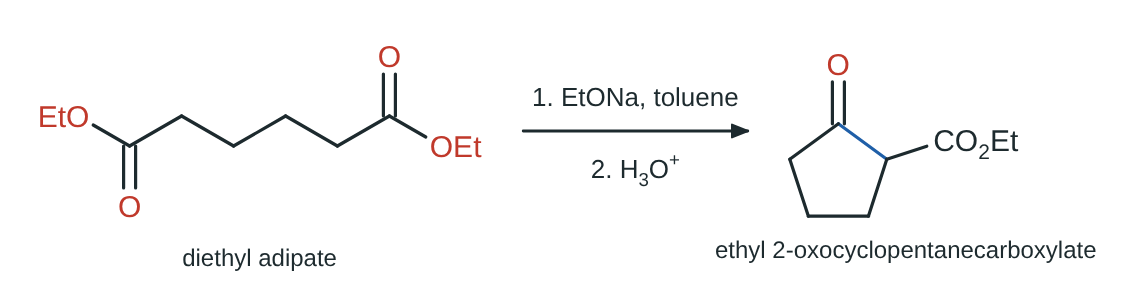
The Dieckmann condensation
The intramolecular version of the ester condensation is called the Dieckmann condensation. It is an important method for forming five- and six-membered rings and has occasionally been used for larger rings. Since the condensation is reversible, the product structure is under thermodynamic control, and when several products are possible the one derived from the most stable enolate is formed:
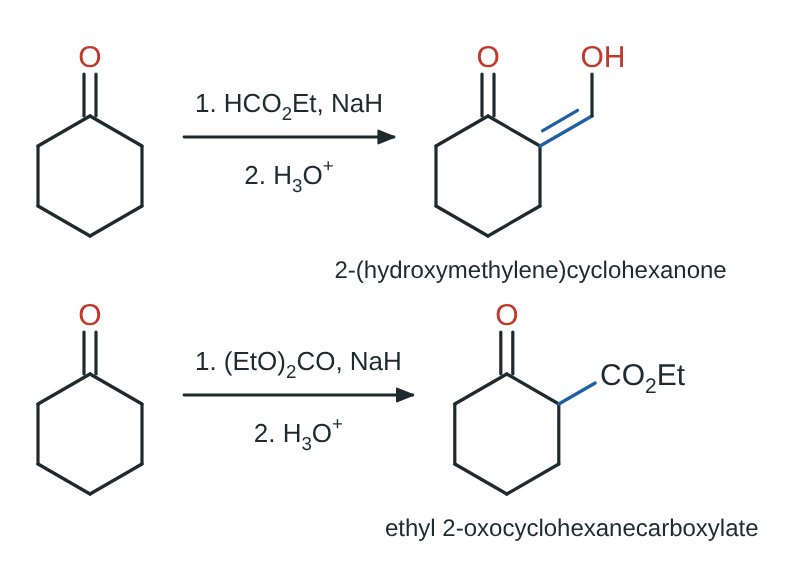
Crossed acylations
Ketone enolates can be acylated by esters and other acylating agents. For a clean reaction the ester must be non-enolizable: formates, carbonates, oxalates or benzoates. The products are β-dicarbonyl compounds, rather acidic, which can then be alkylated in a second step (see the acetoacetic synthesis):
Carbon nucleophiles can also be acylated by more reactive agents such as anhydrides and acid chlorides. With these, O-acylation of the enolate must be avoided; the chelated magnesium enolates of malonates, or Meldrum’s acid, give good results.
Review the Claisen condensation in the reactivity of esters in Organic Chemistry made transparent.