
Lewis-acid-catalyzed aldol addition (Mukaiyama)
In the Mukaiyama reaction the nucleophile is not a metal enolate but a neutral equivalent, a silyl enol ether or a silyl ketene acetal, and what makes the addition possible is a Lewis acid that activates the aldehyde.
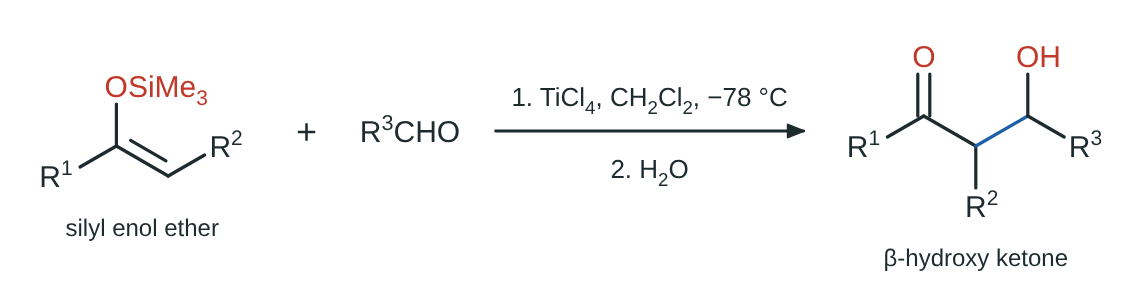
The Mukaiyama aldol reaction is the Lewis-acid-catalysed addition of silyl enol ethers, silyl ketene acetals and similar enolate equivalents to aldehydes and ketones:
Mechanism
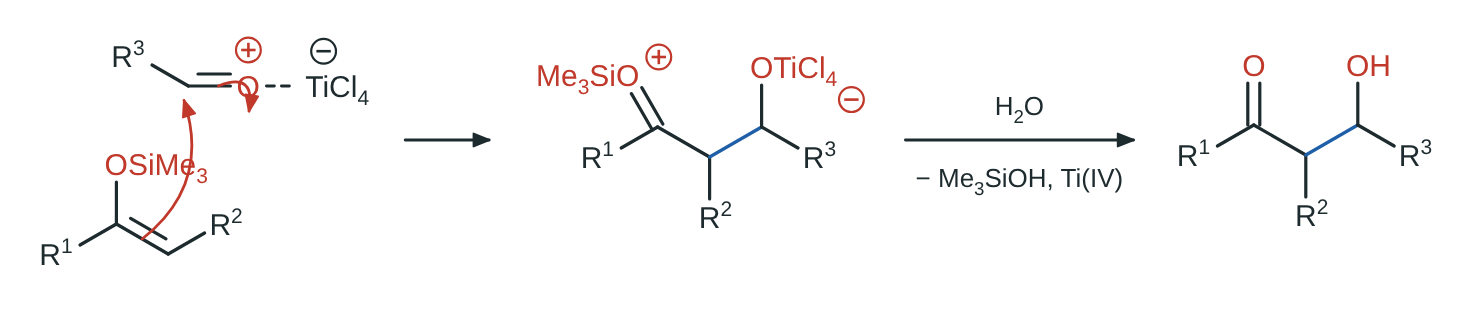
Silyl enol ethers are not nucleophilic enough to react directly with aldehydes or ketones. A Lewis acid such as TiCl4 or SnCl4 coordinates to the carbonyl oxygen and activates it towards nucleophilic attack; the silicon then moves to oxygen, and the final hydrolysis releases the aldol:
Stereochemistry
If no other interaction prevents it, the reaction proceeds through an open (acyclic) transition state, and the proportion of syn and anti products depends on steric factors, not on the geometry of the silyl enol ether. This is the case with BF3: the tetracoordinate boron–aldehyde adduct has no free coordination sites to form a cyclic transition state. Stereoselectivity increases with the size of the substituent on the silyl enol ether.
Silyl ketene acetals
Silyl ketene acetals, prepared by silylating ester enolates, are more nucleophilic than silyl enol ethers and give β-hydroxy esters:
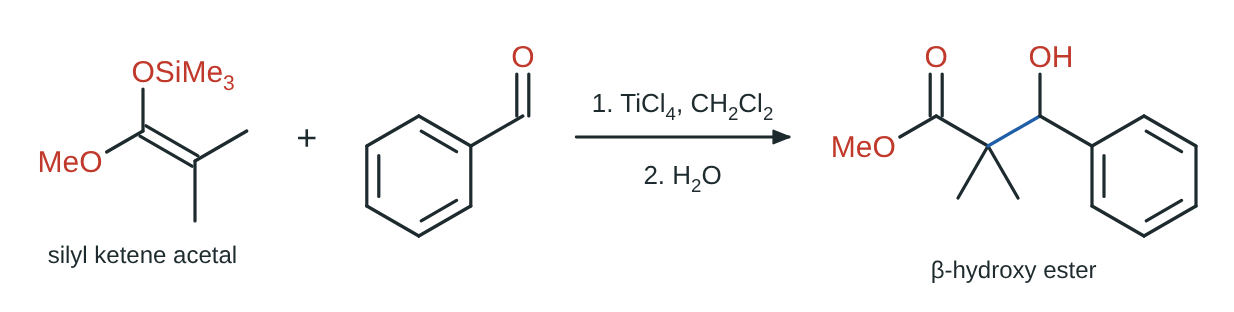
Since the Lewis acid only has to activate the aldehyde, it can be used in catalytic amounts, and if it is chiral the reaction is enantioselective: see chiral catalysis.