
Directed aldol addition
In the directed aldol addition the enolate is generated quantitatively and irreversibly before the electrophile is added. This controls which compound acts as the nucleophile, at which carbon it reacts and, thanks to a cyclic transition state, the relative configuration (syn or anti) of the two stereocentres that are formed.
Kinetic control
The enolate that will act as the nucleophile is prepared stoichiometrically, usually with lithium as the counterion, in an aprotic solvent at low temperature. Under these conditions the kinetic enolate does not equilibrate with the other regio- or stereoisomeric enolates of the ketone (see the regioselectivity of enolization), and it gives a specific adduct provided that the addition is faster than proton exchange between the reactants. The reaction is under kinetic control both in enolate formation and in the addition step.
The Zimmerman–Traxler model
The diastereoselectivity of aldol additions of metal enolates is explained by a six-membered cyclic transition state in which the metal is coordinated to both the enolate oxygen and the aldehyde oxygen. The Lewis acid character of the metal activates the carbonyl and holds the reactants together. The ring adopts a chair conformation, to which the concepts of cyclohexane conformational analysis can be applied (Zimmerman and Traxler, 1957):
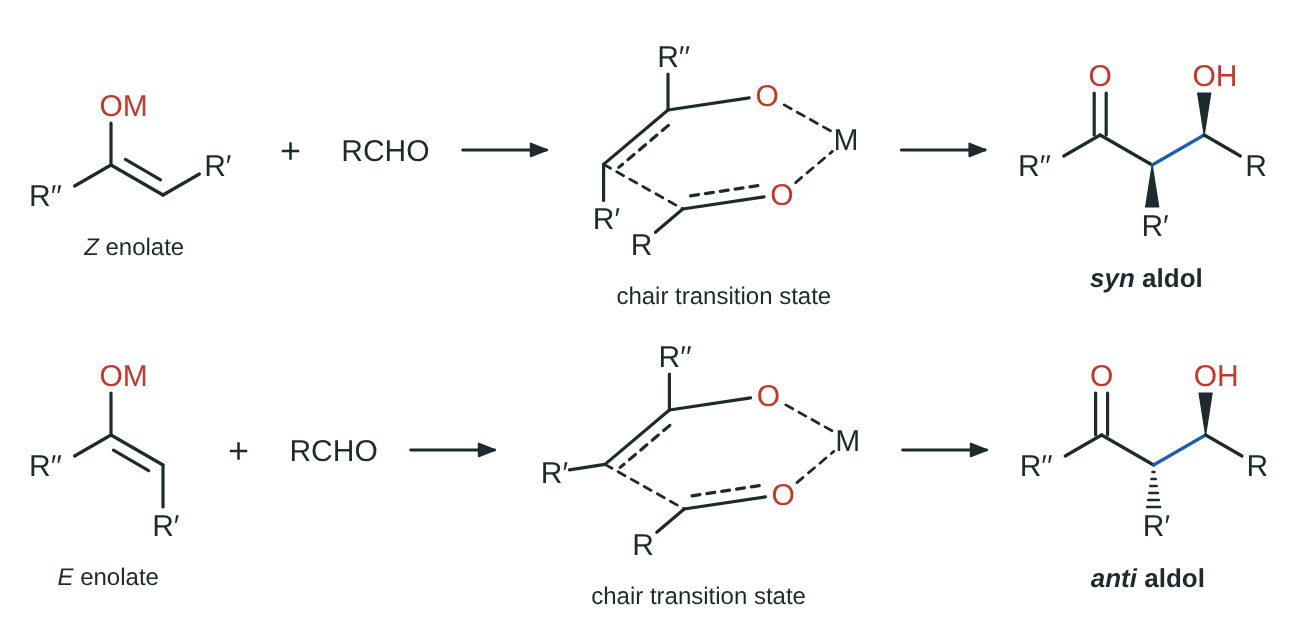
The R substituent of the aldehyde sits in an equatorial position, because in the axial one it would suffer a 1,3-diaxial interaction with the substituent R′′ on C1 of the enolate. With that position fixed, the geometry of the enolate decides the relative configuration of the product. The preference for the chair has been confirmed with deuterium-labelled enolates, and many examples lead to these general rules:
- The Z enolate gives the syn aldol, and the E enolate gives the anti aldol.
- Selectivity is high when the enolate bears a bulky substituent (R′′ = tert-butyl, mesityl…), and low when it does not.
- Z enolates are more stereoselective than E enolates.
Boron enolates
Stereoselectivity improves greatly with boron enolates. The transition state is of the same type, but O–B bonds are shorter than O–Li bonds, the chair is more compact and the steric interactions that control selectivity are magnified. Moreover, the enolate geometry can be chosen with the reagent: dibutylboron triflate with a tertiary amine gives the Z enolate, and dicyclohexylboron chloride with triethylamine gives the E enolate:
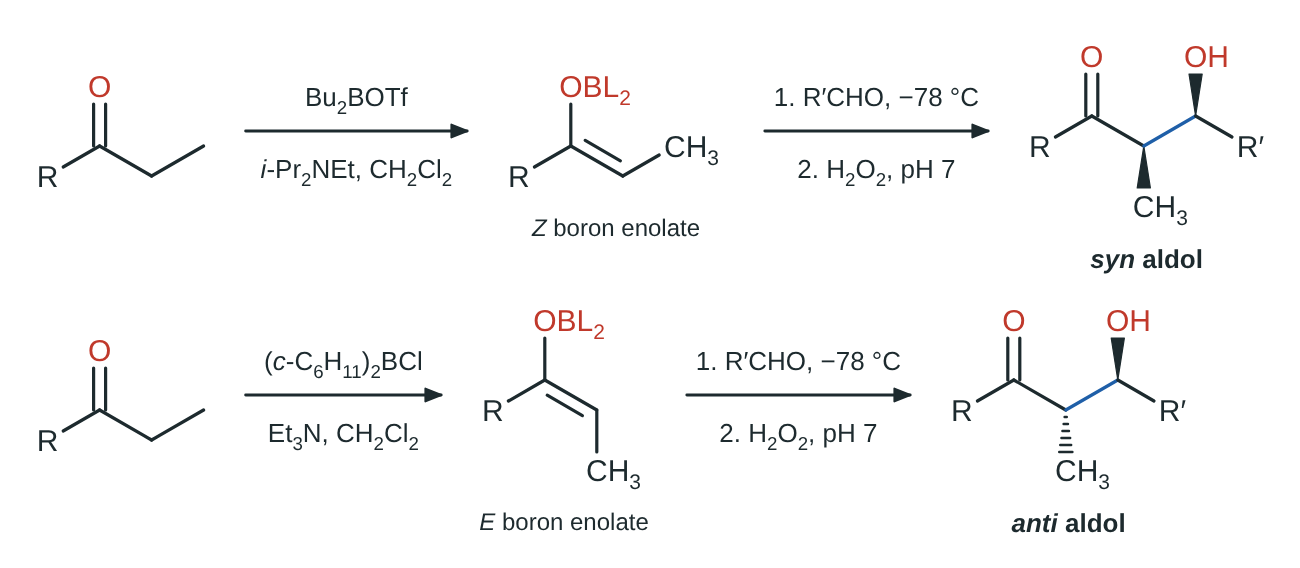
The borates formed are cleaved at the end with hydrogen peroxide in buffered medium.
Titanium, tin and zirconium enolates
Metals such as Ti, Sn and Zr give enolates intermediate in character between ionic Li+ enolates and covalent boron enolates. They accept additional ligands (tetra-, penta- and hexacoordinate structures), which allows chelated transition states when the enolate or the aldehyde carries a nearby donor group. TiCl4 and an amine give syn aldols; tin(II) enolates, prepared with Sn(OTf)2 and a tertiary amine, also give syn aldols regardless of the enolate geometry, which indicates that they react through an open transition state. The selectivity of zirconium enolates, Cp2Zr(Cl)–O–, lies between that of lithium and boron enolates.
When the aldehyde or the enolate is chiral, facial selectivity adds to syn/anti selectivity: see facial control.