
Aldol condensation: importance and mechanism
The aldol condensation joins two carbonyl compounds: the enolate (or enol) of one attacks the carbonyl of the other to form a β-hydroxy carbonyl compound (an “aldol”), which often dehydrates to an α,β-unsaturated carbonyl compound. It is one of the most important methods for forming C–C bonds.
A general method for forming C–C bonds
Many of the most useful methods for forming C–C bonds begin in the same way: a stabilized carbon nucleophile adds to a carbonyl group. The product depends on the nature of the group Z that stabilizes the nucleophile (C=O, C≡N, NO2, SO2R, P+Ph3…), on the substituents A and B of the carbonyl and on how they interact in the addition intermediate:
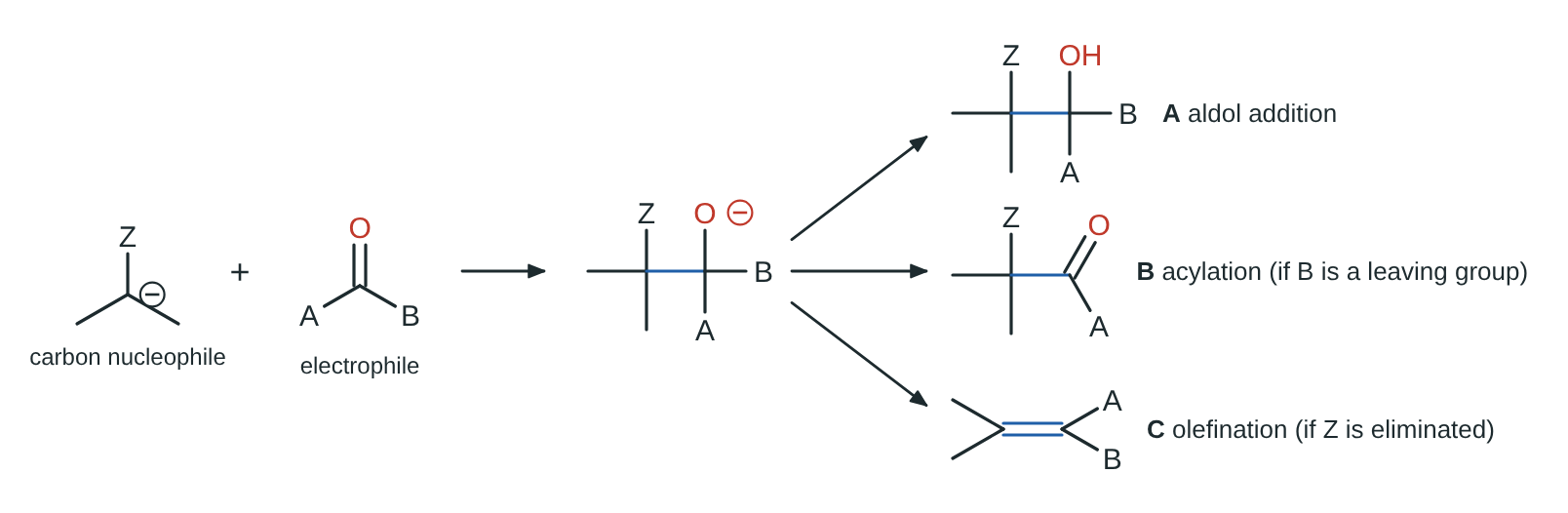
The aldol condensation gives β-hydroxyalkyl or α-alkylidene derivatives of the nucleophile (pathway A). In acylations (pathway B, Claisen and Dieckmann reactions) the electrophile loses a leaving group. If Z is eliminated instead, the result is an olefination (pathway C: the Wittig, Peterson and Julia reactions, studied in topic 8).
Mechanism under basic conditions
The aldol condensation can be carried out under basic or acidic conditions. In hydroxylic solvents (water, alcohols) and with bases such as hydroxide or alkoxides, every step is reversible and the outcome is under thermodynamic control:
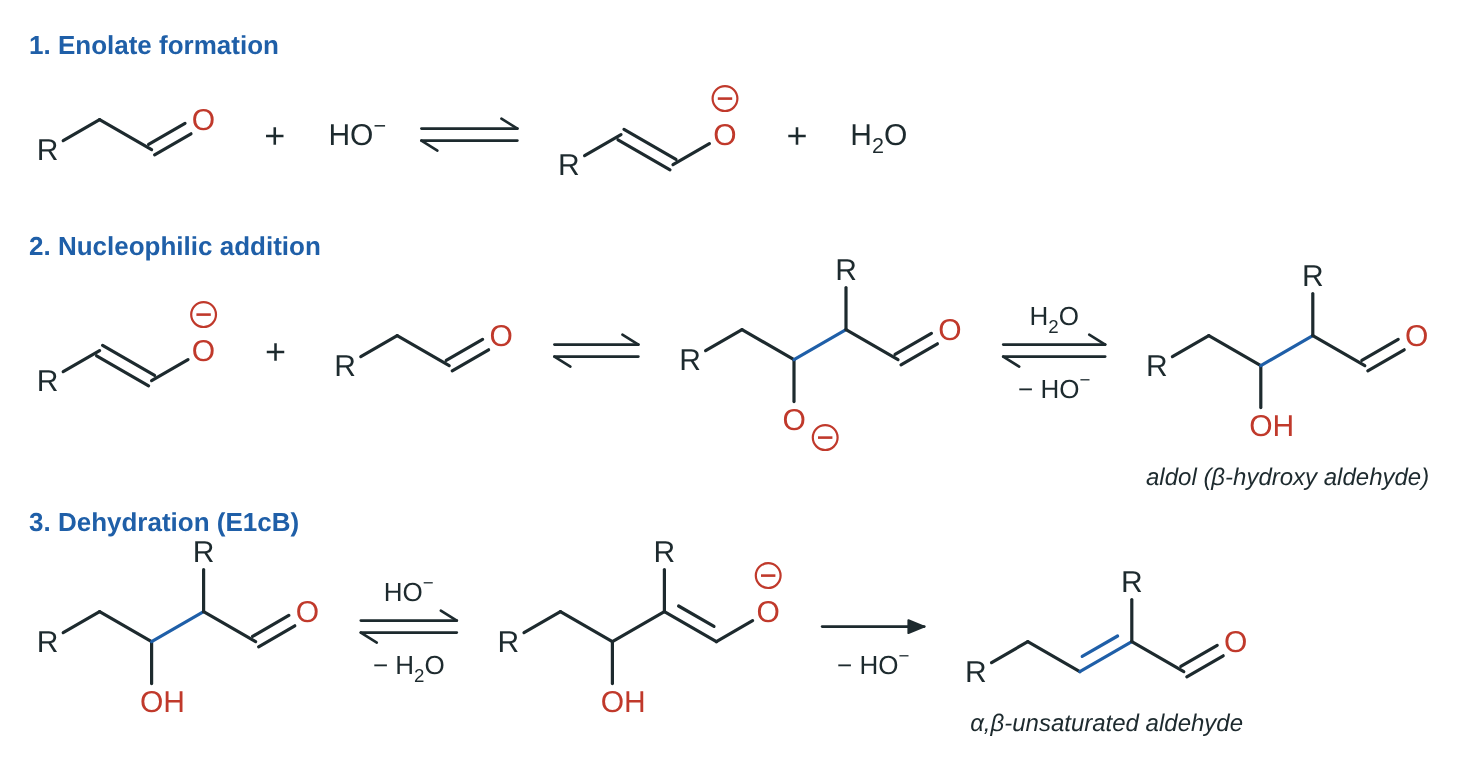
The addition is reversible (retro-aldol reaction), and for ketones the equilibrium usually lies on the side of the reactants. What drives the reaction is dehydration: the α hydrogen of the aldol is acidic, its enolate expels hydroxide from the β carbon (E1cB elimination) and a double bond conjugated with the carbonyl, more stable, is formed.
Mechanism under acidic conditions
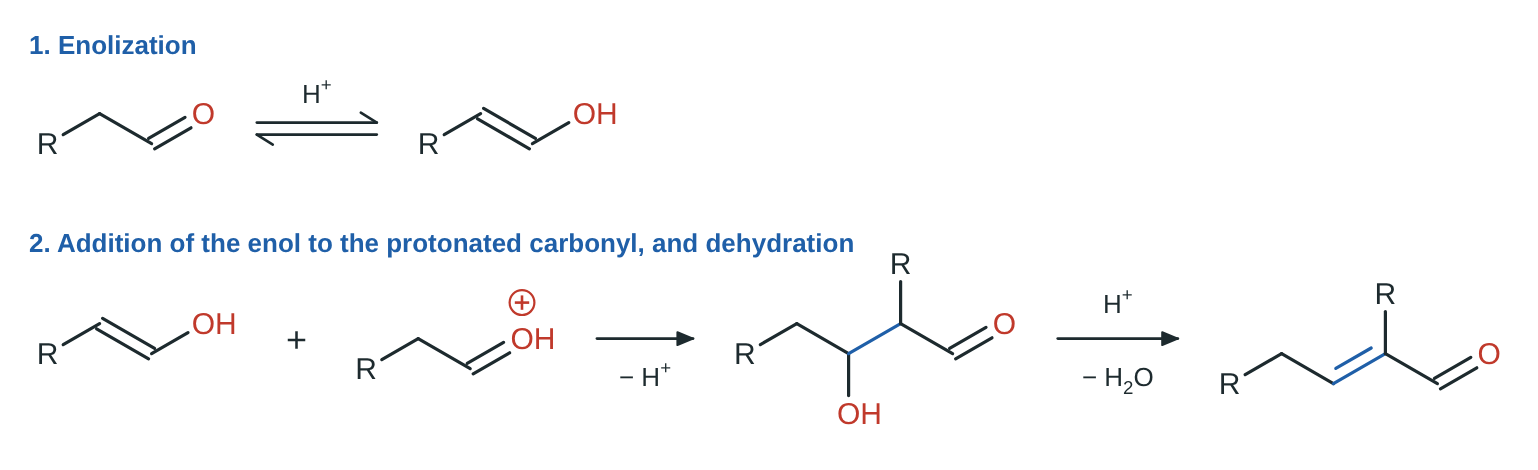
Under acidic conditions the nucleophile is the enol, and the electrophile is the protonated carbonyl, much more reactive than the neutral one. Dehydration is even easier here, and the product isolated is usually the unsaturated compound:
Some examples
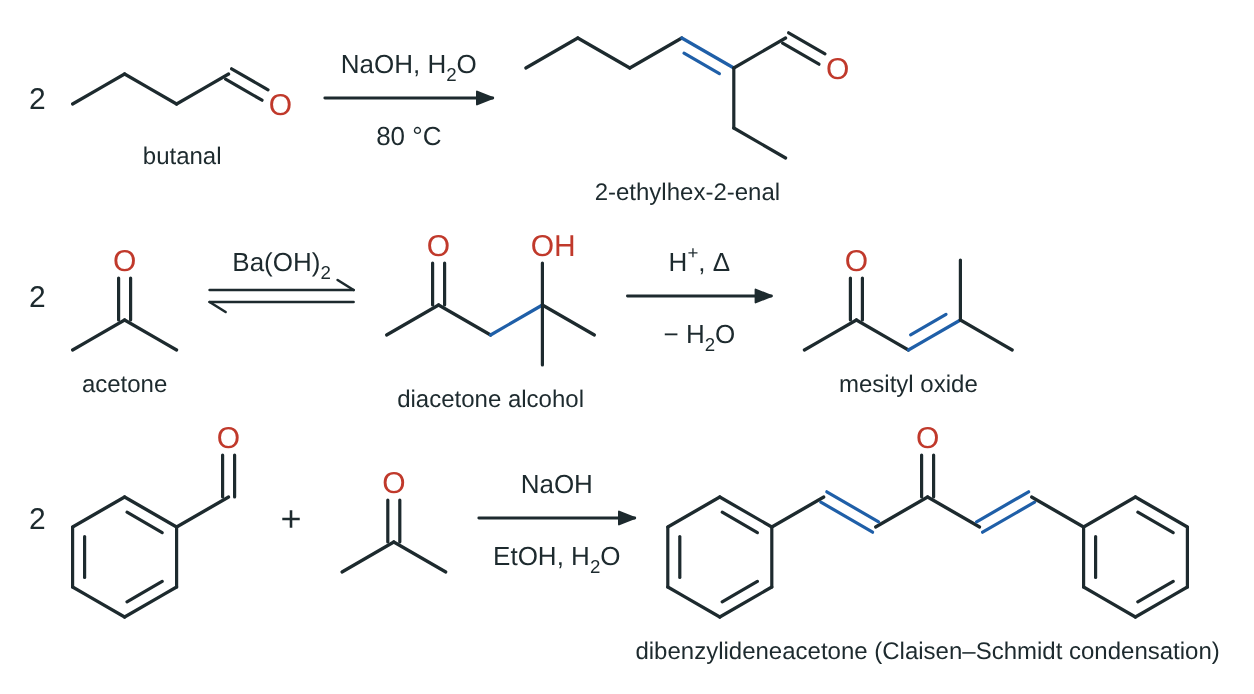
With acetone, the addition equilibrium is unfavourable; diacetone alcohol is obtained in a Soxhlet extractor, which removes the product from contact with Ba(OH)2 as it forms. When one of the compounds has no α hydrogens (like benzaldehyde), it can act only as the electrophile, and the crossed condensation with a ketone is clean: this is the Claisen–Schmidt condensation.
The crossed aldol addition
If two different enolizable carbonyl compounds are mixed under equilibrium conditions, each one can be nucleophile and electrophile, and up to four products are obtained. To control the reaction, one of them must act only as the nucleophile and the other only as the electrophile. The most general way of achieving this is to preform the enolate, for example with LDA at −78 °C, and then add the second compound, under kinetic control:

This approach, the directed aldol addition, also allows the regio- and stereochemistry to be controlled, as shown in the next section.
Review the basics in the aldol condensation in Organic Chemistry made transparent. The reaction was described independently in 1872 by Charles-Adolphe Wurtz, who coined the name “aldol” (aldehyde + alcohol), and by Alexander Borodin.