
Regioselectivity and enantioselectivity in ketone alkylation
An unsymmetrical ketone with hydrogens on both α carbons can give two enolates. By choosing the conditions one or the other is formed, which decides on which side alkylation takes place. In addition, with a chiral auxiliary the alkylation can create a stereocentre with a single configuration.
Kinetic and thermodynamic enolates
2-Methylcyclopentanone has α hydrogens on C2 (tertiary, one) and on C5 (secondary, two). Those on C5 are more accessible and are removed faster; on the other hand, the enolate with the double bond towards C2 is more stable, because its double bond is more substituted:
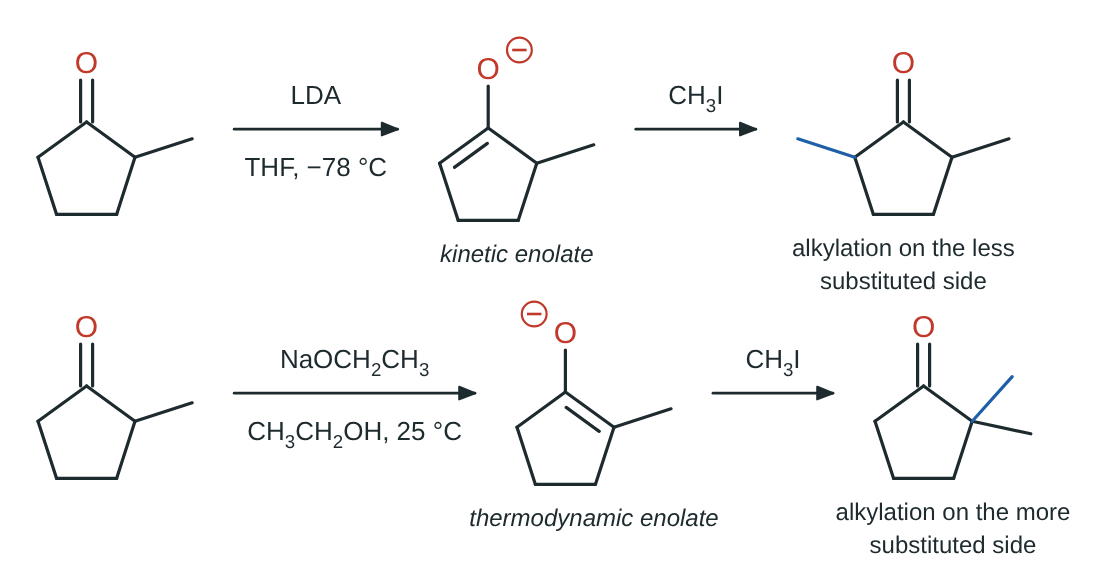
- Kinetic control: a strong, bulky base (LDA), with the ketone as limiting reagent, at low temperature in an aprotic solvent. Deprotonation is fast and irreversible, and the enolate that forms faster, on the less substituted carbon, is obtained.
- Thermodynamic control: a weaker base in a protic solvent, or a slight excess of ketone, at room temperature or above. The enolates interconvert by proton exchange and the more stable, more substituted one predominates.
The difference between kinetic and thermodynamic control of a reaction is explained in Kinetics vs. thermodynamics.
Under thermodynamic conditions alkylation is usually poorly selective: proton exchange is still possible after the first alkylation, and polyalkylated products appear. That is why it is better to fix the desired enolate first and alkylate it afterwards.
Silyl enol ethers
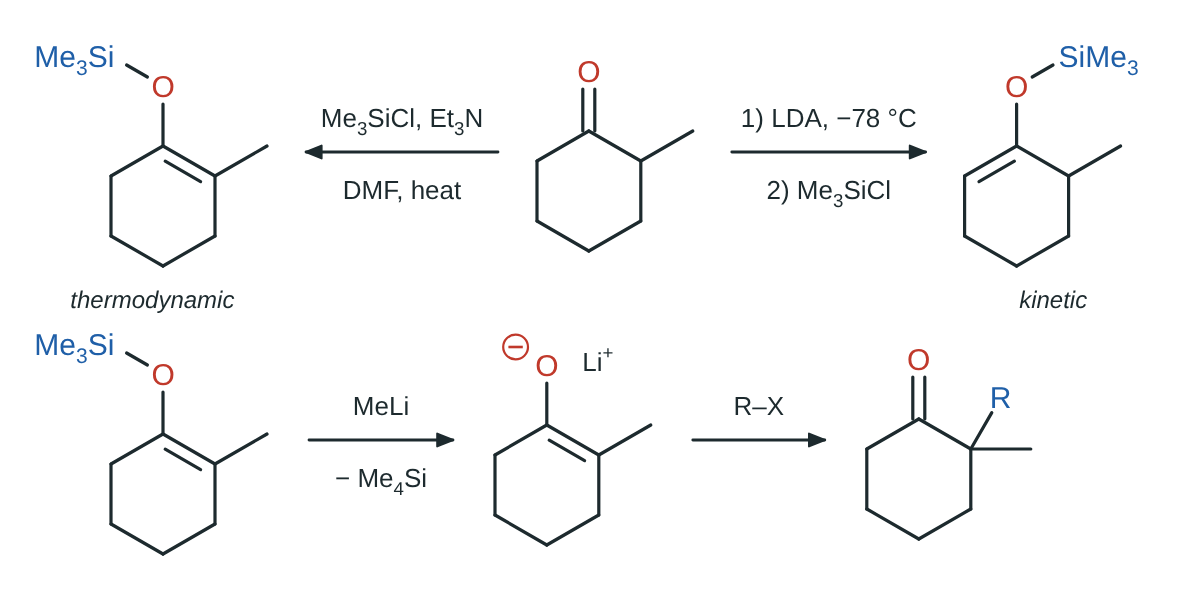
The enolate oxygen reacts very quickly with chlorotrimethylsilane (a “hard” electrophile), and the resulting silyl enol ether keeps the position of the double bond. The desired regioisomer can thus be separated or purified, and the lithium enolate can later be regenerated unambiguously by treatment with methyllithium:
Regiospecific enolates from enones
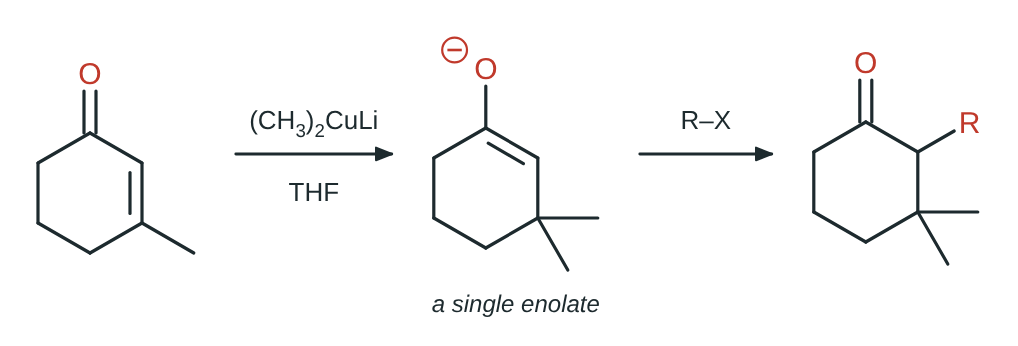
Another way to obtain a single enolate is to generate it from an α,β-unsaturated ketone. The conjugate addition of an organocuprate (or reduction with lithium in liquid ammonia) leaves the charge on the α carbon that was conjugated, and the enolate can be alkylated at that position, even if it is the more hindered one:
Stereoselectivity
In cyclohexanone enolates the electrophile preferably enters from the face that lets the ring evolve directly into a chair conformation, that is, in the axial position: the transition state keeps the overlap between the orbital of the forming bond and the π system. When the ring carries a bulky substituent that “locks” it, this stereoelectronic preference translates into good diastereoselectivity.
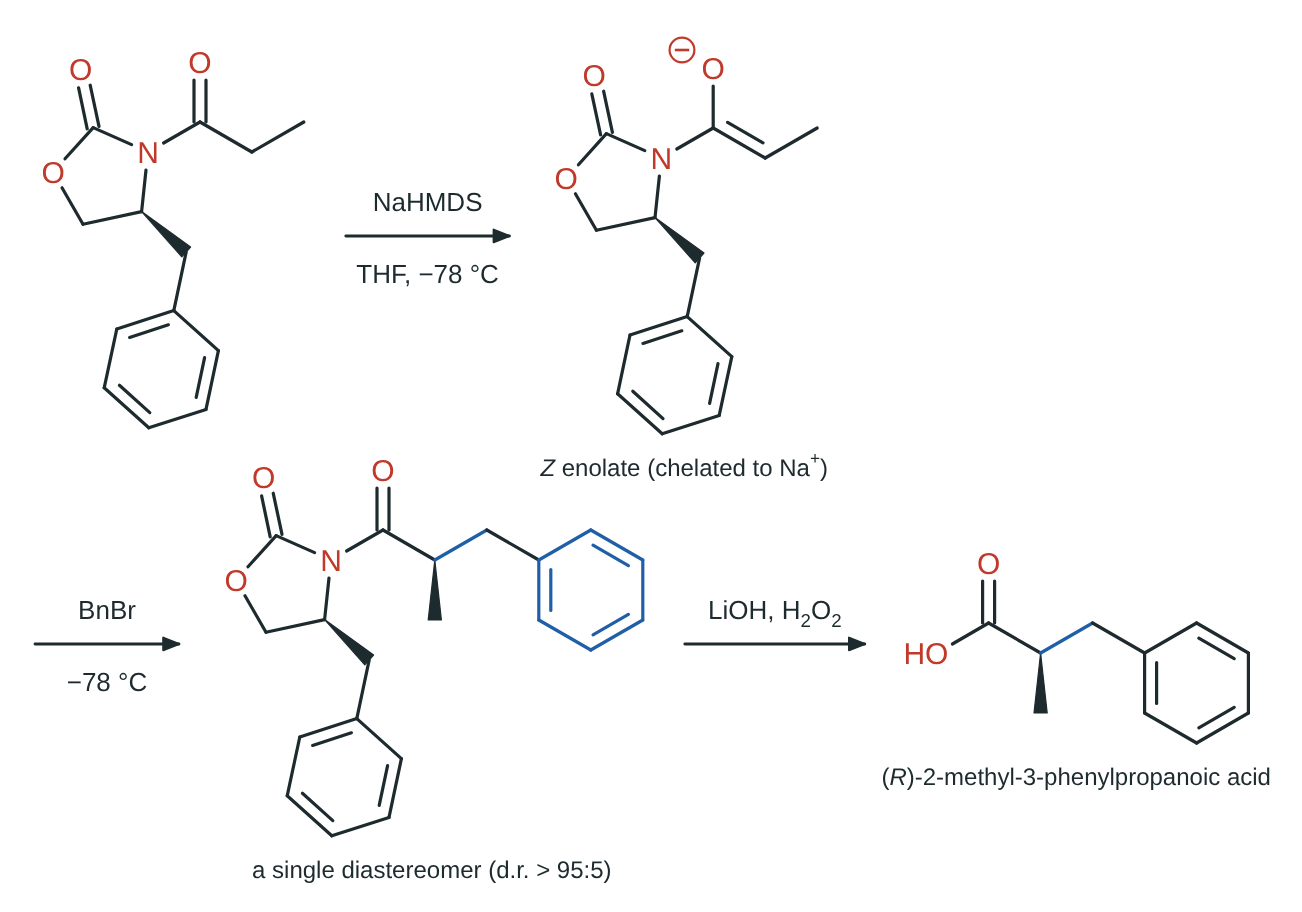
To obtain a single enantiomer, a chiral auxiliary that blocks one face of the enolate is attached to the carboxylic acid. The best known is the Evans oxazolidinone: its Z enolate, chelated by the metal, exposes only the face opposite to the benzyl group, and the electrophile always enters from that side. The auxiliary is then removed without touching the new stereocentre, and recovered:
Other methods of asymmetric alkylation use pseudoephedrine amides (Myers), SAMP and RAMP hydrazones (Enders, see Enamines, imines and hydrazones) or chiral phase-transfer catalysts. Chiral auxiliaries in the aldol reaction are dealt with in topic 7.