
Enamines, imines and hydrazones
Enamines, metalated imines and hydrazones are nitrogen equivalents of enolates. They are prepared from the carbonyl compound, alkylated at the α carbon and, on hydrolysis, give back the alkylated ketone: a milder, more selective or even enantioselective alternative to direct alkylation.
Enamines: the Stork alkylation
A ketone with α hydrogens reacts with a secondary amine such as pyrrolidine or morpholine, in the presence of an acid and removing the water formed, to give an enamine:
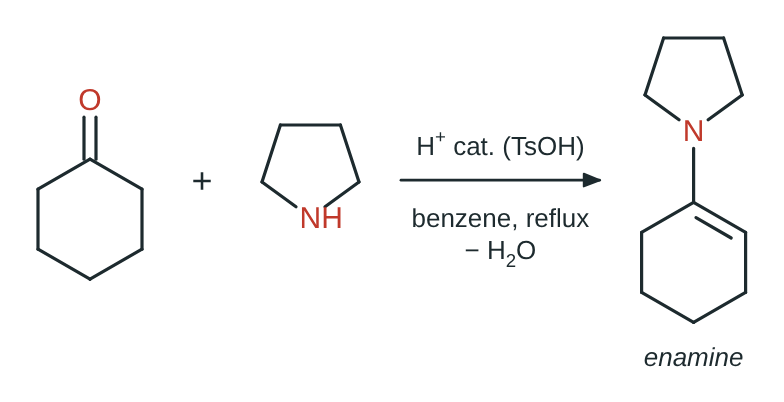
The nitrogen lone pair is conjugated with the double bond and makes the β carbon of the enamine, which is the former α carbon of the ketone, nucleophilic. Gilbert Stork showed (1954) that enamines are alkylated at that carbon and that the resulting iminium salt is easily hydrolysed:
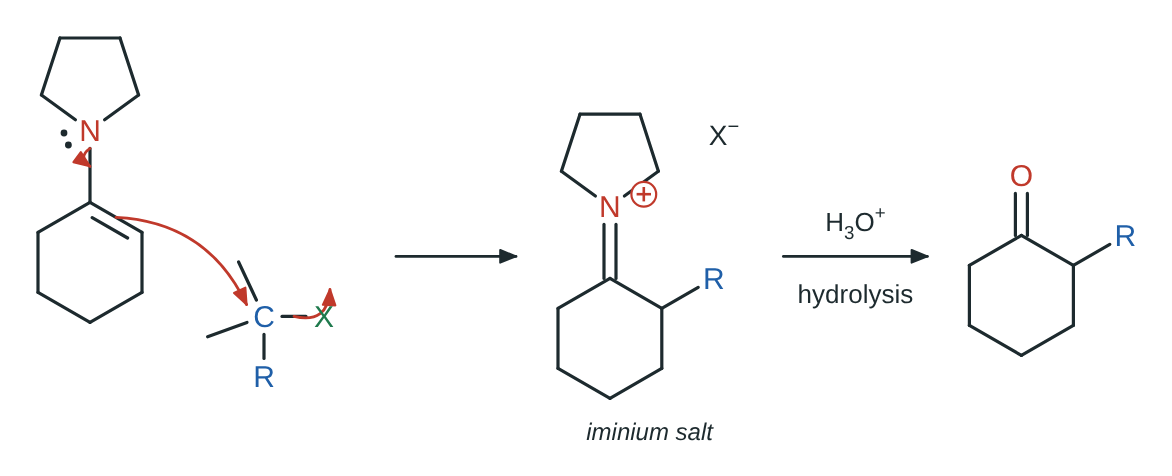
- Enamines are neutral and much less basic than enolates, so no strong bases are needed and there is no polyalkylation: the iminium salt formed is no longer nucleophilic.
- They are moderate nucleophiles: they work well with reactive electrophiles (allylic and benzylic halides, α-halo ketones and esters, acyl halides) and with Michael acceptors. With simple alkyl halides N-alkylation competes.
- With unsymmetrical ketones the less substituted enamine forms preferably, because in the more substituted one the substituent clashes with the amine ring (A1,3 allylic strain). That is why enamines alkylate the less substituted side.
Metalated imines (aza-enolates)
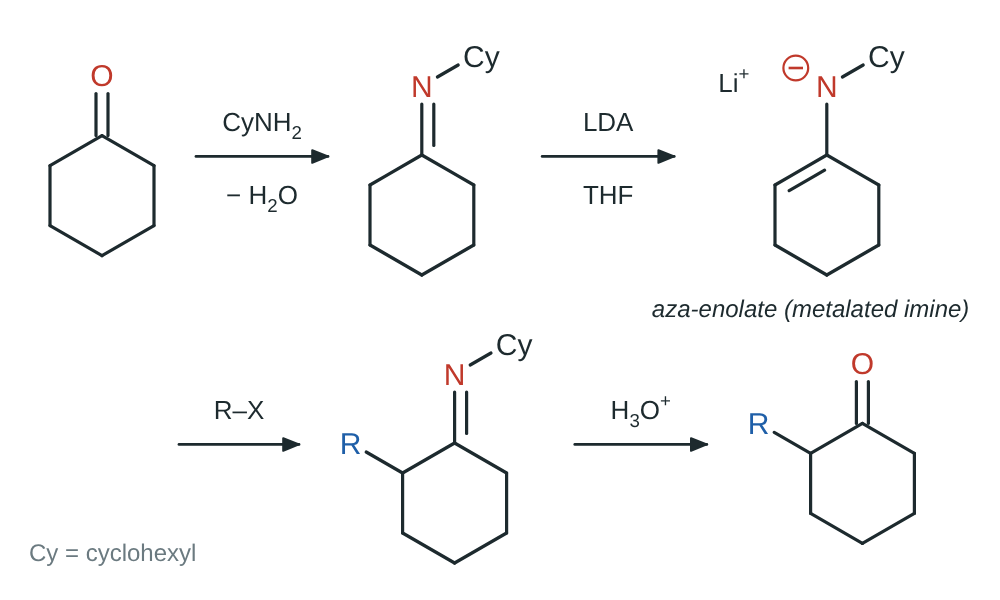
Imines derived from primary amines still have an acidic α hydrogen. With LDA or a Grignard reagent they give an aza-enolate, more nucleophilic than the enamine and less basic than the ketone enolate: it alkylates well even with secondary alkyl halides and does not cause self-condensation. The final hydrolysis releases the alkylated ketone:
Hydrazones: the Enders SAMP/RAMP method
N,N-Dimethylhydrazones are deprotonated by LDA and alkylated just like imines. Dieter Enders exploited this chemistry for asymmetric synthesis by using as chiral auxiliary (S)-1-amino-2-(methoxymethyl)pyrrolidine (SAMP), derived from proline, or its enantiomer (RAMP). In the aza-enolate, lithium is chelated by the methoxymethyl oxygen, which blocks one of the faces; after alkylation, the auxiliary is removed by ozonolysis (or with methyl iodide and acid) to give the ketone in very high enantiomeric excess:
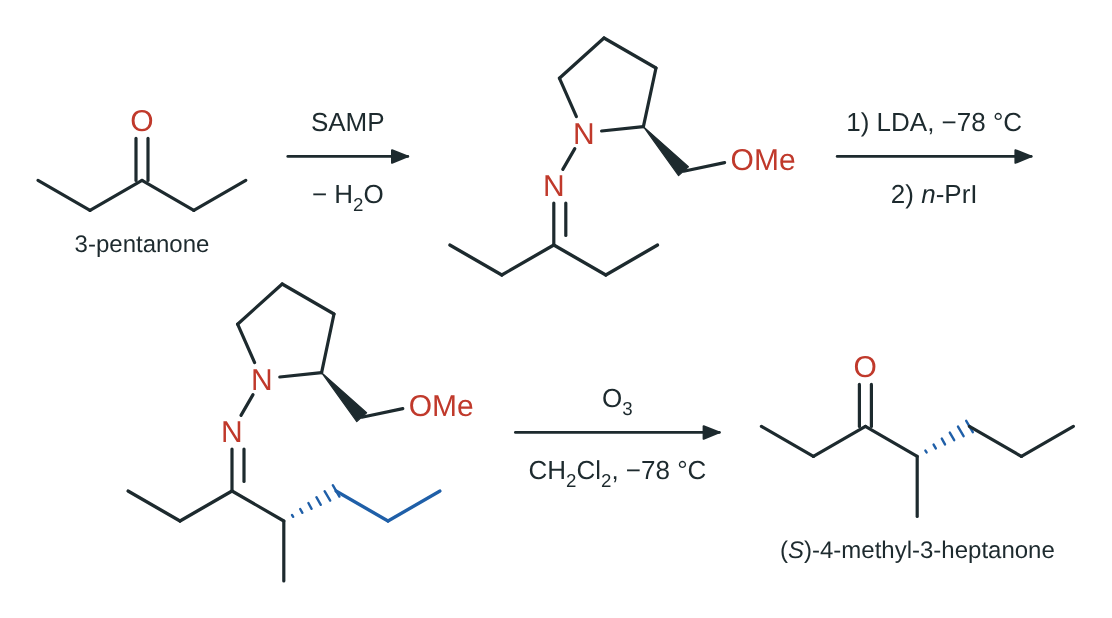
(S)-4-Methyl-3-heptanone is the alarm pheromone of several ant species. Its synthesis was one of the first examples of the Enders method.