
Chiral auxiliaries
A chiral auxiliary is an enantiomerically pure group temporarily attached to the enolate; it directs the reaction to one of its faces and is then removed, without damaging the product, so that it can be recovered.
Another way of controlling stereochemistry is to install a chiral auxiliary, which gives very high facial selectivity. The most useful method for enantioselective aldol additions is based on the Evans oxazolidinones, already seen in the alkylation of enolates. They are prepared from natural amino acids (valine, phenylalanine) or from norephedrine, are available in both enantiomeric forms and give access to either enantiomer of the product. Oppolzer’s camphor sultams, combined with Lewis acids, play the same role.
The Evans aldol reaction
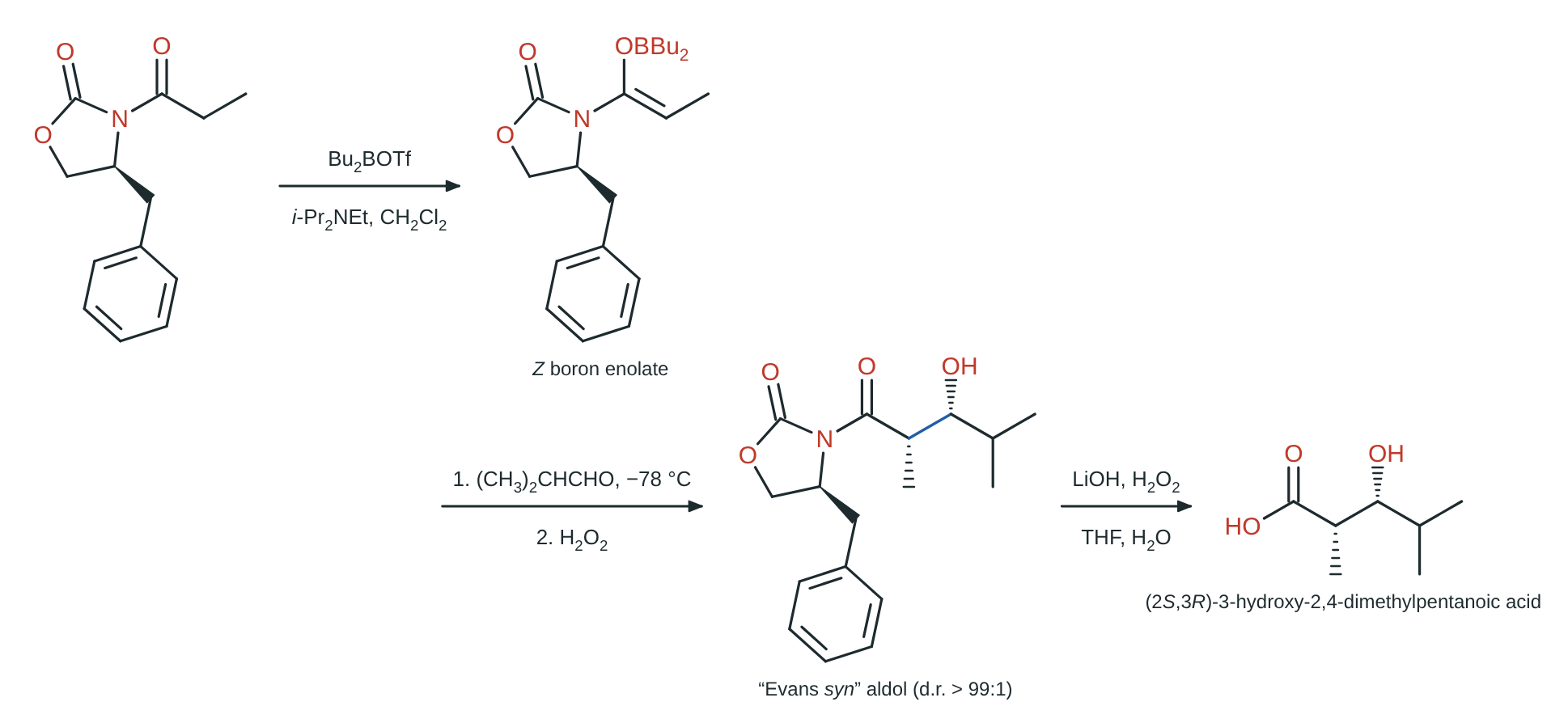
The oxazolidinones are acylated and their N-acyl derivatives are converted into lithium, boron, tin or titanium enolates by the same methods used for ketones and esters. With dibutylboron triflate and a tertiary amine the Z boron enolate is formed; the substituent at C4 of the auxiliary blocks one of its faces and the aldehyde approaches from the other, through a chair transition state in which the dipoles of the two carbonyls of the auxiliary point in opposite directions:
Removal of the auxiliary
N-Acyloxazolidinones can be solvolysed in water or alcohols to give the enantiomerically pure β-hydroxy acid or β-hydroxy ester (LiOH/H2O2, which attacks the exocyclic carbonyl rather than the ring one; or alkoxides), reduced to alcohols (LiBH4) or to aldehydes, or converted into Weinreb amides, useful for preparing ketones. In every case the auxiliary is recovered.
By changing the metal and conditions (titanium enolates with excess base, Crimmins thiazolidinethiones) the “non-Evans” syn aldol, the opposite syn diastereomer, can also be reached with the same auxiliary.