Asymmetric metal catalysis: Sharpless and Noyori
A transition metal with a chiral ligand creates an asymmetric environment in which the substrate can react from only one of its faces. The 2001 Nobel Prize in Chemistry recognized two families of these reactions: the asymmetric hydrogenations of Knowles and Noyori, and the asymmetric oxidations of Sharpless.
Asymmetric hydrogenation with rhodium
Wilkinson’s catalyst, RhCl(PPh3)3, hydrogenates alkenes in solution through the catalytic cycle of topic 9. In the late 1960s, William Knowles replaced triphenylphosphine with chiral phosphines, and in 1971 Henri Kagan introduced DIOP, a C2-symmetric diphosphine derived from tartaric acid. With the diphosphine DIPAMP, Knowles developed at Monsanto the first industrial synthesis by asymmetric catalysis, that of L-DOPA, the drug for Parkinson’s disease (1974).
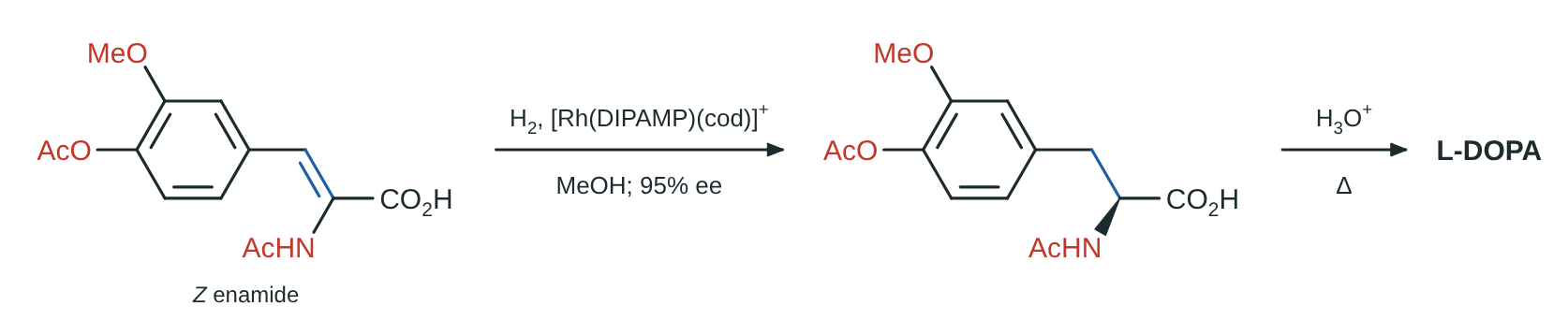
The acetamido group is essential: its oxygen coordinates to rhodium together with the double bond and holds the substrate in a rigid geometry. Many asymmetric hydrogenations need such a group to “anchor” the substrate to the metal.
Noyori: BINAP and ruthenium
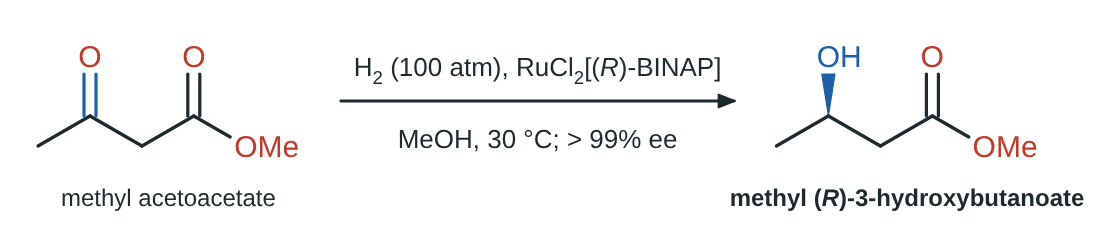
BINAP, 2,2′-bis(diphenylphosphino)-1,1′-binaphthyl, prepared by Ryōji Noyori in 1980, has no stereocentres: it is chiral because the two naphthalenes cannot rotate about the bond that joins them (axial chirality). Its ruthenium(II) complexes hydrogenate a very wide range of substrates with more than 99% ee: unsaturated acids, allylic alcohols and, above all, ketones with a coordinating group, such as β-keto esters. Unlike the reduction with oxazaborolidines (CBS), it uses hydrogen and very small amounts of catalyst.
In 1995 Noyori described ruthenium catalysts with a chiral diamine, which reduce simple ketones, such as acetophenone, by hydrogen transfer from isopropanol or formic acid. The hydrogen of the ligand NH and the metal hydride are transferred simultaneously to the carbonyl.
Sharpless epoxidation
In 1980, Tsutomu Katsuki and K. Barry Sharpless described the epoxidation of allylic alcohols with tert-butyl hydroperoxide, titanium tetraisopropoxide and diethyl tartrate (DET). The alcohol and the oxidant bind to the same titanium, whose chiral environment is fixed by the tartrate, and oxygen is transferred to a single face of the double bond. The enantiomer of the tartrate decides that of the epoxide, with ee above 90%, and the reaction affects only the allylic double bond: in geraniol, the C6=C7 double bond is untouched.
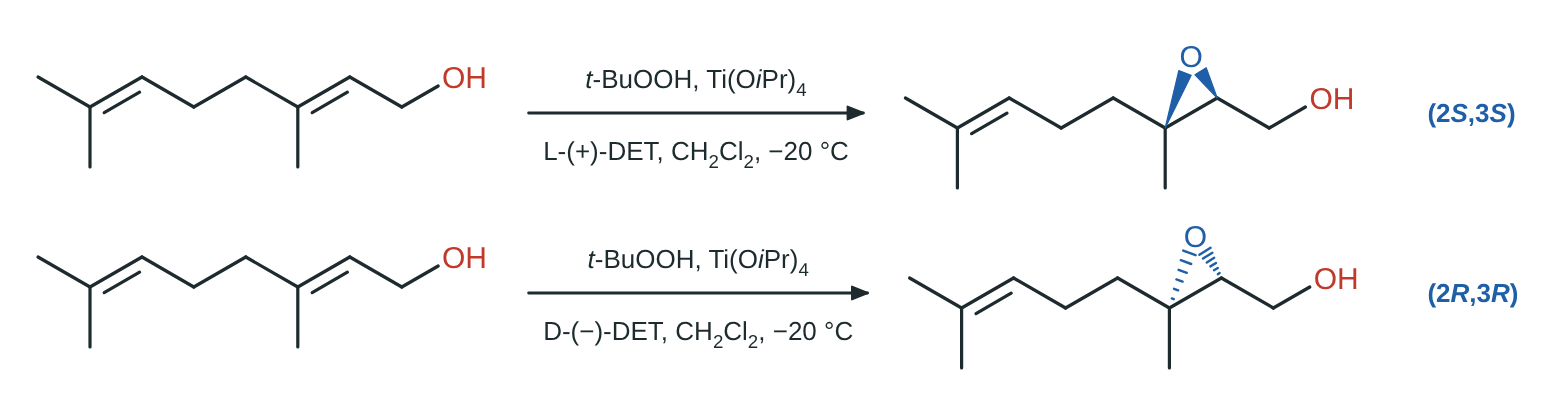
Since both enantiomers of the tartrate are cheap, both epoxides can be obtained. With racemic secondary allylic alcohols the reaction is a kinetic resolution: one enantiomer is epoxidized much faster than the other. For alkenes without a hydroxyl group, the manganese–salen complexes of Jacobsen and Katsuki (1990) are used. Review the epoxidation of alkenes.
Asymmetric dihydroxylation
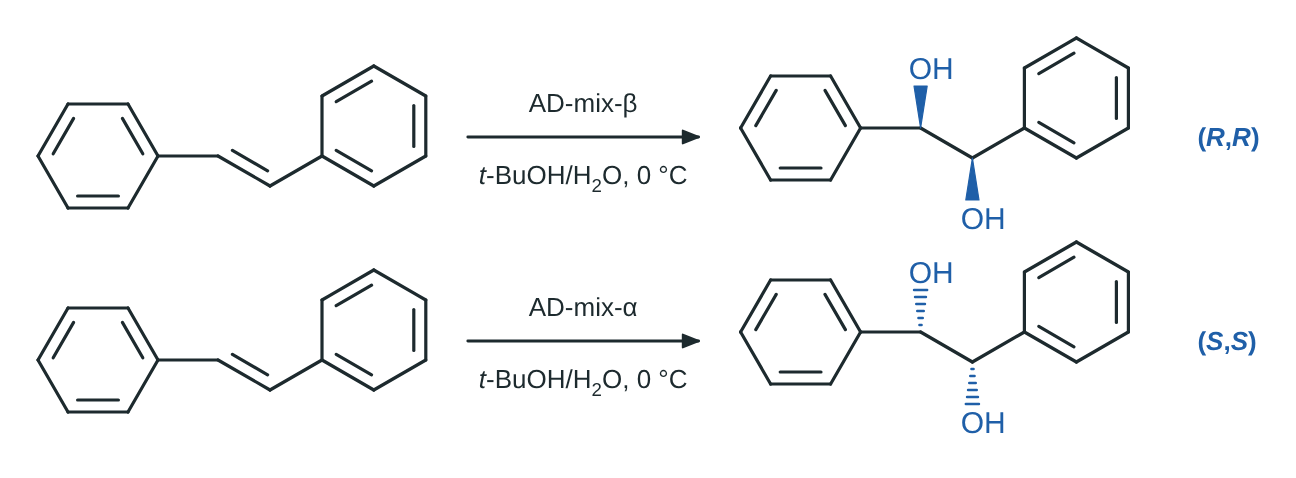
Dihydroxylation with OsO4 becomes enantioselective with ligands derived from the cinchona alkaloids: dihydroquinidine (DHQD) and dihydroquinine (DHQ), linked through a phthalazine (PHAL). Sharpless marketed them as ready-to-use mixtures: AD-mix-β contains (DHQD)2PHAL and AD-mix-α (DHQ)2PHAL, together with catalytic potassium osmate, potassium ferricyanide as reoxidant and potassium carbonate. Unlike the epoxidation, it works with almost any alkene.