Alkanes, alkenes, alkynes and arenes
C–C double and triple bonds are the easiest groups of hydrocarbons to oxidize and reduce. Depending on the reagent, an alkene can be converted into an epoxide, a diol or two carbonyl compounds; an alkyne into the Z alkene, the E alkene or the alkane; and an aromatic ring into a cyclohexadiene.
Oxidation of alkenes
Peroxy acids such as m-chloroperbenzoic acid transfer an oxygen atom to the double bond in a single concerted step and form an epoxide that retains the geometry of the alkene (epoxidation). Osmium tetroxide undergoes a [3+2] cycloaddition with the alkene; hydrolysis of the cyclic osmate forms the syn 1,2-diol. As OsO4 is expensive and very toxic, it is used in catalytic amounts with an oxidant that regenerates it, N-methylmorpholine N-oxide (NMO; Upjohn method).
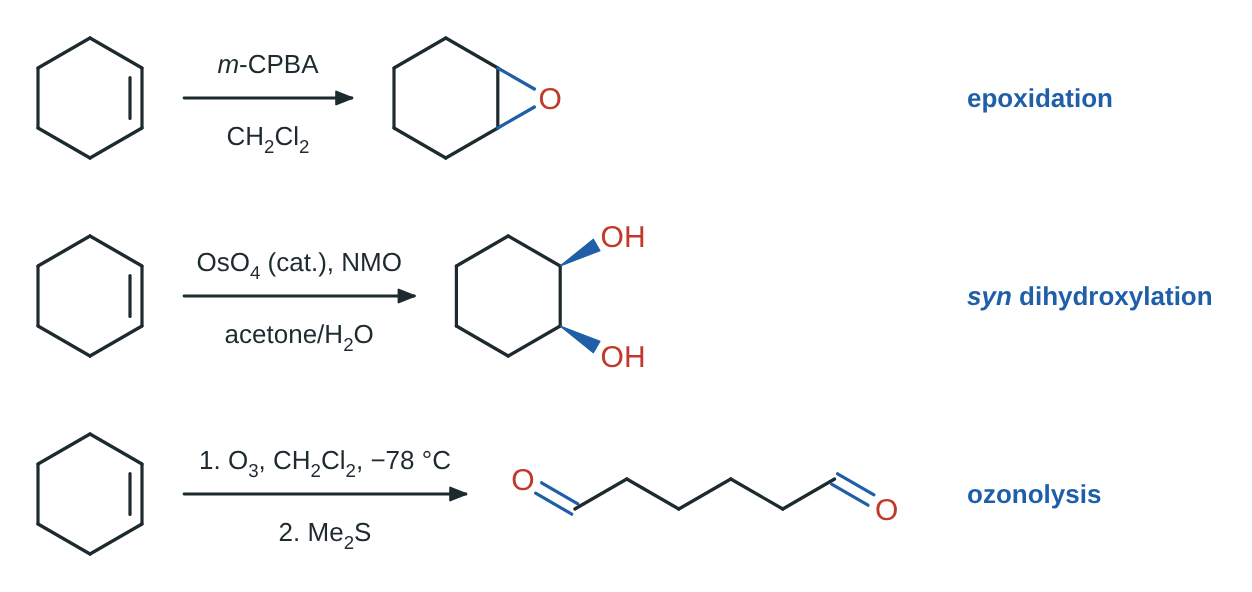
Ozone cleaves the double bond completely. According to the Criegee mechanism, it forms an unstable molozonide that fragments into a carbonyl compound and a carbonyl oxide; both recombine to the ozonide, which is treated with a reducing agent (Me2S, PPh3, Zn) to obtain aldehydes and ketones, or with H2O2 to obtain carboxylic acids. The combination of catalytic OsO4 and NaIO4 (Lemieux–Johnson) achieves the same cleavage without ozone. Review the oxidation of alkenes in Organic Chemistry made transparent.
Two further oxidations act next to the double bond without breaking it: selenium dioxide hydroxylates the allylic position, and the Wacker oxidation (catalytic PdCl2, CuCl2, O2, water) converts terminal alkenes into methyl ketones. The side chains of arenes are oxidized at the benzylic position.
Reduction of alkenes and alkynes
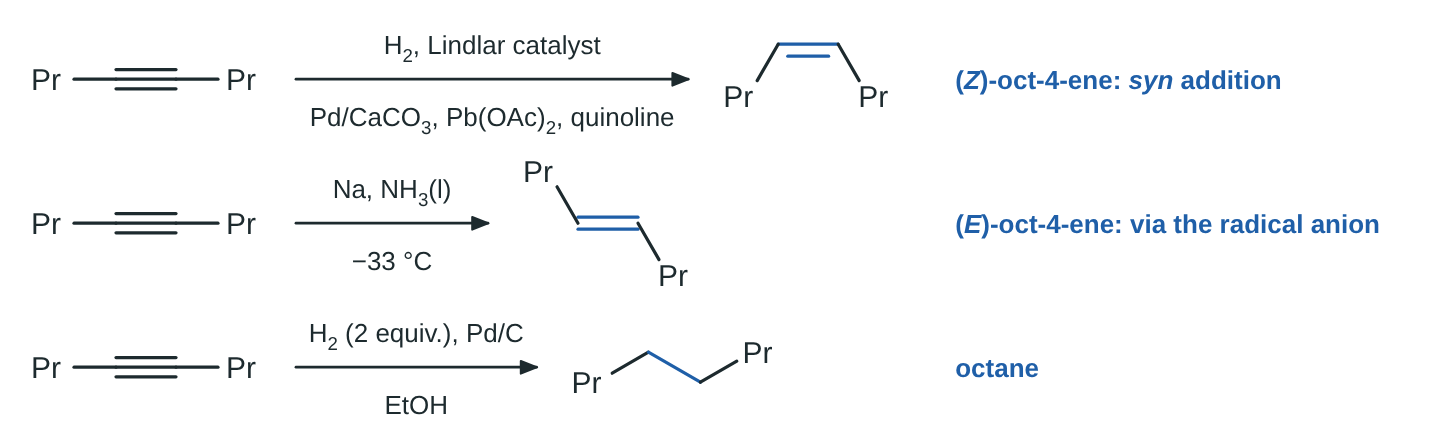
Catalytic hydrogenation with Pd, Pt or Ni adds two hydrogens from the same face (syn); homogeneous catalysts, such as Wilkinson’s, follow the catalytic cycle of the previous topic. Alkynes allow the geometry of the alkene to be chosen:
- With the Lindlar catalyst, palladium deactivated with lead acetate and quinoline, hydrogenation stops at the alkene and gives the Z isomer (hydrogenation of alkynes).
- With sodium in liquid ammonia the alkyne accepts an electron and forms a radical anion, which is protonated and reduced again. The vinyl anion adopts the more stable trans arrangement, and the E alkene is obtained (reduction with metals).
The Birch reduction
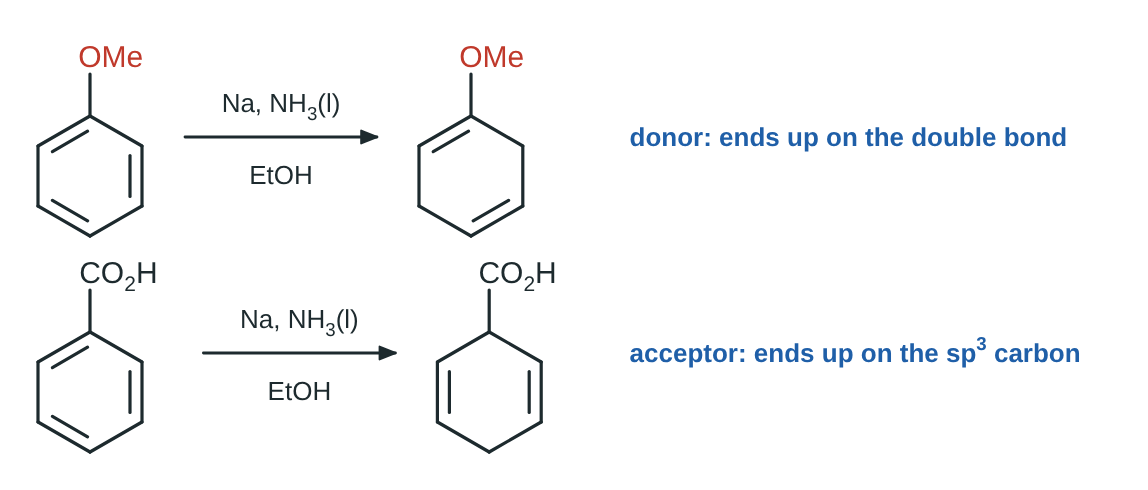
Aromatic rings resist hydrogenation under mild conditions, but alkali metals in liquid ammonia, with an alcohol as proton source, reduce them to cyclohexa-1,4-dienes (Arthur J. Birch, 1944). Two single-electron transfers and two protonations take place, and the two hydrogens enter para positions. Electron-donating substituents (OMe, alkyl) end up on one of the double bonds of the product; acceptors (CO2H), on an sp3 carbon.