Skip to content
qorganica.es qorganica.comOrganic Chemistry made transparent Course map Español

Oxidation

The carbons of olefins are in a relatively low oxidation state and they can thus be transformed into other more oxidized substances. Olefin oxidation can be carried out gently or vigorously, with different outcome.
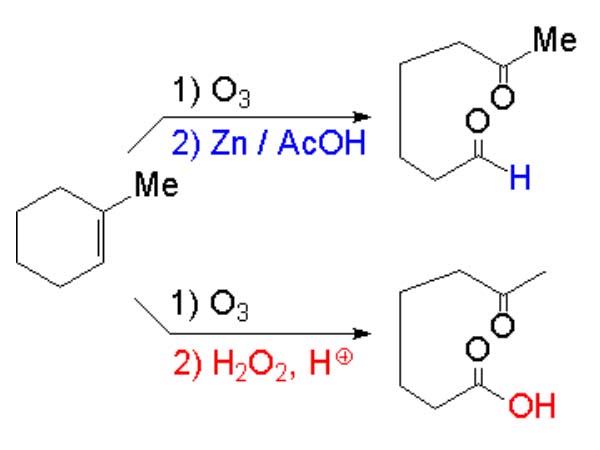
Ozonolysis of 1-methylcyclohexene with reductive (Zn/AcOH: aldehyde) or oxidative (H₂O₂/H⁺: acid) work-up

Mild oxidation

Baeyer Test (cold dilute solution of potassium permanganate):
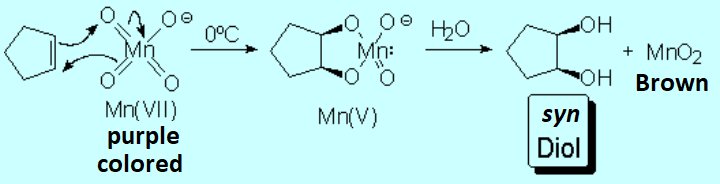
Baeyer test: permanganate (Mn(VII), purple) gives with cyclopentene a cyclic Mn(V) ester that is hydrolysed to the syn diol, forming MnO₂ (brown)
Baeyer test: permanganate forms with the alkene a cyclic manganese ester whose hydrolysis gives the syn diol and MnO2.
Video of the Baeyer test: permanganate is decolorized in the presence of an alkene
When the alkene is added, the purple colour of permanganate disappears and brown MnO2 precipitates.

Vigorous oxidation (ozonolysis)

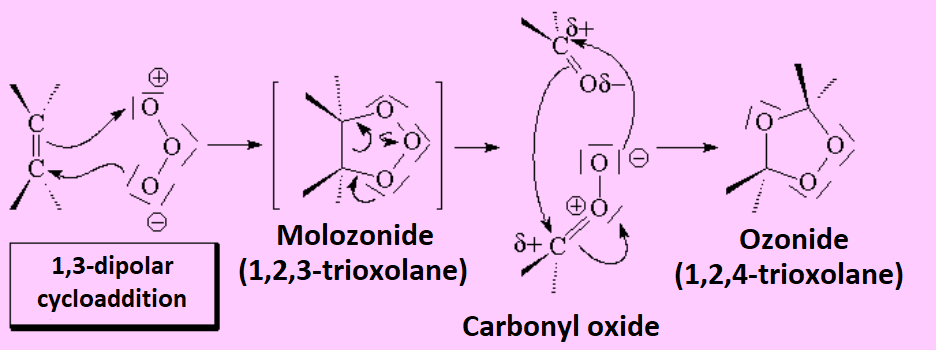
The reaction of ozone with a given olefin goes through a complicated mechanism that implies a very important type of reaction in organic chemistry, the so-called 1,3-dipolar cycloaddition, as a consequence of ozone's electronic structure:
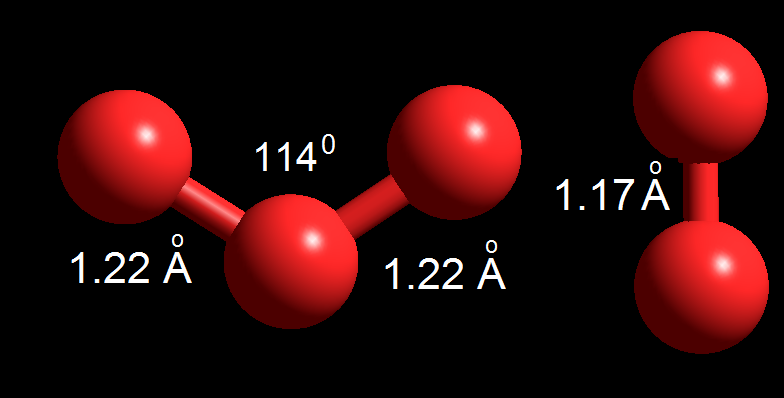
Models of ozone (114° angle and 1.22 Å bonds) and oxygen (1.17 Å)
Comparison between the size and shape of ozone and oxygen.

The ozone molecule has an angular structure whose angle is in between those of sp3 and sp2 hybridizations. This fact is explained by ozone's resonant forms that also indicate the charge separation between both ends of the molecule.
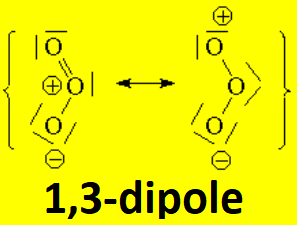
Resonance forms of ozone: a 1,3-dipole
Mechanism of ozonolysis: 1,3-dipolar cycloaddition (molozonide, 1,2,3-trioxolane), cleavage to a carbonyl and a carbonyl oxide and new cycloaddition to the ozonide (1,2,4-trioxolane)

The decomposition of the ozonide gives more or less oxidized products depending on the reagent used: aldehydes and ketones with a reductive work-up, and carboxylic acids and ketones with an oxidative work-up.
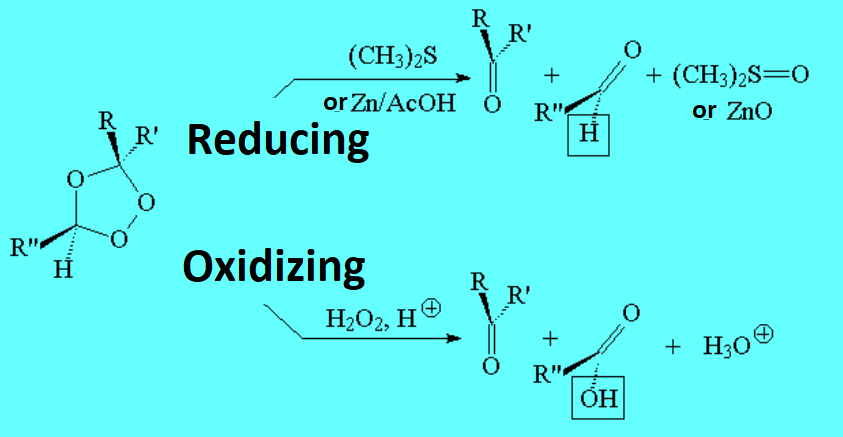
Decomposition of the ozonide: reductive work-up ((CH₃)₂S or Zn/AcOH) gives a ketone and an aldehyde; oxidative work-up (H₂O₂/H⁺), a ketone and an acid