
SolutionsOxidation
1. Oxidations of 1-phenylcyclohexene
Predict the result of the following reactions:
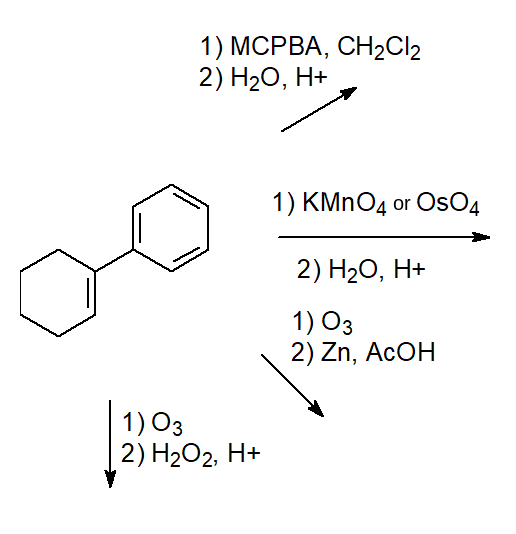
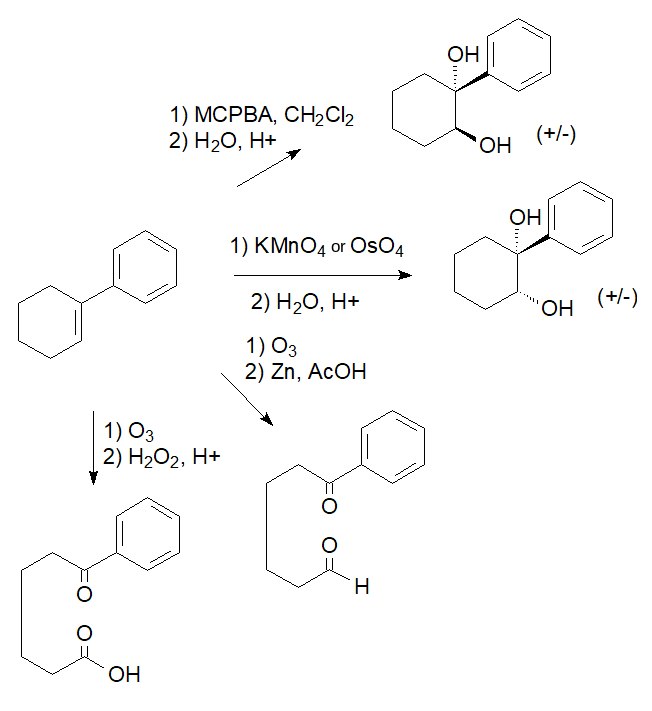
Ozonolysis cleaves the double bond: since the ring is opened, a single compound bearing both carbonyls is obtained. The carbon that carried the phenyl gives a ketone and the other one an aldehyde (reductive work-up) or an acid (oxidative work-up).
2. Deduce the alkene
Ozonolysis with reductive work-up of an alkene C6H12 gives acetone and propanal. What is the alkene?
2-Methylpent-2-ene, (CH3)2C=CHCH2CH3: the two carbonyl carbons of acetone and propanal are joined by a double bond.
3. Baeyer test
What is observed when a dilute KMnO4 solution is added to cyclohexene and to cyclohexane? Why?
With cyclohexene the purple colour of permanganate disappears and a brown precipitate of MnO2 appears: the alkene is oxidized to the diol. With cyclohexane, which has no double bond, the purple colour remains.