
Catalytic Hydrogenation
In spite of the favourable ΔH°, ethylene and hydrogen do not react even when heated at 200 °C under high pressure. A metal catalyst is necessary in order to homolytically break the H-H bond.

Hydrogen splits at the metal surface leading to two electrophilic, very reactive hydrogen atoms.
The π cloud of the C=C double bond is thus easily attacked yielding the corresponding alkane.
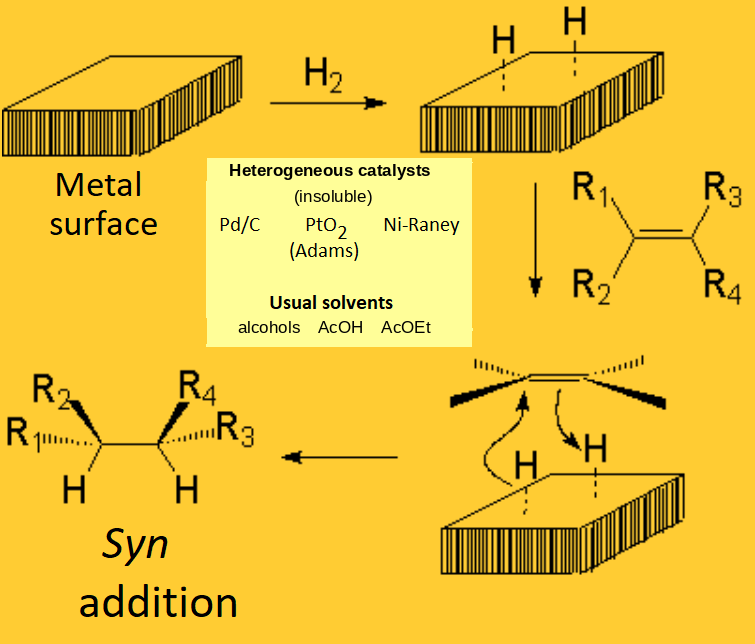

Hydrogenation with heterogeneous catalysts is stereospecific, in that the two hydrogens come from the same side of the C=C double bond.
If the two faces of the C=C double bond are not equivalent, the least sterically hindered will be preferred.
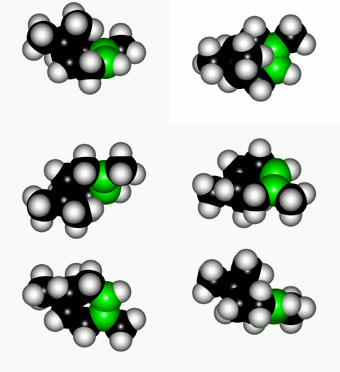

The hydrogenation of carene is a good example of this selectivity. Click here for an additional explanation.
The catalytic hydrogenation is carried out in an apparatus like this one (Parr hydrogenator):
