
Halogenated derivatives
The C–halogen bond can be reduced to C–H, by substitution with a hydride, by hydrogenolysis or, above all, by a radical chain reaction with tributyltin hydride. In the opposite direction, the carbon bearing the halogen can be oxidized to a carbonyl with DMSO (Kornblum oxidation).
Radical reduction with Bu3SnH
The Sn–H bond is weak (about 310 kJ/mol) and the tributylstannyl radical readily abstracts bromine and iodine from alkyl halides. An initiator, AIBN, which decomposes on heating into N2 and two radicals, starts a chain with two propagation steps: the stannyl radical forms Bu3SnX and an alkyl radical, and this abstracts the hydrogen from another molecule of Bu3SnH, regenerating the stannyl radical.
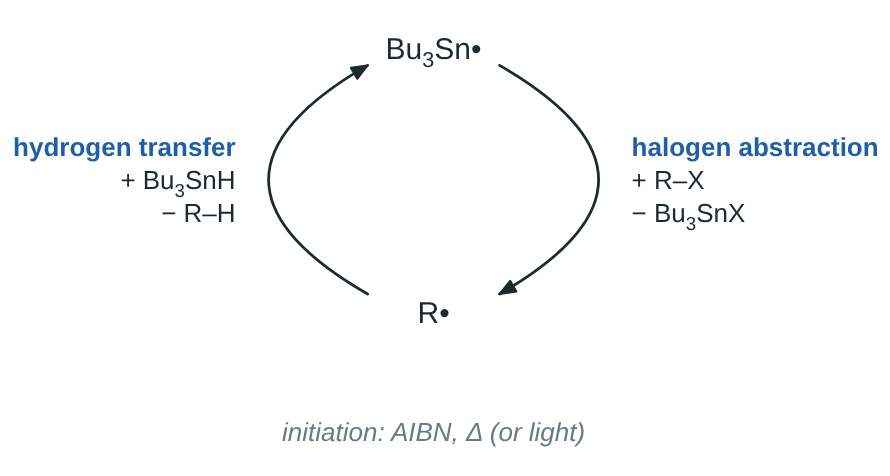
Since the alkyl radical is an intermediate, it can rearrange before taking the hydrogen: if there is a double bond at the right distance, it cyclizes. These radical cyclizations form five-membered rings very efficiently. Because of the toxicity of tin compounds, alternatives are sought, such as tris(trimethylsilyl)silane or photocatalysis.
Other reductions
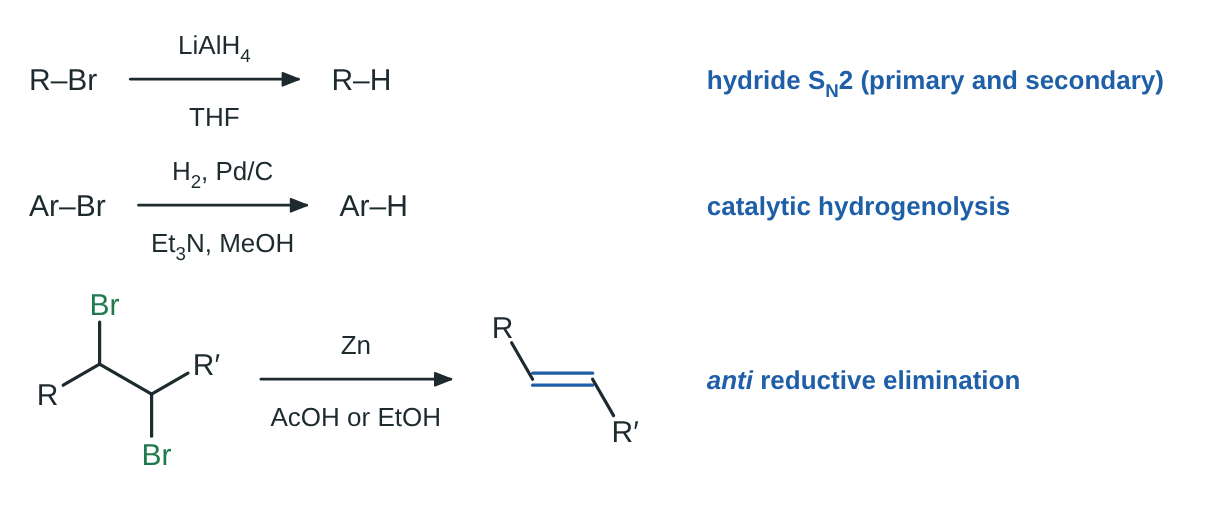
LiAlH4 reduces primary and secondary halides by an SN2 substitution of hydride ion. Aryl halides are hydrogenolysed with palladium and a base that neutralizes the HX, which allows a halogen to be used as a protecting or directing group and removed at the end. Zinc reduces vicinal dihalides to the alkene with anti stereochemistry, the reverse of halogen addition, and is used to protect a double bond temporarily as the dibromide.
Oxidation: the Kornblum reaction
The oxygen of DMSO is nucleophilic and displaces active primary halides (benzylic, allylic, α-halocarbonyls) and tosylates. The alkoxysulfonium salt formed loses a proton from the carbon next to oxygen, and the resulting ylide fragments into the aldehyde and dimethyl sulfide, exactly as in the Swern oxidation (Nathan Kornblum, 1957).
