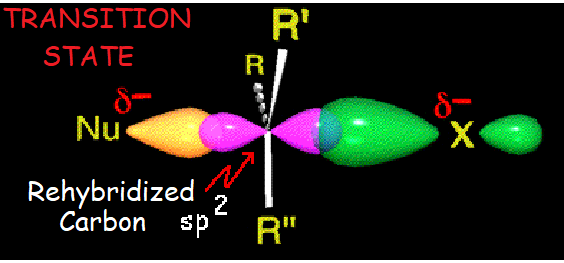
Bimolecular Nucleophilic Substitution
In the reaction of (R)-2-bromooctane with hydroxide, the formation of the major product, (S)-2-octanol, can be easily explained with the aid of the following scheme:

The nucleophile (HO−) has attacked the carbon bearing the halogen (LEAVING GROUP) from the side opposite to the one the latter leaves from. This is the only way to explain the inversion of configuration observed.
The reaction can be performed with other nucleophiles on different substrates with other LEAVING GROUPS: