Nucleophilicity and Solvation
The SN2 reaction will be easier if it is performed with a good attacking nucleophile. What makes a good nucleophile?
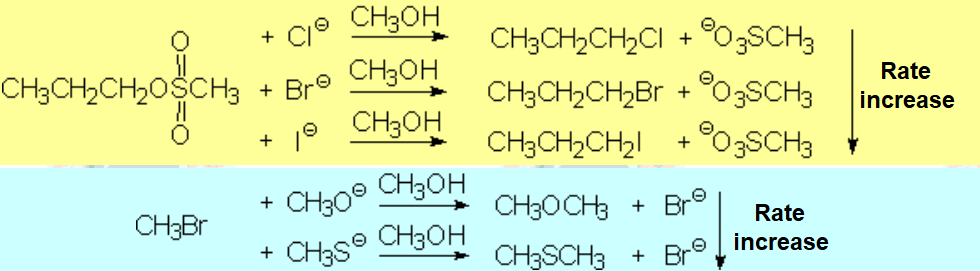
In methanol, substitution of propyl mesylate becomes faster in the order Cl− < Br− < I−, and bromomethane reacts faster with CH3S− than with CH3O−. In both cases the more reactive nucleophile is the less basic one: in a protic solvent, large and polarizable anions are less solvated and attack more easily.
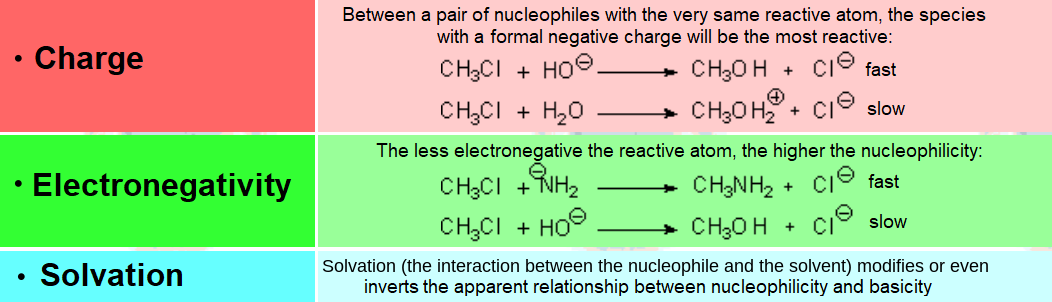
Three factors determine nucleophilicity: charge (with the same reactive atom, HO− reacts faster than H2O), electronegativity (NH2− is more nucleophilic than HO− because nitrogen holds its electrons less tightly than oxygen) and solvation, which can even reverse the relationship between nucleophilicity and basicity.
The ability to be a good leaving group can be related to basicity because both are thermodynamic processes. Nucleophilicity, however, is a kinetic process.
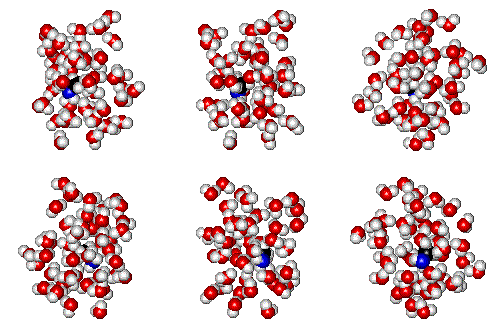
The more concentrated the charge on the reactive atom, the greater, in principle, its nucleophilicity, but also the stronger its interaction with the solvent, which acts as a screen and lowers its nucleophilicity. Therefore, the nature of the solvent is of prime importance in a nucleophilic substitution.
There are two kinds of solvents:

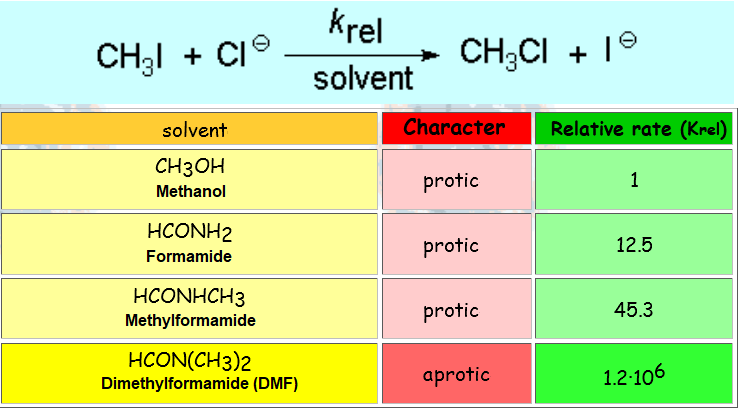
The reaction takes place much more quickly in DMF (dimethylformamide), a solvent without hydrogens that can participate in hydrogen bonding.
In contrast, the N-H groups of formamide and its N-methyl derivative or the O-H group of methanol, associate strongly with the chloride through hydrogen bonds, shielding the anion and considerably slowing down its reaction.