Alcohols and phenols
The oxidation of alcohols is the most common way of obtaining aldehydes, ketones and carboxylic acids. Modern reagents make it possible to stop the oxidation of a primary alcohol at the aldehyde, under mild conditions and without toxic metals. The reverse reaction, complete removal of the oxygen (deoxygenation), is achieved by a radical pathway.
Choice of oxidant
Secondary alcohols give ketones with almost any oxidant. With primary alcohols a choice must be made: in aqueous media the aldehyde is hydrated and the hydrate is oxidized further to the acid, so the reagents that stop at the aldehyde work in anhydrous solvents. Review the oxidation of alcohols in Organic Chemistry made transparent.
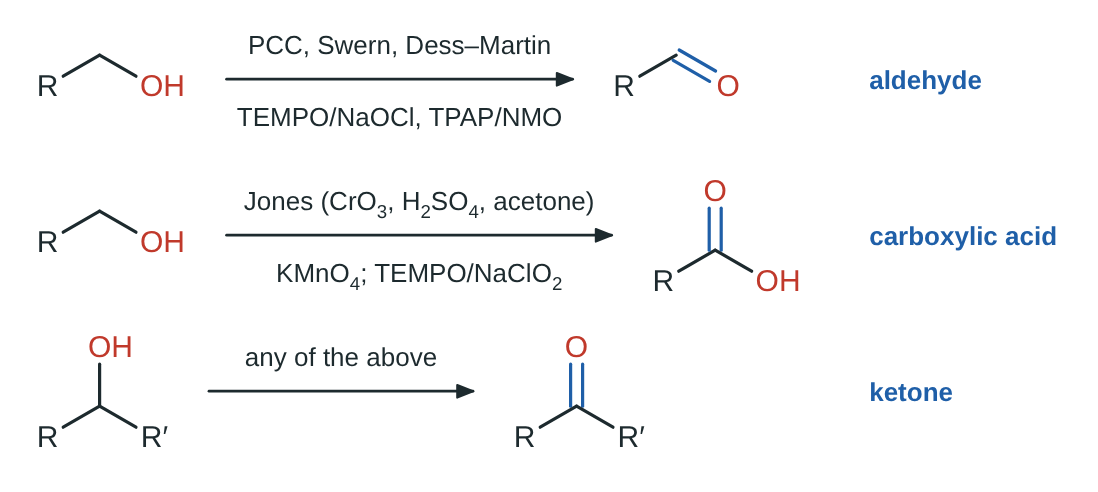
| Reagent | Conditions | Comment |
|---|---|---|
| Jones: CrO3, H2SO4 | acetone, 0 °C | Primary → acids; acidic and uses carcinogenic Cr(VI) |
| PCC (pyridinium chlorochromate) | CH2Cl2 | Stops at the aldehyde; also Cr(VI) |
| Swern: DMSO, (COCl)2, Et3N | −78 °C | Very mild; releases foul-smelling Me2S |
| Dess–Martin (periodinane) | CH2Cl2, r.t. | Neutral and fast; expensive, shock-sensitive reagent |
| TEMPO (cat.), NaOCl, KBr | CH2Cl2/H2O, 0 °C | Cheap and scalable; selective for primary alcohols |
| MnO2 | CH2Cl2, r.t. | Allylic and benzylic alcohols only |
The Swern oxidation
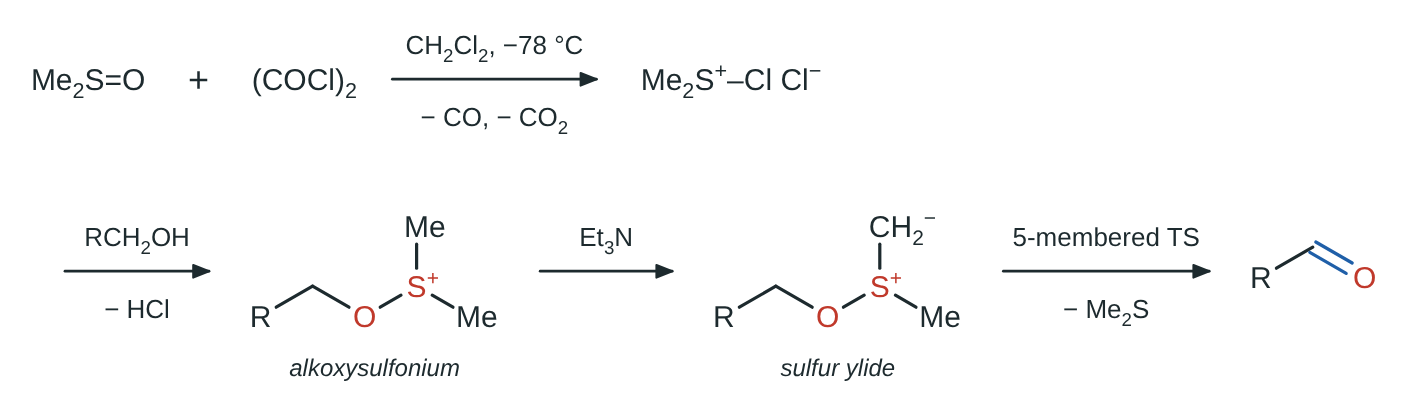
DMSO is activated with oxalyl chloride at −78 °C to form chlorodimethylsulfonium chloride, with loss of CO and CO2. The alcohol displaces chloride and forms an alkoxysulfonium salt; triethylamine removes a proton from a methyl group, and the resulting sulfur ylide takes the hydrogen from the carbon bearing the oxygen through a five-membered transition state. The carbonyl compound and dimethyl sulfide are formed (Daniel Swern and Kanji Omura, 1978).
Phenols
Phenols cannot be oxidized to a carbonyl without losing aromaticity, but those with an OH or NH2 ortho or para are easily oxidized to quinones: hydroquinone gives p-benzoquinone with dichromate or iron(III) salts, and phenol does so with Fremy’s salt, (KSO3)2NO. The hydroquinone/quinone pair is a reversible redox system found in the respiratory chain (ubiquinone). Review the reactivity of phenols.
Barton–McCombie deoxygenation
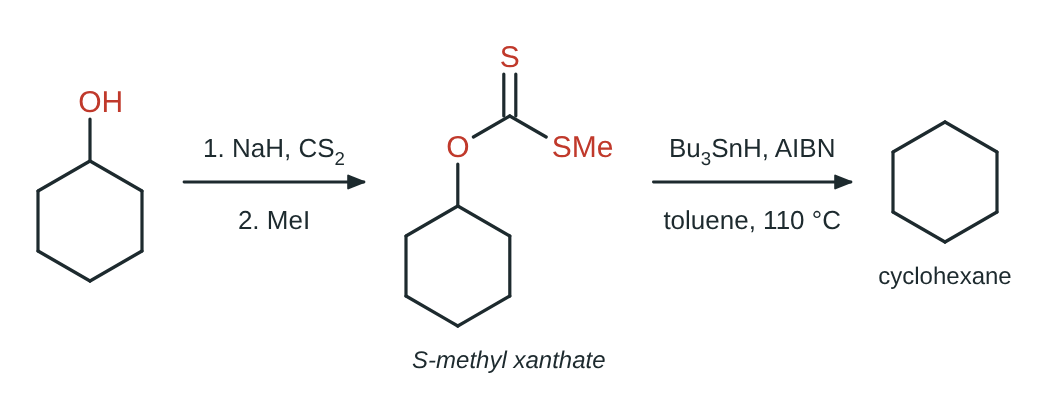
The OH group cannot be replaced directly by a hydrogen. In the Barton–McCombie method (1975), the alcohol is converted into an S-methyl xanthate, which is treated with Bu3SnH and AIBN. The stannyl radical attacks the thiocarbonyl sulfur, the intermediate fragments into the alkyl radical and the dithiocarbonate, and the radical takes a hydrogen from the stannane. It works very well with secondary alcohols, whose tosylates are poorly reduced by LiAlH4.