
Amines and anilines
Most amines are prepared by reduction of more oxidized nitrogen groups: nitro, nitrile, amide, azide or imine. The oxidation of amines, on the other hand, gives N-oxides, hydroxylamines and nitro compounds, and is used mainly to prepare intermediates.
Reduction of nitro compounds
Nitration followed by reduction is the classic route to anilines. The nitro group accepts six electrons and six protons in three stages, through the nitroso compound and the hydroxylamine. It is reduced with hydrogen and a catalyst or with metals in acid: iron and hydrochloric acid (Béchamp, 1854) were for a century the industrial method for making aniline for dyes. With zinc and ammonium chloride, under nearly neutral conditions, reduction stops at the arylhydroxylamine.

SnCl2 and iron are chemoselective: they reduce the nitro group without touching esters, nitriles or aryl halogens, which hydrogenation over palladium might remove. Review the preparation of amines by reduction and nitroalkanes.
Reductive amination
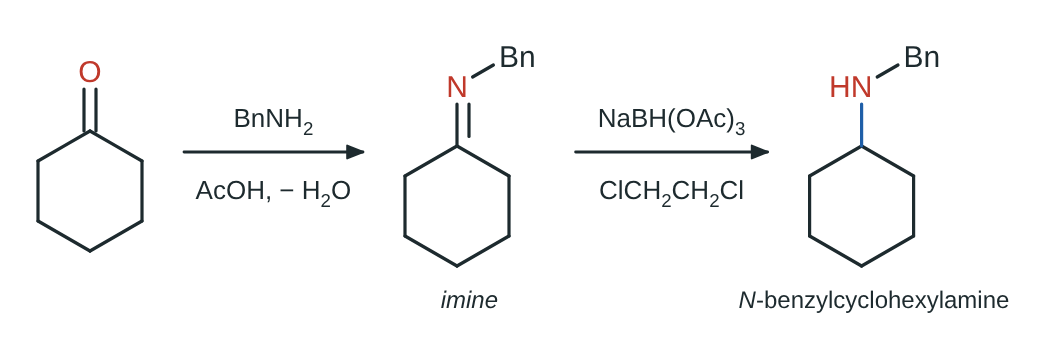
An aldehyde or a ketone and an amine form an imine or an iminium ion in mildly acidic medium, which a selective hydride reduces to the amine. Sodium triacetoxyborohydride, NaBH(OAc)3, and sodium cyanoborohydride, NaBH3CN, reduce the iminium ion much faster than the starting carbonyl compound, so the reaction is carried out in a single step. Unlike alkylation with halides, it does not give mixtures of more highly substituted amines.
Nitriles, amides and azides
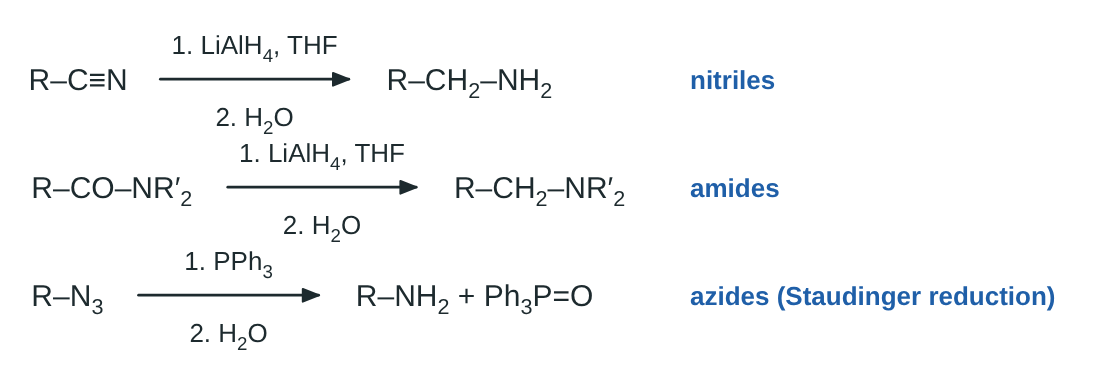
LiAlH4 reduces nitriles to primary amines, with one carbon more than the halide from which the nitrile was made, and amides to amines, without losing the carbonyl carbon. Azides, obtained by SN2 of a halide with sodium azide (azides), are an NH2− equivalent that does not polyalkylate. They are reduced with hydrogen and palladium or, under very mild conditions, with triphenylphosphine: in the Staudinger reaction the phosphine attacks the azide, N2 is lost and the iminophosphorane is hydrolysed to the amine and triphenylphosphine oxide.
Oxidation of amines
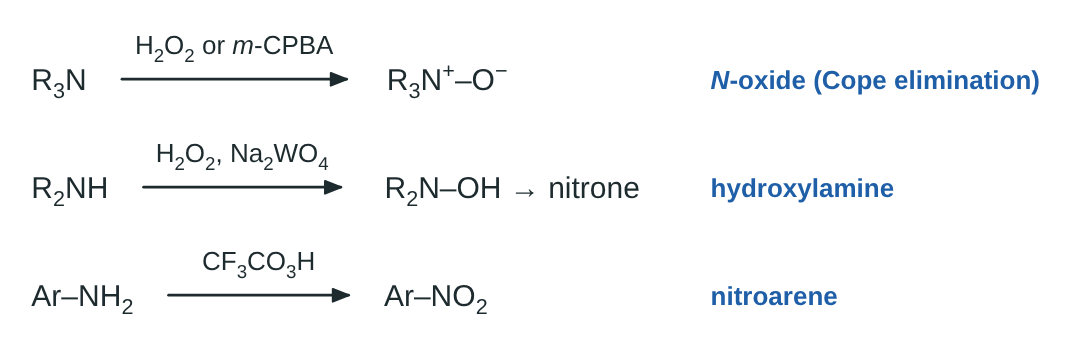
Tertiary amines give N-oxides with H2O2 or peracids; on heating they undergo the Cope elimination. Trifluoroperacetic acid oxidizes anilines all the way to the nitro group, which allows nitro groups to be introduced in positions that nitration cannot reach.