
Aldehydes and ketones
Aldehydes and ketones are reduced to alcohols with metal hydrides, and all the way to CH2 by the Clemmensen and Wolff–Kishner reductions. The choice of hydride determines the chemoselectivity and the stereochemistry of the alcohol. On oxidation, aldehydes give acids and ketones give esters (Baeyer–Villiger reaction).
Reduction with hydrides
Mild NaBH4 reduces aldehydes and ketones in alcohol solvents without affecting esters, amides or nitriles; the much more reactive LiAlH4 reduces all carbonyl groups and reacts violently with water. Review the reduction of carbonyls in Organic Chemistry made transparent.
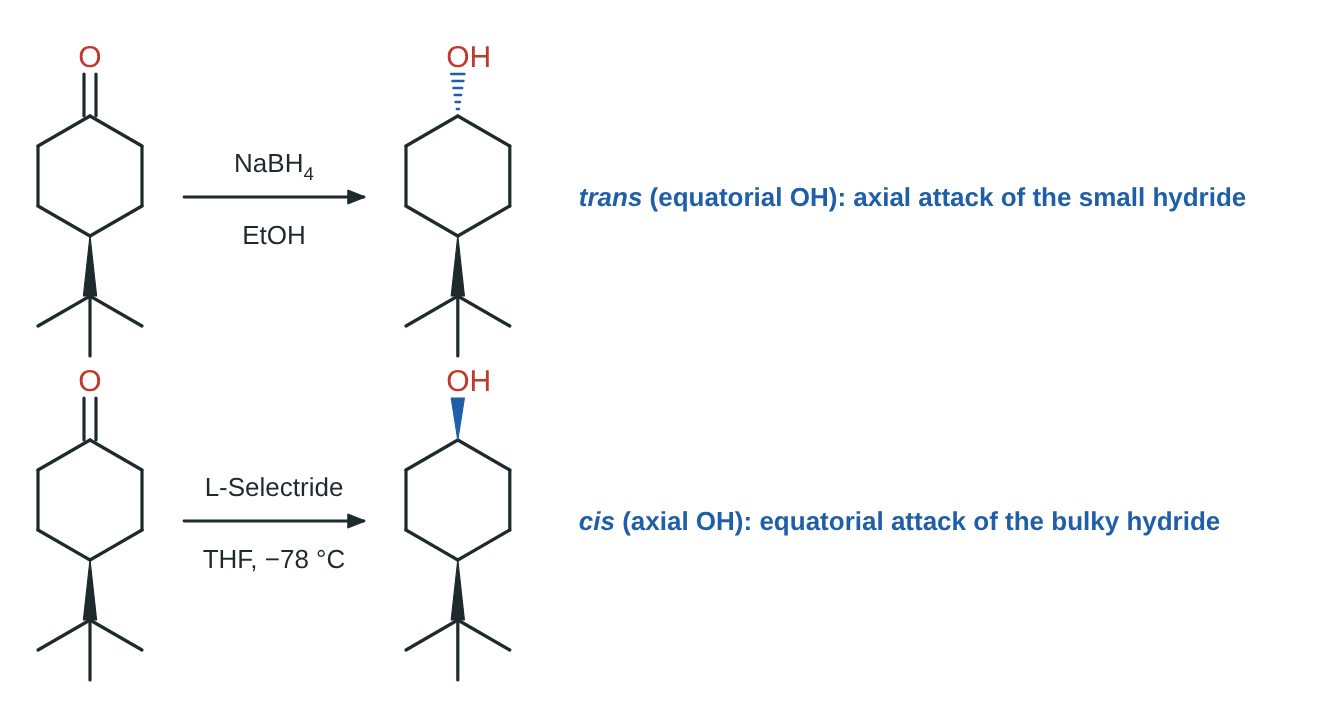
In cyclohexanones, the size of the hydride controls the stereochemistry. Small hydrides attack preferentially from the axial face, which avoids torsional interaction with the neighbouring C–H bonds, and give the more stable equatorial alcohol. Bulky ones, such as L-Selectride (lithium tri-sec-butylborohydride), attack from the less hindered equatorial face and give the axial alcohol.
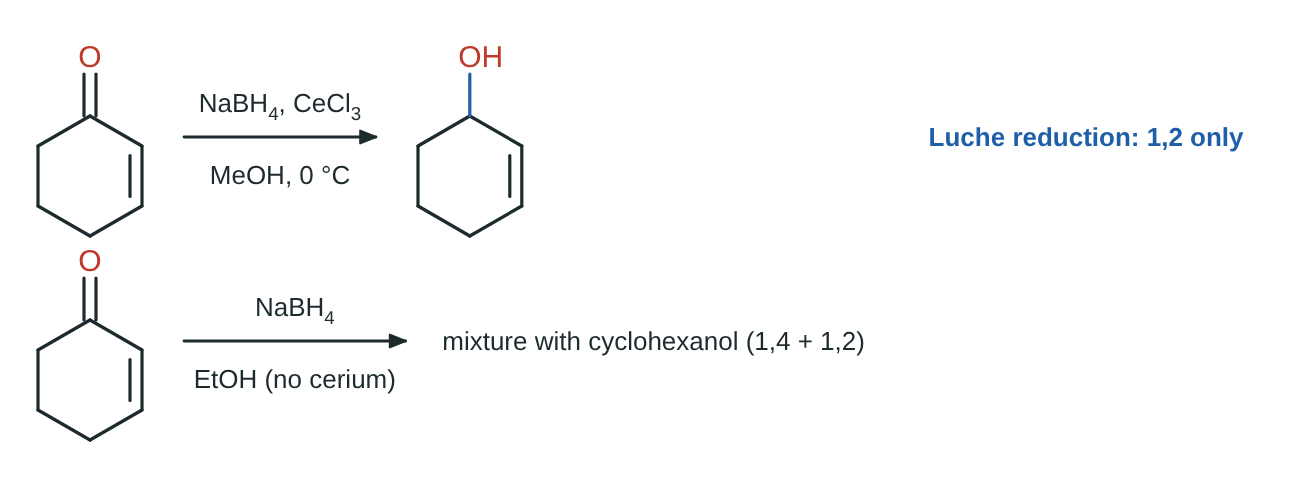
With enones, NaBH4 gives mixtures of 1,2- and 1,4-addition. In the Luche reduction CeCl3 is added in methanol: cerium activates the carbonyl and harder methoxyborohydrides are formed, which attack only the carbonyl and give the allylic alcohol. For the enantioselective reduction of ketones the chiral catalysts of Corey–Bakshi–Shibata (oxazaborolidines) or Noyori (ruthenium–BINAP) are used.
Deoxygenation: from C=O to CH2
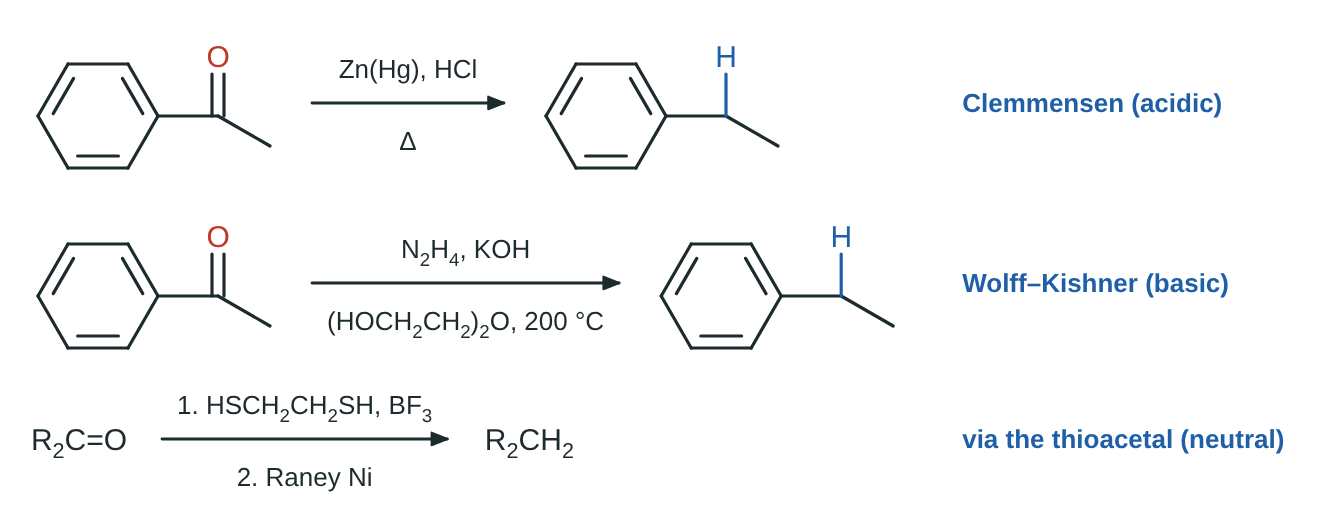
The Clemmensen reduction (1913) uses zinc amalgam in hot concentrated hydrochloric acid, and is useful for the aryl ketones obtained by Friedel–Crafts acylation. The Wolff–Kishner reduction (Ludwig Wolff and Nikolai Kizhner, 1911–1912) forms the hydrazone, which under basic conditions at high temperature loses N2 and gives the carbanion, which is protonated; the Huang Minlon variant does it in a single step in diethylene glycol. They are complementary: the one that tolerates the other groups in the molecule is chosen. A third route, under neutral conditions, is the desulfurization of a thioacetal with Raney nickel.
Oxidation: aldehydes and the Baeyer–Villiger reaction
Aldehydes are oxidized to acids very easily (oxidation of carbonyls); the mildest method is that of Pinnick, with sodium chlorite and a scavenger for the hypochlorite formed (2-methylbut-2-ene), which spares double bonds and adjacent stereocentres. Ketones are not easily oxidized, but peracids insert an oxygen atom between the carbonyl and one of the adjacent carbons to form an ester or a lactone: this is the Baeyer–Villiger reaction (1899).
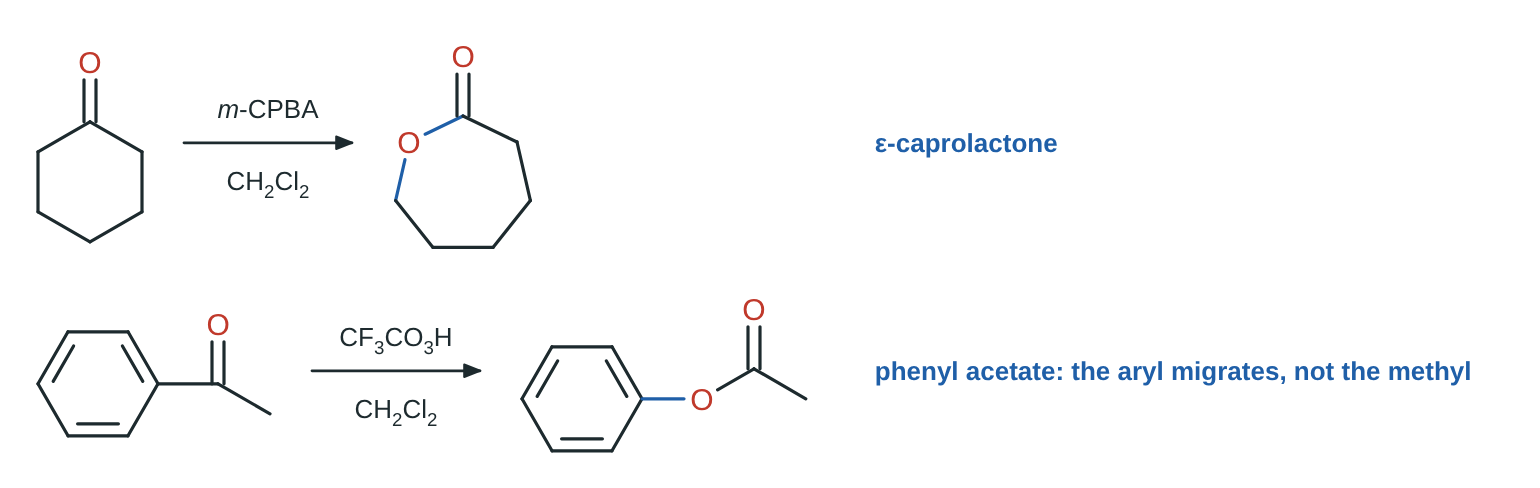
The peracid adds to the carbonyl and forms the Criegee intermediate; one of the groups migrates to oxygen as the carboxylate leaves. The group that best stabilizes the partial positive charge migrates: H > tertiary alkyl > cyclohexyl ≈ secondary ≈ aryl > primary > methyl. The group migrates with retention of configuration.