Carboxylic acids and derivatives
Carboxylic acids and their derivatives are at the highest oxidation state of carbon in common organic compounds, apart from CO2. Their redox chemistry is mainly reduction: depending on the reagent it stops at the aldehyde or goes on to the alcohol or the amine. Radical decarboxylations are studied as oxidations.
Reduction: which reagent for which product
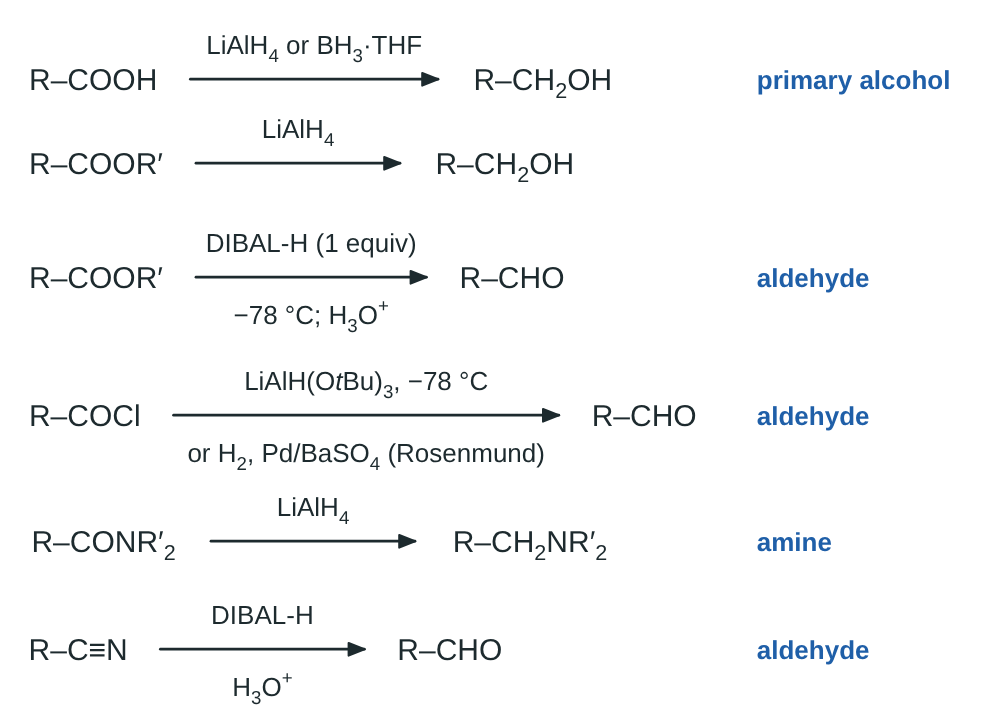
LiAlH4 reduces all acid derivatives. With esters, the intermediate aldehyde is more reactive than the ester and is reduced at once to the alcohol; with amides, the oxygen leaves as aluminate and an iminium ion forms, which is reduced to the amine (reduction of carboxylic acids, reactivity of esters).
Borane (BH3·THF or BH3·SMe2) is an electrophilic Lewis acid: it reacts rapidly with electron-rich carboxylic acids, through a triacyloxyborane, and very slowly with esters. It therefore reduces an acid in the presence of an ester, exactly the opposite of nucleophilic hydrides.
Stopping at the aldehyde
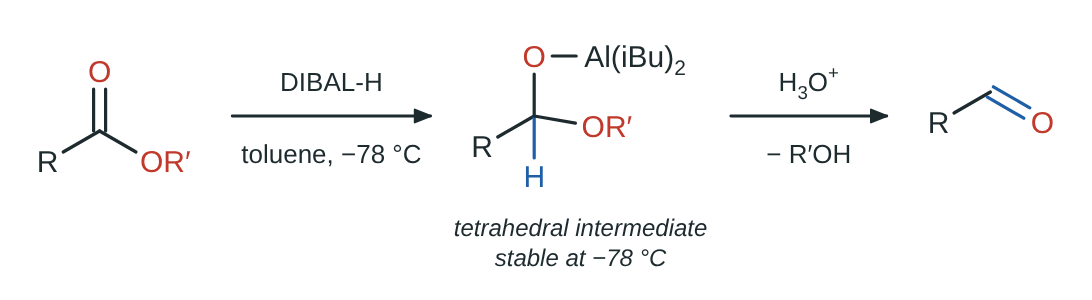
Diisobutylaluminium hydride (DIBAL-H) is a Lewis acid that coordinates to the carbonyl oxygen and transfers a single hydride. At −78 °C the tetrahedral intermediate is stable and does not expel the alkoxide; on hydrolysis the aldehyde is released, when no reducing agent is left. With nitriles it gives an aluminium imine, which is also hydrolysed to the aldehyde.
The more reactive acid chlorides are reduced to the aldehyde with a weakly reactive hydride, lithium tri-tert-butoxyaluminium hydride, or by hydrogenation over palladium poisoned with barium sulfate (Rosenmund reduction, 1918), in which the weakly active catalyst does not reduce the aldehyde formed. Weinreb amides give aldehydes with LiAlH4 or DIBAL-H, for the same reason they give ketones with Grignard reagents.
Radical decarboxylations
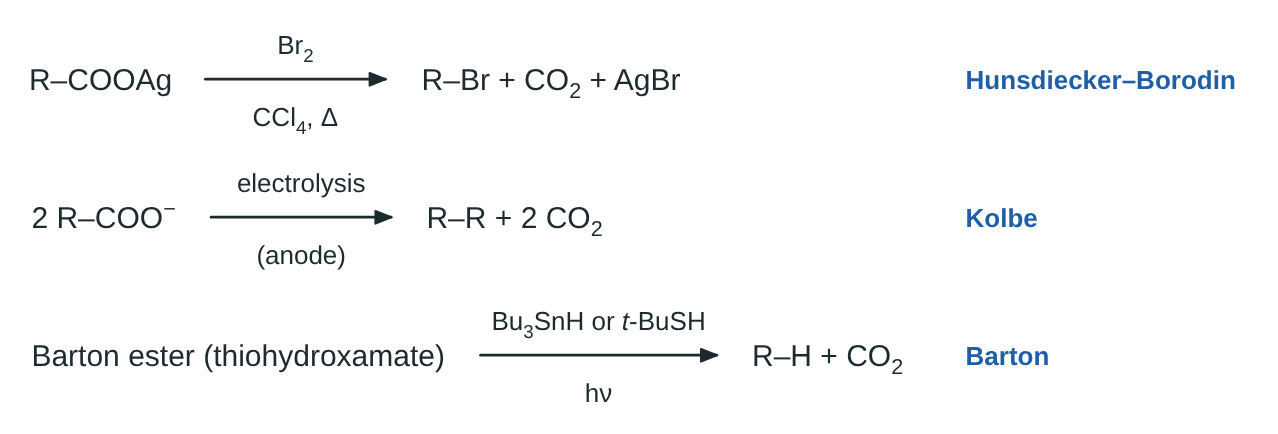
Acyloxy radicals, RCO2•, lose CO2 very easily to give the alkyl radical. In the Hunsdiecker reaction (described by Borodin in 1861 and developed by Heinz and Cläre Hunsdiecker in 1939) the silver salt of the acid and bromine form an acyl hypobromite, whose homolytic cleavage leads to the alkyl bromide with one carbon fewer. In the Kolbe electrolysis the carboxylate is oxidized at the anode and the radicals dimerize. Barton esters (thiohydroxamates) generate the radicals with light and allow them to be reduced to R–H or trapped with other reagents.