
Organolithiums, Grignard reagents and cuprates
In the organometallic compounds of the most electropositive metals (lithium, magnesium) the C–metal bond is strongly polarized towards carbon, which behaves like a carbanion: it is both a very strong base and a good nucleophile. The softer cuprates add in a conjugate fashion to enones and displace halides.
Preparation
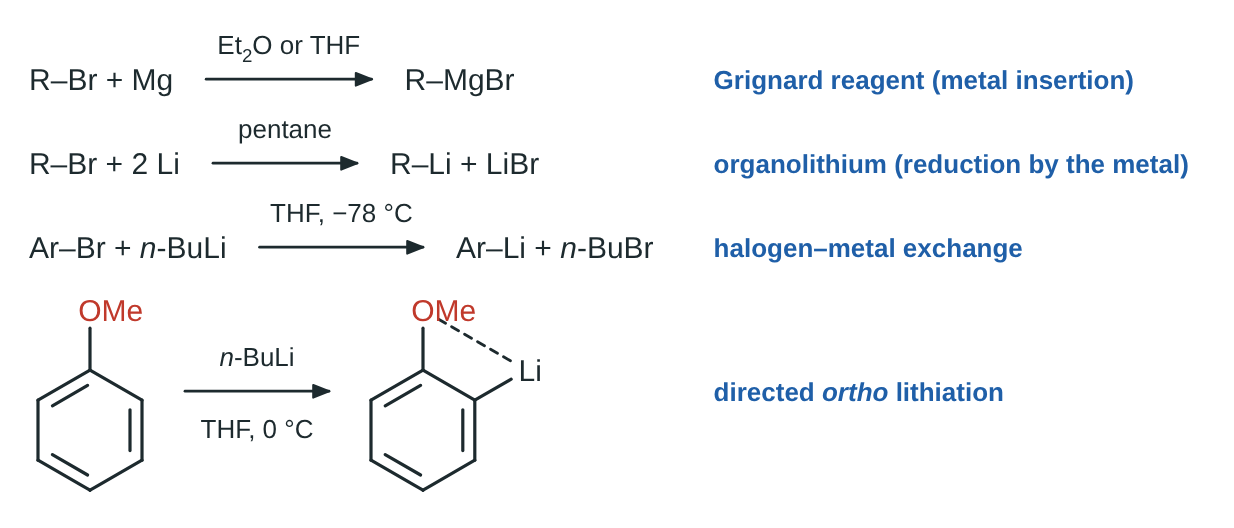
Grignard reagents are formed by insertion of magnesium metal into the C–halogen bond of an alkyl, alkenyl or aryl halide, in dry diethyl ether or THF; the ether coordinates to magnesium and stabilizes the reagent. Organolithiums are obtained in a similar way, by reduction of the halide with two equivalents of lithium. Review the formation of organometallic reagents in Organic Chemistry made transparent.
Two further methods give access to organolithiums that cannot be made from the metal:
- Halogen–metal exchange: an aryl or vinyl bromide or iodide reacts very rapidly, at −78 °C, with n-BuLi or t-BuLi. The equilibrium lies on the side of the more stable organolithium, the one on the sp2 carbon, and tolerates groups that would not survive the preparation with lithium metal.
- Deprotonation of an acidic C–H with an alkyllithium or a lithium amide. A heteroatom with lone pairs (OMe, CONR2, OCONR2) coordinates lithium and directs deprotonation to the adjacent ortho position: this is directed ortho metalation, which allows electrophiles to be introduced with a regioselectivity impossible in electrophilic aromatic substitution.
Organolithiums and Grignard reagents are not monomers: in solution they form aggregates (dimers, tetramers, hexamers) whose size depends on the solvent. Additives that break up the aggregates, such as TMEDA or HMPA, greatly increase their reactivity. Grignard reagents are also subject to the Schlenk equilibrium, 2 RMgX ⇌ R2Mg + MgX2.
Addition to carbonyl compounds
Organolithiums and Grignard reagents add to aldehydes and ketones and, after hydrolysis, give secondary and tertiary alcohols (addition of organometallics). With esters and acid chlorides the intermediate ketone is more reactive than the starting material and a second equivalent adds, so that the tertiary alcohol is obtained. With very hindered or easily enolized ketones, enolization and reduction by β-hydride transfer compete; anhydrous cerium(III) chloride, which forms less basic and highly oxophilic organocerium reagents, favours addition.
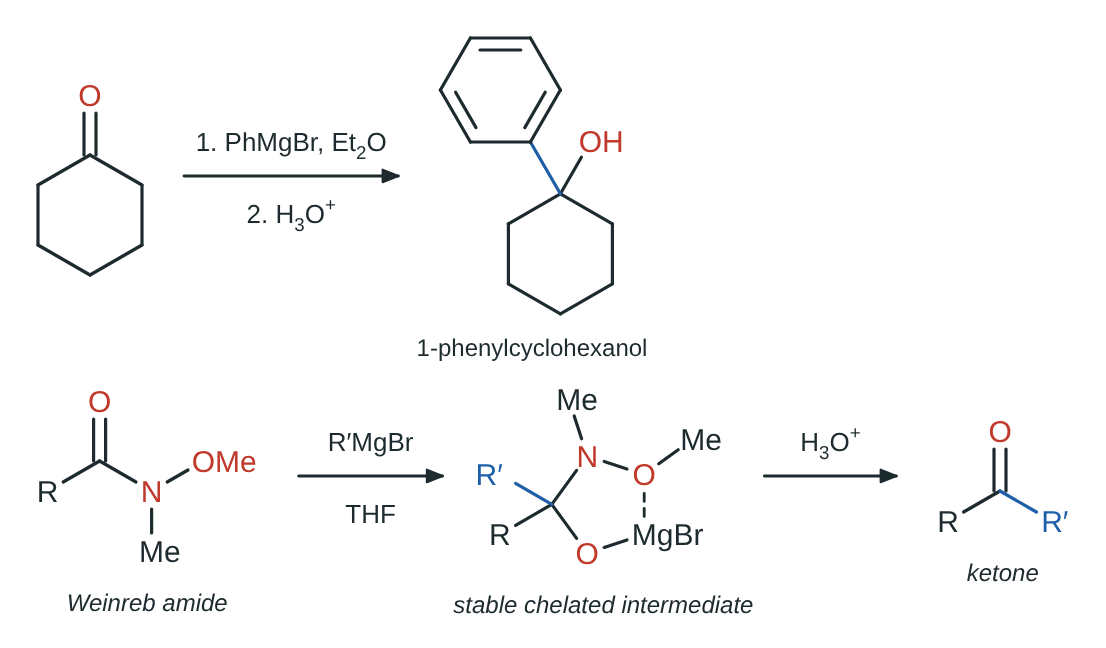
To stop the reaction at the ketone, Weinreb amides, N-methoxy-N-methylamides, are used (Steven M. Weinreb and Steven Nahm, 1981). The tetrahedral intermediate is chelated by the metal between the two oxygens, is stable at the reaction temperature and does not expel the amine until it is hydrolysed: by then no organometallic reagent is left to attack the ketone.
Cuprates
Two equivalents of an organolithium and a copper(I) salt form a lithium diorganocuprate, R2CuLi, the Gilman reagent. Cuprates are soft, weakly basic nucleophiles: they do not add to ketones at low temperature, but they do add to the β position of enones (conjugate addition), and they displace alkyl, alkenyl and aryl halides, tosylates and epoxides. With acid chlorides they give ketones (organocuprates and acid halides).
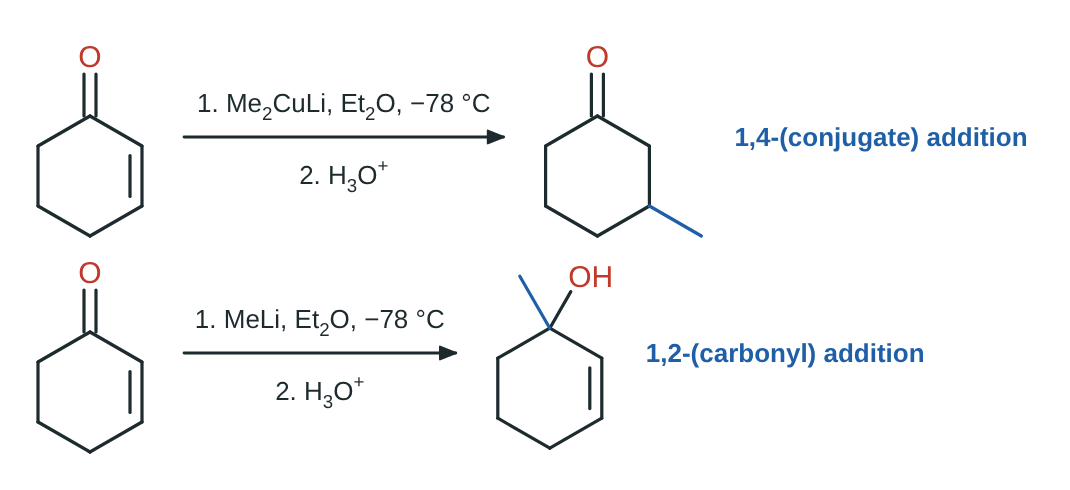
Conjugate addition is thought to begin with formation of a π complex between copper and the double bond, followed by an oxidative addition that gives a copper(III) intermediate and a reductive elimination that forms the C–C bond: the same elementary steps studied in the catalytic cycle. The enolate formed can be trapped with an electrophile, for example an alkyl halide or a chlorosilane.
Magnesium reagents were discovered by Victor Grignard in 1900. Compare the conjugate addition of cuprates with the Michael addition of enolates.