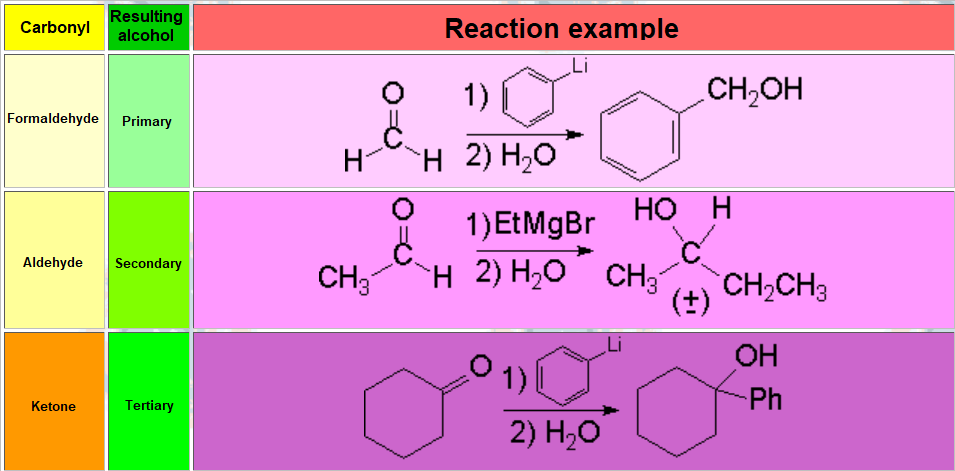
Addition of Organometallic Reagents
A carbon atom bonded to a metal, which is much less electronegative, is turned into an electron rich center and an excellent nucleophile. The C-Metal bond is heavily polar.
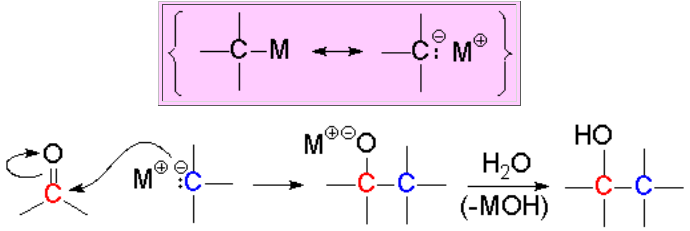
The C–M bond is so polarized that the carbon behaves almost like a carbanion (structure on the right, inside the braces). This nucleophilic carbon (in blue) attacks the electrophilic carbon of the carbonyl group (in red): a new C–C bond is formed and the oxygen ends up as a metal alkoxide. When water is added, the alkoxide is protonated and the alcohol is obtained.
The most common reagents are the organolithium and the organomagnesium (Grignard) derivatives.

Organometallics have to be used right after their preparation because they are so reactive that they are easily and violently destroyed by oxygen and moisture. Their preparation and use must be carried out under an inert atmosphere (N2 or Ar).
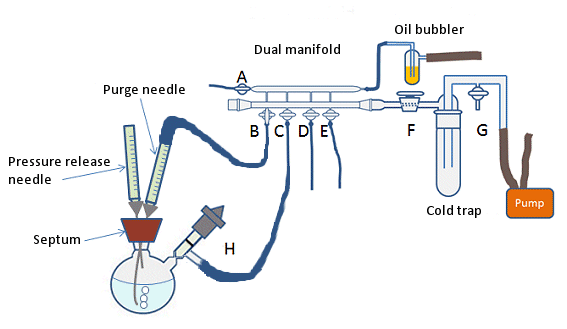

The corresponding alkane is an extremely weak acid (pKa > 50), so the carbon of the organometallic is an extremely strong base. Water, alcohols or simply the moisture in the air protonate it at once and turn it into the alkane, releasing a lot of heat. That is why anhydrous solvents and an inert atmosphere are used, and why the molecule cannot contain acidic groups such as OH, NH or COOH.
Depending on the structure of the carbonyl group, the resulting alcohol will be differently substituted: