
Enolization and enolate ions
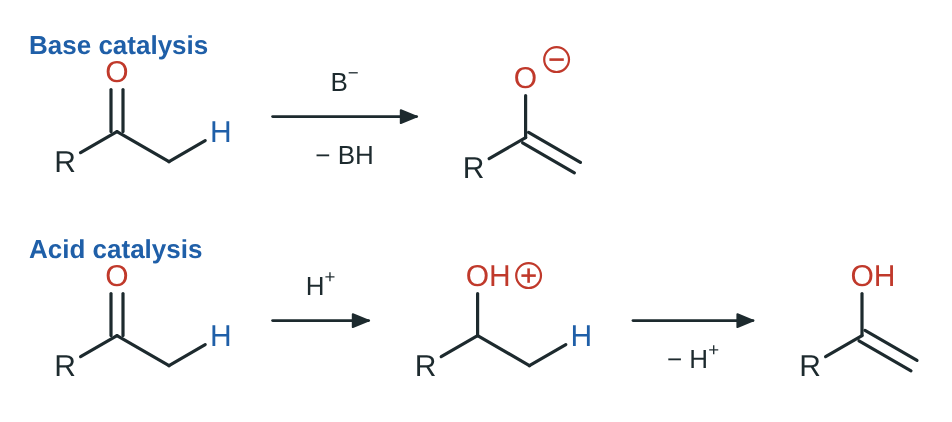
The hydrogens on the carbon next to a carbonyl group (α hydrogens) are acidic: when they are removed, the negative charge is shared between the carbon and the oxygen. The conjugate base, the enolate ion, is the most important carbon nucleophile in organic synthesis.
Keto–enol tautomerism
An aldehyde or ketone bearing α hydrogens is in equilibrium with its enol, an isomer in which that hydrogen has moved to the oxygen and the C=O double bond has become a C=C bond. The two tautomers interconvert quickly in the presence of traces of acid or base, but for simple monocarbonyl compounds the equilibrium lies far towards the keto form.
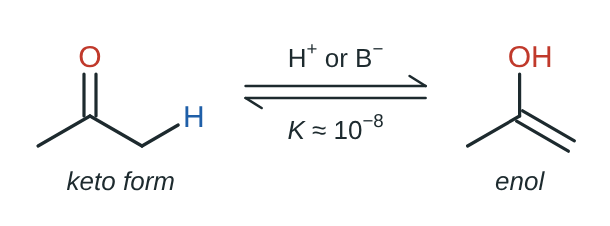
In 1,3-dicarbonyl compounds the situation changes: the enol is conjugated and forms an intramolecular hydrogen bond, so acetylacetone (2,4-pentanedione) is mostly enolized. Enolization is catalysed by acids and by bases; in both cases the key step is the loss of the α proton:
Review these ideas in the acid–base properties of aldehydes and ketones and in α-halogenation, which proceeds through the enol or the enolate.
The acidity of α hydrogens
Acidity depends on how well the neighbouring group stabilizes the charge. A single ketone carbonyl puts the pKa at about 19–20; esters, whose carbonyl is already “busy” with the electron donation of the alkoxy oxygen, are less acidic; and two electron-withdrawing groups on the same carbon bring the pKa down to values comparable to those of phenols or water:
| Compound | Acidic hydrogen | pKa (approx.) |
|---|---|---|
| Ethyl acetate | CH3CO2Et | 25 |
| Acetonitrile | CH3CN | 25 |
| Acetone | CH3COCH3 | 19-20 |
| Acetaldehyde | CH3CHO | 17 |
| Diethyl malonate | CH2(CO2Et)2 | 13 |
| Ethyl acetoacetate | CH3COCH2CO2Et | 11 |
| Nitromethane | CH3NO2 | 10 |
| Acetylacetone | CH3COCH2COCH3 | 9 |
Meldrum's acid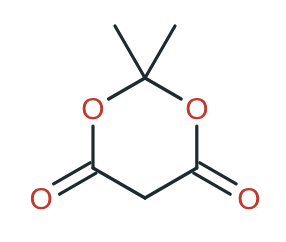 | ring CH2 | 4.8 |
For reference, water has a pKa of 15.7, ethanol 16, tert-butanol 18 and diisopropylamine 36. The values refer to water or are extrapolated to it; in DMSO they are all higher, but the order is the same.
Choosing the base
With an alkoxide (pKa 16–18) the deprotonation of a ketone is partial: ketone, enolate and alcohol coexist, and the enolate can attack the ketone itself (aldol condensation) or exchange protons. To alkylate cleanly, all the carbonyl compound must be turned into the enolate before the electrophile is added, which calls for a much stronger, non-nucleophilic base. The most widely used is lithium diisopropylamide (LDA), prepared just before use from diisopropylamine and butyllithium:
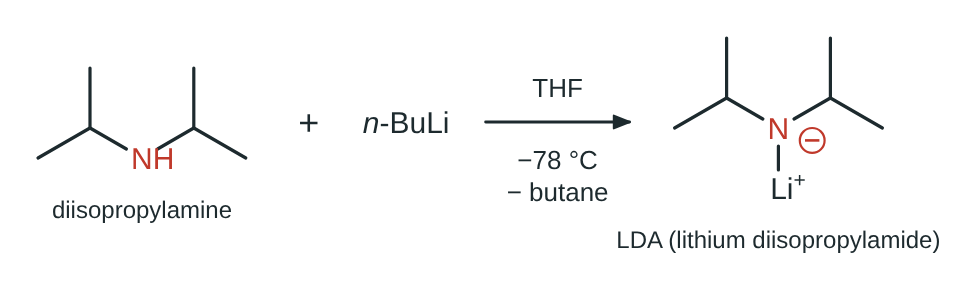
The isopropyl groups make LDA a very strong base but a very poor nucleophile: it removes protons without attacking the carbonyl. Other bases of this kind are lithium, sodium or potassium hexamethyldisilazide (LiHMDS, NaHMDS, KHMDS) and sodium hydride.
The enolate, an ambident nucleophile
The charge of the enolate is shared between the α carbon and the oxygen, so it can react through either of them: it is an ambident nucleophile. With alkyl halides C-alkylation, which forms a C–C bond, is the usual outcome; O-alkylation gives enol ethers.
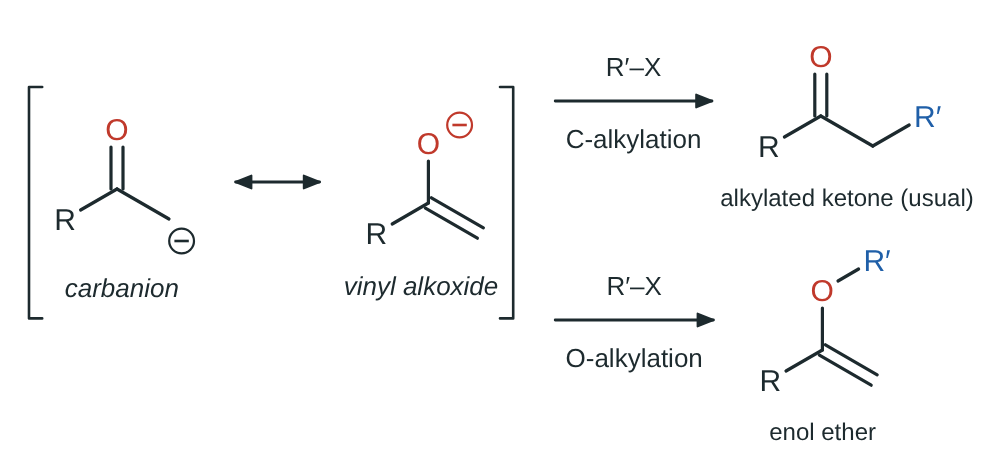
The oxygen carries most of the charge and reacts with “hard” electrophiles (silyl chlorides, alkyl sulfates, trialkyloxonium salts), especially with large counterions such as K+ and in polar aprotic solvents that leave the enolate “naked” (DMSO, HMPA). The softer, more polarizable carbon reacts preferably with alkyl iodides and bromides, all the more so with Li+ as the counterion, which binds tightly to the oxygen.
In solution, lithium enolates are not free ions: they form aggregates (dimers, tetramers) in which lithium is coordinated to the oxygen of several enolates and to molecules of solvent or of additives such as TMEDA. The degree of aggregation affects both reactivity and selectivity.