
Organometallic Reagents
A carbon bonded to a metal, of much lower electronegativity, becomes an electron-rich centre and hence a nucleophile. The C-Metal bond is very polar.
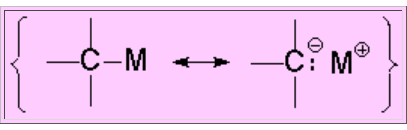
Organometallic compounds are prepared by treating a halogenated derivative with a metal. The most common ones are those of lithium and magnesium. Organomagnesium compounds are called Grignard reagents.
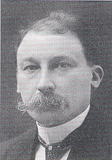
Victor Grignard (1871-1935): French chemist. In 1900 he discovered the organomagnesium reagents that bear his name. This discovery earned him the 1912 Nobel Prize in Chemistry, shared with Sabatier. He was the author of a 20-volume treatise on organic chemistry.

Organometallics have to be used right after their preparation because they are so reactive that they are quickly and violently destroyed by oxygen and moisture. Their preparation and use must be carried out under inert atmosphere (N2 or Ar).

Organometallic reagents are very good carbon nucleophiles and are used to build new C-C bonds, the most important task in Organic Chemistry. Here are some examples:
