The catalytic cycle: oxidative addition, transmetalation and reductive elimination
Transition metals can change their oxidation state and their number of ligands easily. Thanks to this, a catalytic amount of a palladium, nickel, rhodium or ruthenium complex forms bonds that would be very difficult to form otherwise, through a cyclic sequence of elementary steps in which the catalyst is regenerated.
Electrons and ligands
Stable transition-metal complexes usually have 18 electrons in the valence shell of the metal (its d electrons plus those donated by the ligands), like the following noble gas; review the eighteen-electron rule. The square-planar complexes of Pd(II), Ni(II) and Rh(I), with a d8 configuration, are an important exception: they have 16 electrons. Active catalysts are usually species with fewer electrons, with vacant coordination sites, formed by dissociation of a ligand.
The most common ligands are phosphines. Their size (measured by the Tolman cone angle) and their donor ability control the reactivity of the metal: bulky, electron-rich phosphines such as P(t-Bu)3 or Buchwald’s dialkylbiarylphosphines favour the formation of very reactive monoligated complexes and accelerate oxidative addition and reductive elimination. N-Heterocyclic carbenes (NHCs) are even stronger donors and bind more tightly to the metal.
The elementary steps
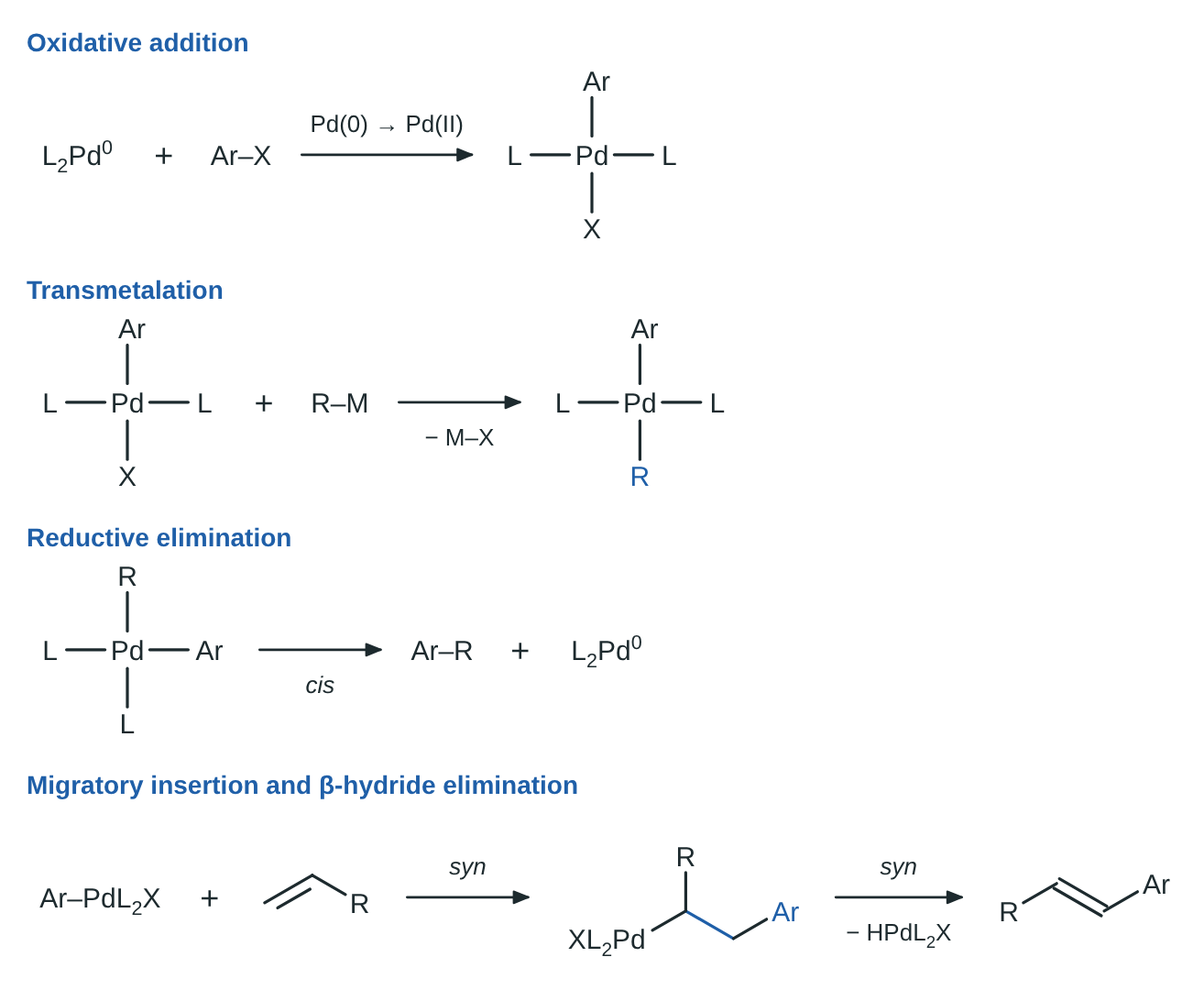
- Oxidative addition. The metal inserts into a σ bond (C–X, H–H); its oxidation state and its coordination number both increase by two. The ease depends on the bond being broken: Ar–I > Ar–Br ≈ Ar–OTf ≫ Ar–Cl.
- Transmetalation. An organic group is transferred from a more electropositive metal (B, Zn, Sn, Mg, Cu) to the transition metal, which gives up the halide in exchange. The oxidation state does not change.
- Reductive elimination. Two cis ligands couple and leave the metal, whose oxidation state decreases by two. It is the step that forms the C–C or C–N bond of the product, and it is the reverse of oxidative addition.
- Migratory insertion and β-hydride elimination. A coordinated alkene inserts into an M–C or M–H bond (syn addition of M and the group across the double bond). The reverse reaction, β-hydride elimination, requires a syn hydrogen on the β carbon and regenerates an alkene.
The catalytic cycle
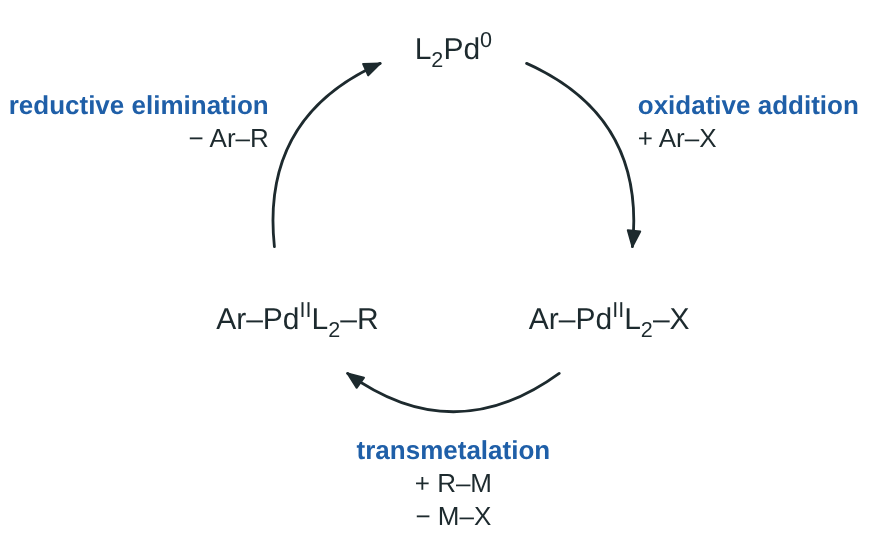
Combining these steps builds a cycle. The one for cross-coupling has three: oxidative addition of the organic halide to Pd(0), transmetalation and reductive elimination, which forms the product and returns Pd(0) to the cycle.
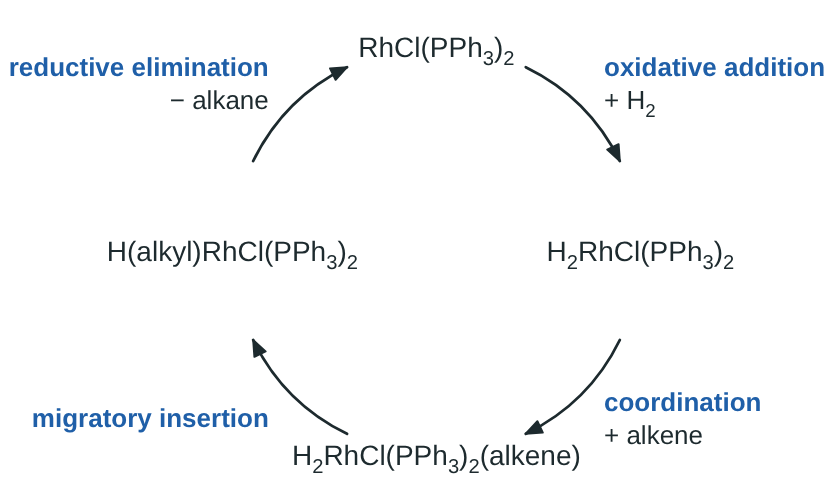
Another classic example is homogeneous hydrogenation with Wilkinson’s catalyst, RhCl(PPh3)3. After losing a phosphine, rhodium(I) oxidatively adds H2, coordinates the alkene, inserts it into an Rh–H bond and releases the alkane by reductive elimination. Being a bulky catalyst, it reduces less substituted double bonds in the presence of more substituted ones, which is difficult with heterogeneous hydrogenation.