
Michael (conjugate) addition
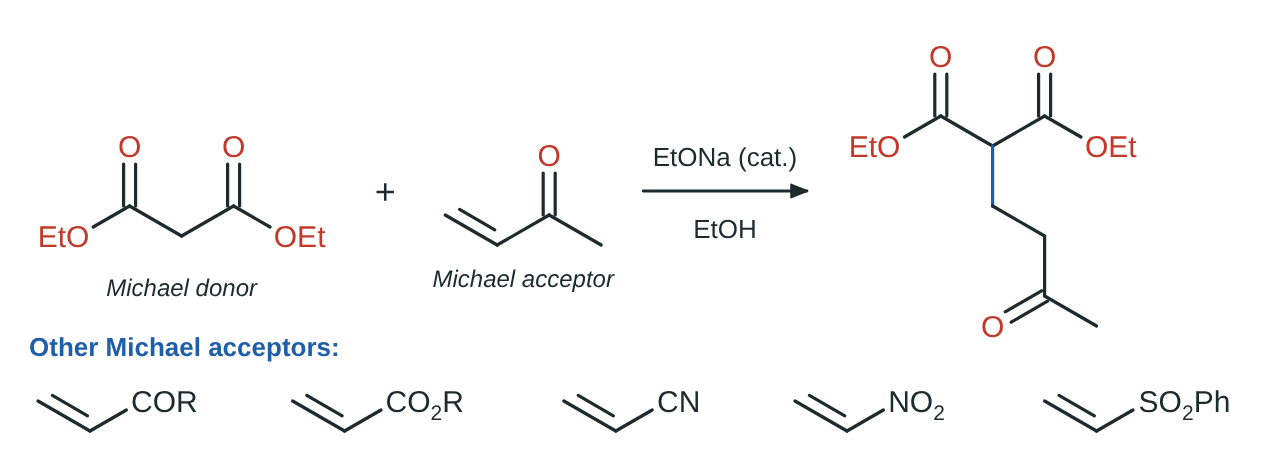
In conjugate addition or the Michael reaction, a stabilized carbon nucleophile adds to the β carbon of a C=C double bond activated by an electron-withdrawing group. It forms a bond α to one group and β to the other, and gives 1,5-dicarbonyl compounds.
An important method for alkylating carbon nucleophiles is their addition to an electrophilic multiple bond. The acceptor is usually an α,β-unsaturated ketone, aldehyde or ester, but other electron-withdrawing groups such as nitro, cyano or sulfonyl also activate C–C double and triple bonds towards nucleophilic attack. This is the Michael reaction:
Mechanism
The carbanion attacks the β carbon of the acceptor, and the negative charge moves to oxygen: a new enolate is formed, which is protonated by another molecule of the donor. That is why, with acidic donors such as malonate or acetoacetate, a catalytic amount of base is enough:
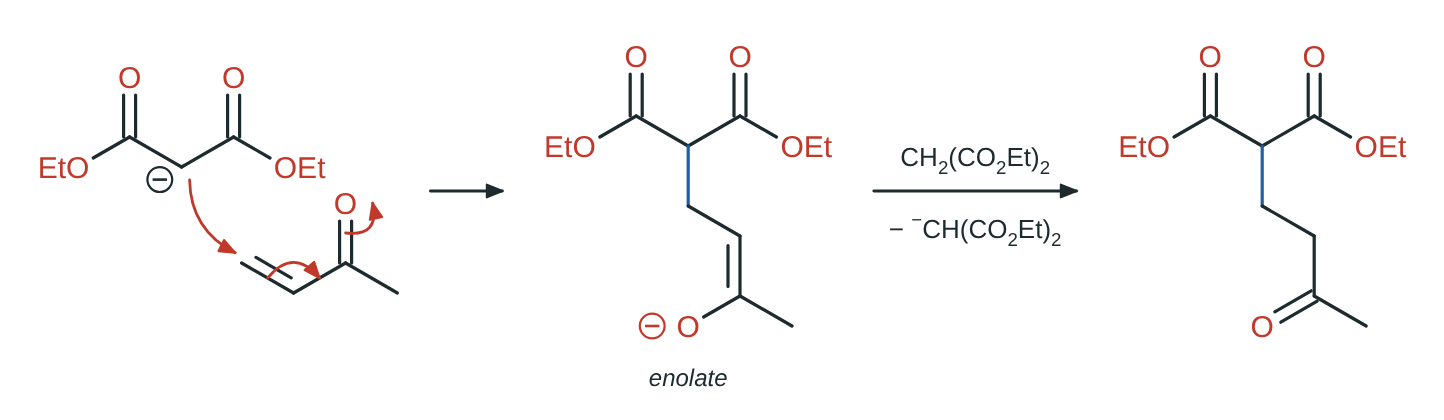
The combinations of electron-withdrawing groups that can act as anion stabilizers and alkene activators are very varied, so conjugate addition can build systems with two functional groups in a 1,5 relationship.
The Mukaiyama–Michael reaction
The scope of conjugate addition is extended by using Lewis acids with enolate equivalents, especially silyl enol ethers and silyl ketene acetals, as in the Mukaiyama aldol reaction. The adduct is stabilized by a new bond to the Lewis acid, and hydrolysis gives the product:
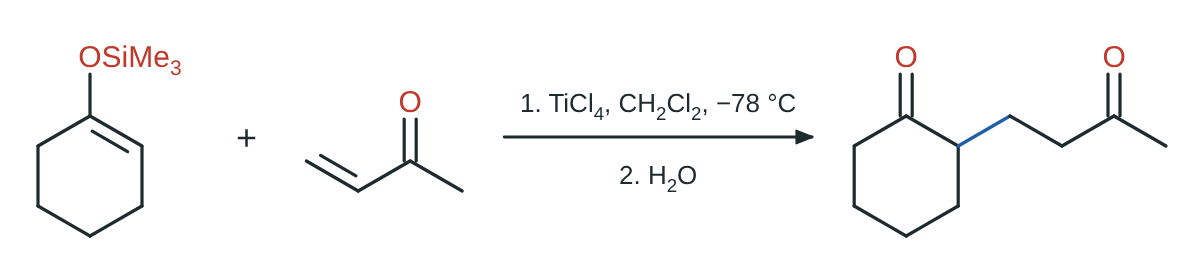
Early studies suggested that the Mukaiyama–Michael reaction proceeds through an open transition state, since it tends to give the anti product regardless of the geometry of the silyl enol ether; selectivity improves when Ti(O-i-Pr)4 is added.
Stereochemistry
If both the enolate and the acceptor carry substituents, syn or anti adducts can form. With lithium enolates the outcome depends on the enolate geometry: Z enolates favour anti adducts and E enolates favour syn adducts. This is explained by an eight-membered chelated transition state in which the enone adopts the s-cis conformation; that is why bulky substituents on the enone carbonyl, which favour that conformation, increase stereoselectivity. Computational studies also support this transition state.
Nitroalkenes
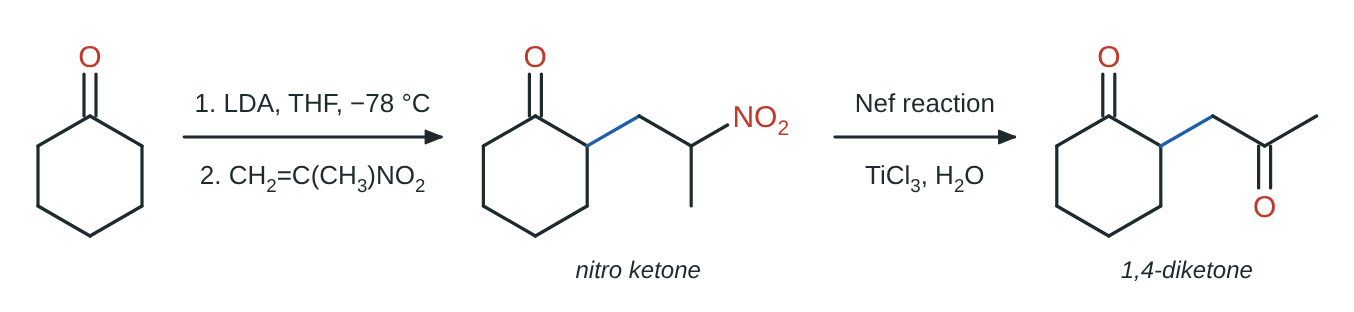
Nitroalkenes are excellent acceptors: the nitro group is strongly electron-withdrawing and is not usually attacked by the nucleophile. The nitro group can then be converted into a carbonyl by hydrolysis of its nitronate anion (Nef reaction; see topic 6), which allows 1,4-dicarbonyl compounds to be synthesized:
Tandem conjugate addition and alkylation
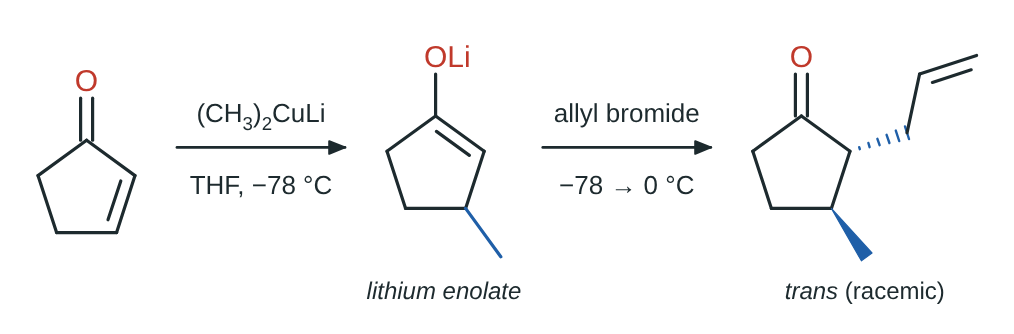
If the conjugate addition is carried out under aprotic conditions, with a stoichiometric amount of the nucleophile, the adduct remains as an enolate until a proton source is added. That enolate can be used for a second reaction by adding an alkyl halide or sulfonate: two new C–C bonds are thus formed in a single operation. The example uses a cuprate as the nucleophile (organocuprates are studied in topic 9); the electrophile enters from the face opposite to the group just introduced:
Review conjugate addition in Organic Chemistry made transparent. The combination of Michael addition and aldol condensation is the Robinson annulation.