
Umpolung (polarity inversion)
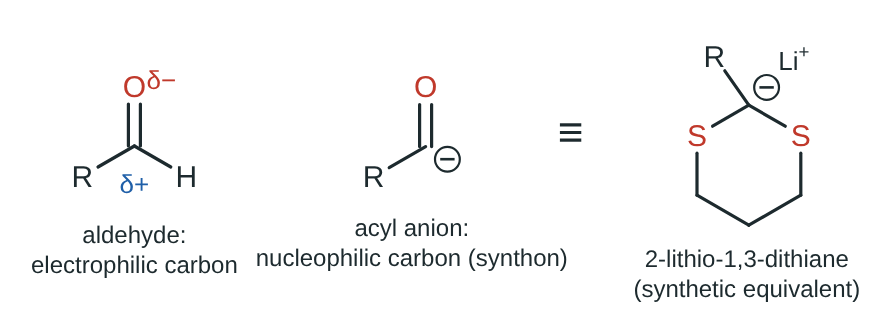
The German word umpolung means “polarity inversion”. It refers to the tactics that turn a normally electrophilic atom into a nucleophile, or vice versa. The classic example is the carbon of an aldehyde, which as a 1,3-dithiane is deprotonated and acts as a nucleophile.
The term was introduced by Dieter Seebach and E. J. Corey in the mid-1960s. Retrosynthetic analysis is also an analysis of polarities: many disconnections give synthons with the “natural” polarity of common reagents, but others call for a synthon that does not exist with that polarity, such as the acyl anion, R–C−=O. α-Hydroxy ketones and 1,4-dicarbonyl compounds are typical examples.
Dithiane chemistry
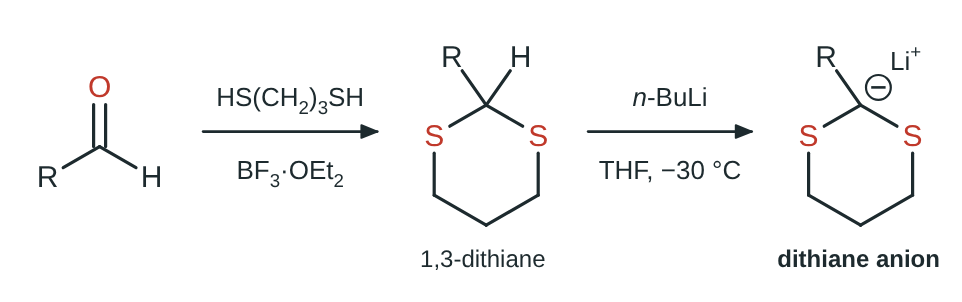
The Corey–Seebach reaction (1965) converts the aldehyde into a 1,3-dithiane by dithioacetalization with propane-1,3-dithiol and a Lewis acid. The proton on the carbon between the two sulfurs is relatively acidic (pKa ≈ 31), because the large, polarizable sulfur atoms stabilize the carbanion, and butyllithium removes it at −30 °C. The polarity of the formerly carbonyl carbon has been inverted.
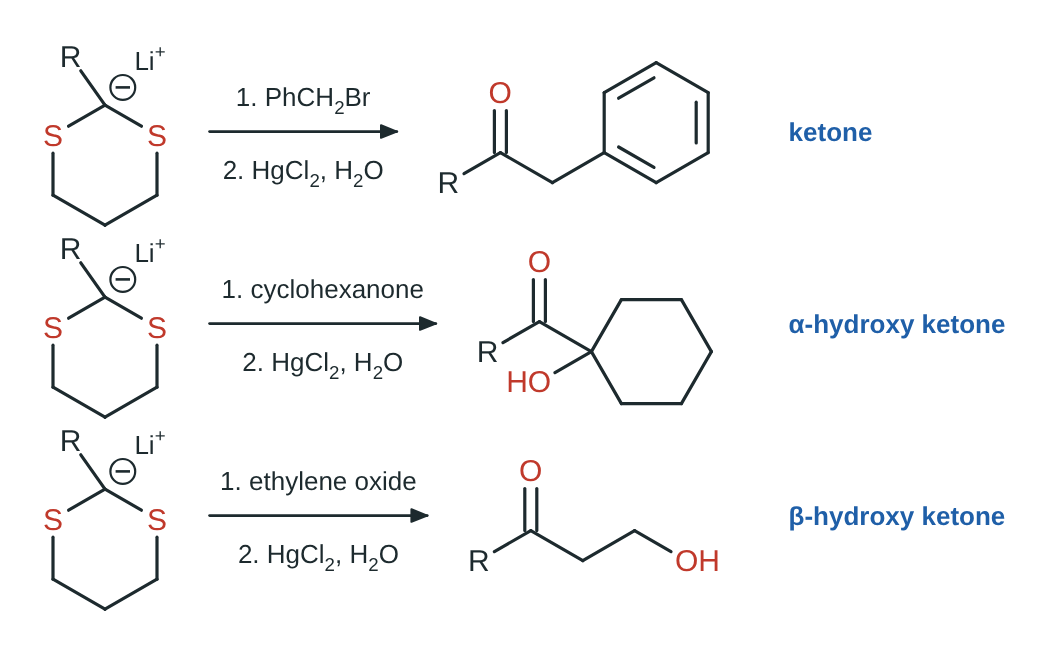
The dithiane anion reacts with primary alkyl halides, with aldehydes and ketones and with epoxides, and subsequent hydrolysis releases the carbonyl. As dithianes are very stable, deprotection requires mercury(II) salts (HgCl2 with CaCO3 in aqueous acetonitrile) or hypervalent iodine reagents, such as bis(trifluoroacetoxy)iodobenzene, PhI(OCOCF3)2. Ketones, α-hydroxy ketones and β-hydroxy ketones are thus obtained from aldehydes.
Other acyl anion equivalents
- The cyanide ion in the benzoin condensation: it adds to the aldehyde, and the deprotonated cyanohydrin attacks another aldehyde molecule. N-heterocyclic carbenes (thiazolium salts, like thiamine) do the same in the Stetter reaction.
- Nitroalkanes: the nitronate anion is nucleophilic, and the Nef reaction then converts the nitro group into a carbonyl (see nitronates).
- Lithiated enol ethers, such as 1-methoxyvinyllithium, an equivalent of the acetyl anion: after the addition, acid hydrolysis of the enol ether gives the methyl ketone.