
Functional group interconversion
A functional group interconversion (FGI) changes one group into another without modifying the carbon skeleton. In retrosynthesis it is used to reach a group that allows a disconnection, or to replace a group that is hard to introduce with an easier one.
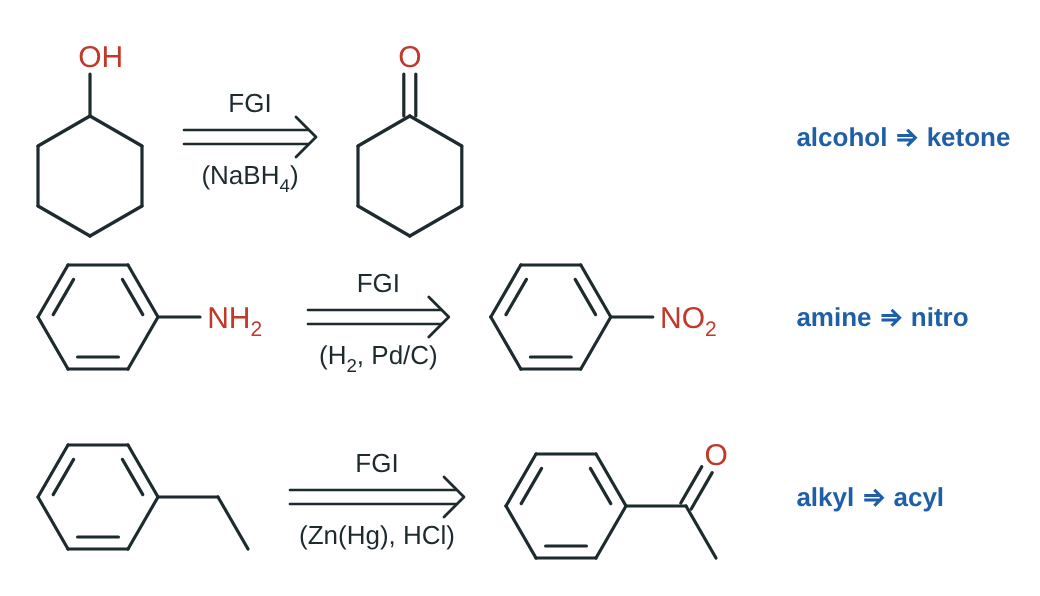
The commonest FGIs are redox: an alcohol comes from an aldehyde, ketone or ester by reduction; an amine from a nitro compound, amide, nitrile or imine; an alkyl group attached to a ring from a ketone by Clemmensen or Wolff–Kishner reduction. The oxidation and reduction reactions of topic 10 are therefore the basic repertoire of FGIs. Other FGIs involve substitution (alcohol ⇒ halide or sulfonate), elimination and addition (alcohol ⇒ alkene) or hydrolysis (acid ⇒ nitrile or ester).
An FGI can open up a disconnection that did not exist. A secondary amine does not disconnect well by SN2 (amine alkylation gives mixtures), but if it is mentally converted into the imine, the C=N bond disconnects into a carbonyl compound and a primary amine: this is reductive amination. Likewise, an alkene can be disconnected by the Wittig reaction and a secondary alcohol is converted into the ketone so that it can be disconnected by an enolate alkylation.
There are also functional group addition (FGA) operations: a group is mentally added that eases a disconnection and is later removed, such as a double bond hydrogenated at the end or an ester that activates a carbon and is then decarboxylated. To learn the available transformations, review in Organic Chemistry made transparent the preparation of alcohols, of amines and of carbonyl compounds.