
The synthetic equivalent
The synthetic equivalent is the real reagent used in the laboratory to behave like the synthon. The methyl anion does not exist as such, but methylmagnesium bromide reacts as if it were.
| Synthon | Synthetic equivalent | Reaction |
|---|---|---|
| CH3− | CH3MgBr, CH3Li | addition to carbonyls |
| R2C+–OH | R2C=O | nucleophilic addition |
| CH3C+=O | CH3COCl + AlCl3 | Friedel–Crafts |
| −CN | NaCN, KCN | SN2 |
| +COOH | CO2 | carboxylation of organometallics |
| −CH2COOH | CH2(CO2Et)2 + base | malonic ester synthesis |
| +NH2 (on an aryl) | NO2+ and reduction | nitration |
| RC−=O (acyl anion) | 2-lithio-1,3-dithiane | umpolung |
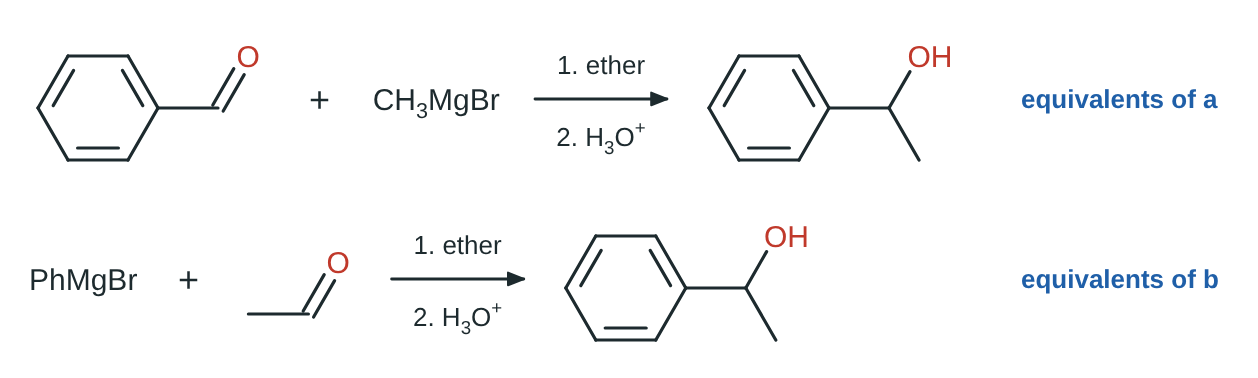
For 1-phenylethanol, the equivalents of the synthons of disconnection a are benzaldehyde and methylmagnesium bromide; those of b, phenylmagnesium bromide and acetaldehyde. The two routes are equally short, and the choice would depend on the price and availability of the reagents. Review the preparation of alcohols with organometallics.
The same synthon may have several equivalents, and sometimes the equivalent does not resemble it: the +NH2 synthon required by the disconnection of an aniline has no direct equivalent, and nitration followed by reduction is used instead; the −CH2COOH synthon is achieved with diethyl malonate, which is then hydrolysed and decarboxylated. Choosing the equivalent well is the most creative part of the analysis.