
The synthon
A synthon is each of the idealized fragments, usually ionic, resulting from a disconnection. It is not a compound that can be bought or weighed: it represents the reactivity required of the fragment, nucleophilic or electrophilic.
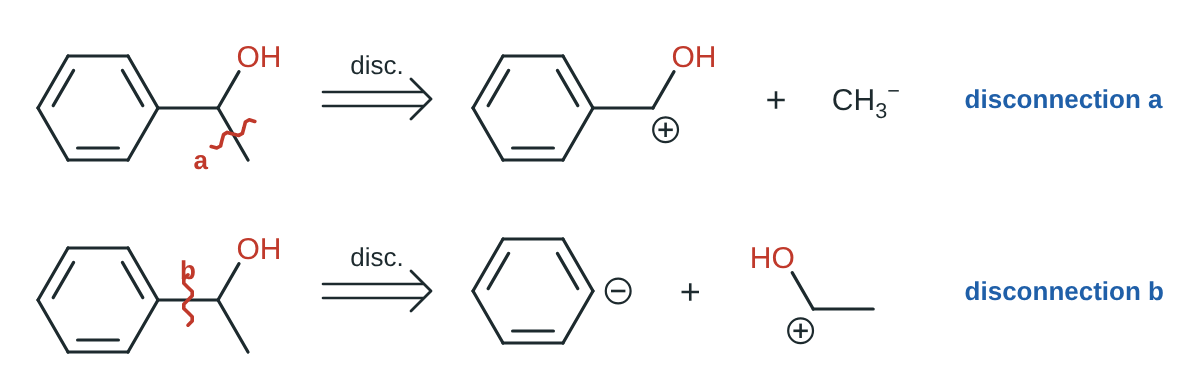
The term was introduced by Corey in 1967. The same molecule admits several disconnections, and each gives its own pair of synthons. In 1-phenylethanol, disconnection a (between the carbinol and the methyl) gives an oxygen-stabilized cation and the methyl anion; b (between the ring and the carbinol) gives the phenyl anion and a hydroxyethyl cation. Both are good, because the two cations are “disguised” carbonyl carbons and the two anions correspond to Grignard reagents.
Synthons are classified by their polarity: donors (d) are nucleophiles and acceptors (a) electrophiles, numbered by the position of the reactive atom relative to the heteroatom of the functional group. Thus the carbon of a carbonyl is an a1 synthon, the α carbon of an enolate a d2 and the β carbon of an enone an a3. This notation of Seebach's helps to see when synthons have the “natural” polarity and when it must be inverted.