
Disconnection
A disconnection is the imaginary breaking of a bond in the target molecule, indicated with a wavy line. It must be the reverse of a known bond-forming reaction, usually a reaction between a nucleophile and an electrophile.
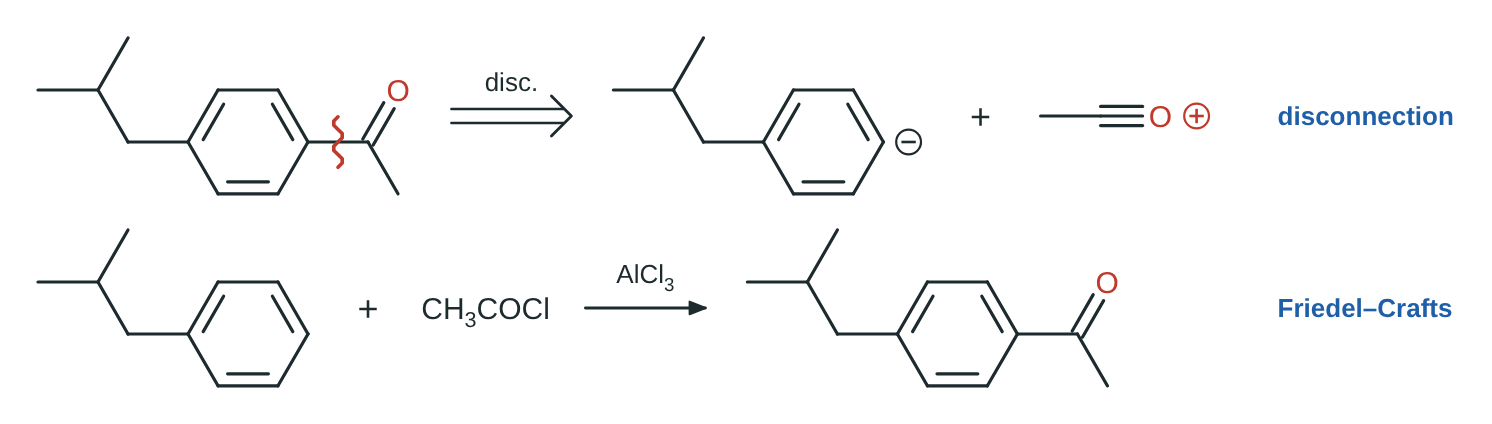
In 4-isobutylacetophenone, the bond between the ring and the carbonyl is disconnected. Heterolytic cleavage can leave the negative charge on either fragment; the correct choice is the one that corresponds to a reaction: the electron-rich aromatic ring acts as the nucleophile and the acylium ion as the electrophile. That is exactly the Friedel–Crafts acylation.
Which bonds to disconnect
- C–heteroatom bonds (esters, amides, ethers, amines): they are easily formed and are usually disconnected first.
- C–C bonds close to the functional group (α or β), because the functional group is what makes possible the reaction that forms them: aldol, Michael, Grignard, enolate alkylation.
- Bonds at branch points and those that divide the molecule into two similar halves (convergent synthesis), or that exploit symmetry.
- The bonds that form rings, by known cyclization reactions (Diels–Alder, Robinson, metathesis).
Aldol and Michael reactions teach another rule: 1,3- and 1,5-dioxygenated compounds are disconnected “naturally”, because the synthons have the polarity of common reagents (enolate and carbonyl). On the other hand, 1,2 and 1,4 relationships require the polarity of one of the fragments to be inverted (umpolung).