Friedel-Crafts Acylation
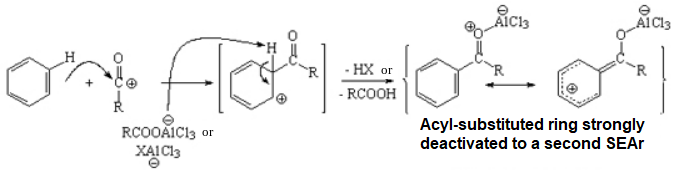
If a carbocation is generated from an acyl halide or an anhydride, the SEAr on benzene leads to an alkyl phenyl ketone.
 ▶ Watch the video on YouTube

The Lewis acid coordinates to the basic centers of the acyl halide or the anhydride and forces the halogen or carboxylate, respectively, to leave giving rise to a carbonyl carbocation whose positive charge is stabilized by the electron lone pairs of the oxygen.

The carbonyl carbocation is attacked by the aromatic ring, yielding an alkyl phenyl ketone.
Carbonyl cations, stabilized by the oxygen, do not rearrange.
The carbonyl group attached to the benzene makes the latter less electron rich and much less reactive thus avoiding polyacylation.