
Robinson annulation
The Robinson annulation builds a new six-membered ring onto a ketone: a Michael addition to methyl vinyl ketone forms a 1,5-diketone, which cyclizes by intramolecular aldol condensation to a cyclohexenone.
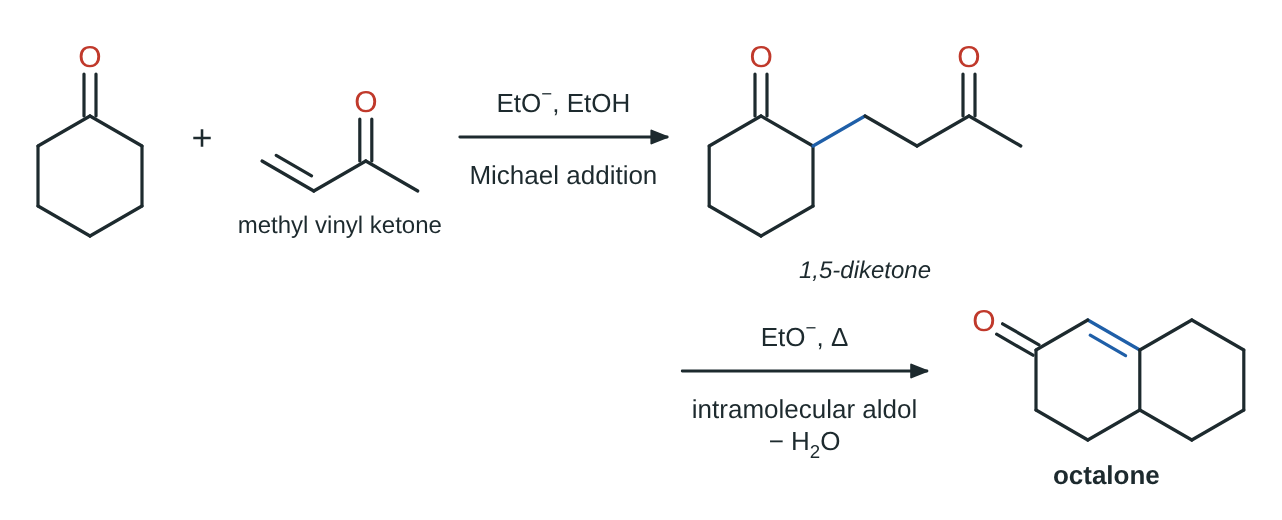
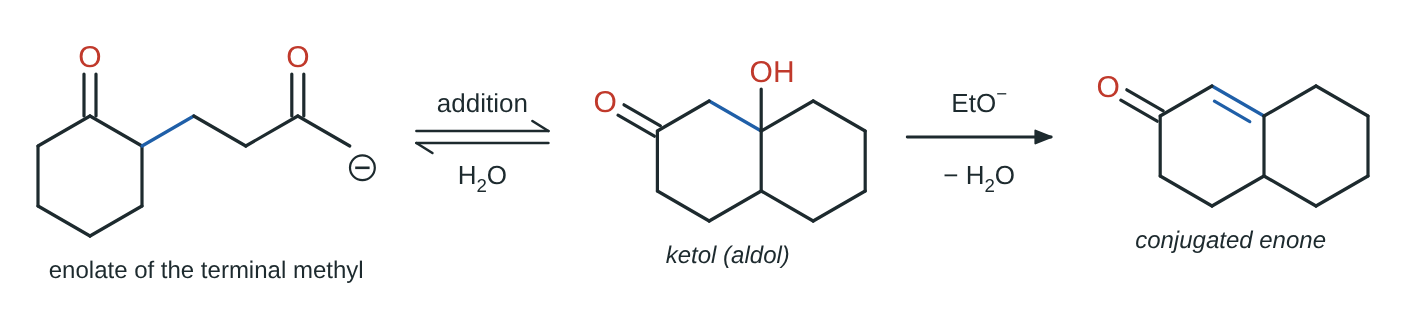
It was discovered by Robert Robinson and William Rapson in 1935, and it soon became a fundamental method for building the rings of steroids and terpenes. The aldol stage is the one we already know: the enolate of the terminal methyl attacks the ring carbonyl, and the bicyclic ketol dehydrates to the conjugated enone:
Variants
Methyl vinyl ketone polymerizes easily under basic conditions, which lowers yields. To avoid this, precursors that release it gradually in the medium are used, such as Mannich bases and their quaternary ammonium salts (see the Mannich reaction), or the enolate is replaced by the Stork enamine, which undergoes the Michael addition under neutral conditions (see the example in topic 6). If the starting ketone is a 1,3-diketone, the annulation leads to the Wieland–Miescher ketone (in the synthesis example) or to the Hajos–Parrish ketone, which can be obtained enantioselectively (see chiral catalysis).
Review the Robinson annulation in Organic Chemistry made transparent.