
Hydrogen, Hydrides, Boranes
The addition of hydrogen, hydrides or borane reduces the C=O group of aldehydes and ketones to an alcohol.
 ▶ Watch the video on YouTube
Catalytic hydrogenation
The reaction is very similar to that studied for the alkenes.

If there are alkenes or alkynes in the molecule, they will also be reduced. The same happens with other functions: look at the table.
| Functional group | Product | Ease |
|---|---|---|
| R–COCl | R–CHO | Extreme |
| R–NO2 | R–NH2 | Very easy |
| alkyne | alkene | Very easy |
| aldehyde | primary alcohol | Easy |
| alkene | alkane | Easy |
| ketone | secondary alcohol | Moderate |
| nitrile | primary amine | Moderate |
| ester | primary alcohol | Difficult |
| aromatic | cycloalkane | Very difficult |
This table is merely orientative: the ease of reduction depends strongly on the overall structure of the molecule.
Bear in mind this competition when planning a complex synthesis.
Remember that the C=O group of aldehydes and ketones can be "protected".
Hydride addition
This reaction was already introduced in the chapter on alcohols as a method for preparing them.
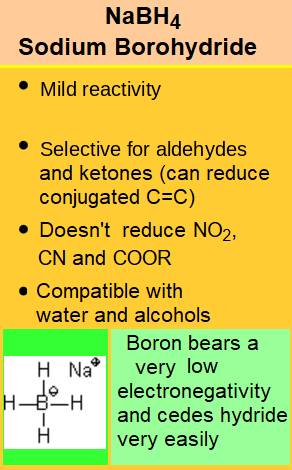

| Functional group | Product | Ease |
|---|---|---|
| aldehyde | primary alcohol | Extreme |
| ketone | secondary alcohol | Extreme |
| R–COCl | primary alcohol | Very easy |
| epoxide | alcohol | Easy |
| ester | primary alcohol | Easy |
| R–COOH | primary alcohol | Moderate |
| amide | amine | Difficult |
| nitrile | primary amine | Difficult |
| alkene | — | Inert |
| alkyne | — | Inert |
This table is merely orientative: the ease of reduction depends strongly on the overall structure of the molecule and on the reaction conditions (solvents, additives, temperature, etc.).
Borane addition
The reaction is very similar to that studied for the alkenes.

In the case of aldehydes and ketones, the boron atom always ends up bonded to oxygen.
Again, bear in mind the competition of other functions for the borane.
| Functional group | Product | Ease |
|---|---|---|
| R–COOH | R–CH2OH | Extreme |
| alkene | alcohol | Very easy |
| aldehyde | primary alcohol | Very easy |
| ketone | secondary alcohol | Easy |
| nitrile | primary amine | Moderate |
| epoxide | alcohol | Difficult |
| ester | primary alcohol | Very difficult |
| R–COCl | — | Inert |
This table is merely orientative: the ease of reduction depends strongly on the overall structure of the molecule and on the reaction conditions (solvents, additives, temperature, etc.).
Notice that, if you compare the three tables on this page, the order of reactivity of the functional groups is very different. Achieving a chemoselective reduction, i.e. one that affects only the function we want, is an art. But don't worry: it is an art learned with time, practice and patience.