
Pyrolytic syn eliminations
Some esters, xanthates, amine N-oxides and selenoxides eliminate on heating without the need for acid or base. The leaving group removes the β hydrogen through a cyclic transition state, so both leave from the same face: it is an intramolecular syn elimination (Ei).
The cyclic transition state
In these reactions an atom of the leaving group with lone pairs (the carbonyl or thiocarbonyl oxygen, or the oxygen of N–O or Se–O) acts as an internal base. Esters and xanthates react through a six-membered transition state; N-oxides and selenoxides through a five-membered one. In both cases the H and the leaving group must be synperiplanar, or nearly so.
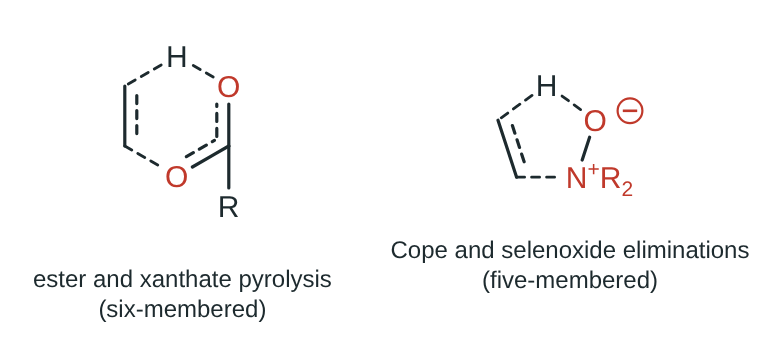
As there is no external base, regioselectivity depends mainly on the number of available β hydrogens and their orientation, not on the stability of the alkene: a substantial proportion of the less substituted alkene (the Hofmann product) is often formed. In cyclic systems only hydrogens cis to the leaving group can be eliminated.
Four variants
The temperature required depends strongly on the leaving group:
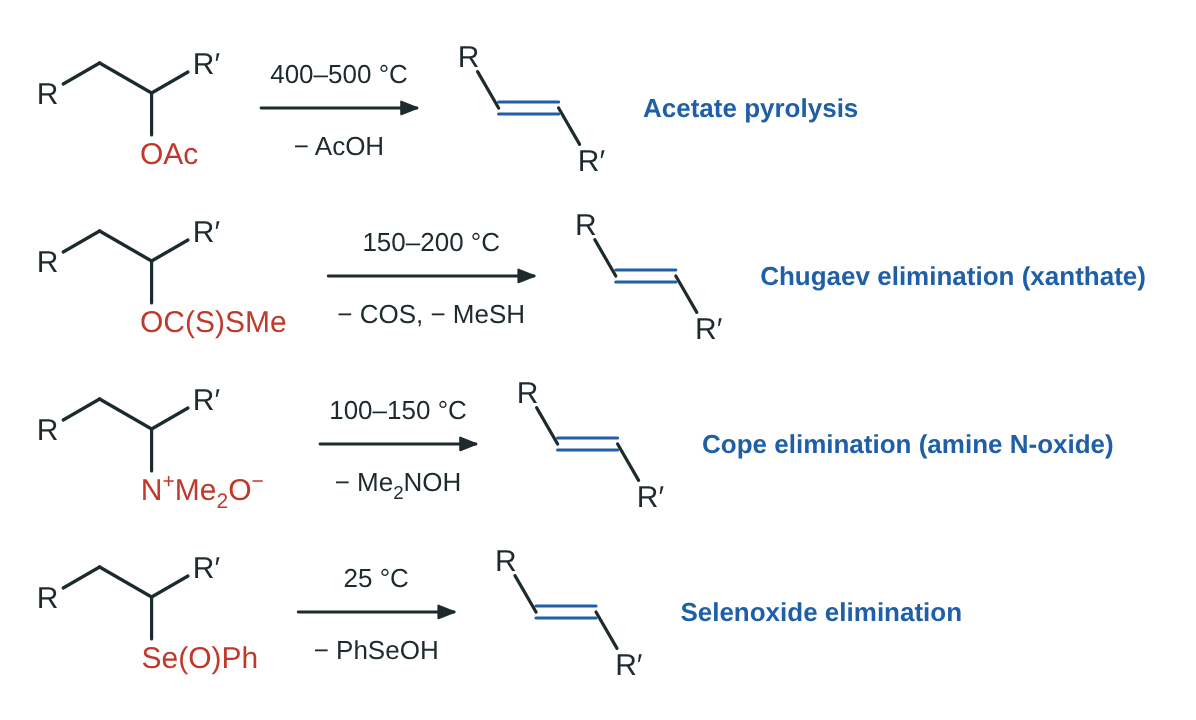
- Acetate pyrolysis requires such high temperatures that it is useful only for simple molecules, usually in the gas phase.
- The Chugaev elimination uses S-methyl xanthates, prepared by treating the alcohol with NaH, CS2 and MeI. C=S is a better base than C=O, and the reaction takes place at much lower temperatures, without the rearrangements of acid-catalysed dehydration.
- In the Cope elimination, the N-oxide is formed by oxidizing a tertiary amine with H2O2 or a peracid, and it decomposes on heating into an N,N-dialkylhydroxylamine and the alkene. It is a mild alternative to the Hofmann elimination.
- The selenoxide elimination is the easiest: the selenoxide, obtained by oxidizing a selenide with H2O2, NaIO4 or a peracid, eliminates at or below room temperature.
Dehydrogenation of carbonyl compounds
The most important application of selenoxide elimination is the conversion of ketones, esters and lactones into their α,β-unsaturated derivatives. The enolate reacts with PhSeCl or PhSeBr to give the α-phenylselanyl derivative; oxidation forms the selenoxide, which immediately eliminates benzeneselenenic acid. The double bond ends up conjugated with the carbonyl because the only β hydrogen that can be eliminated is the one on the other carbon next to selenium.
The xanthate elimination was described by Lev Chugaev in 1899, and that of N-oxides by Arthur C. Cope in 1949. Selenoxide elimination was developed by Hans J. Reich, K. Barry Sharpless and others from 1973 onwards.