Hofmann Degradation
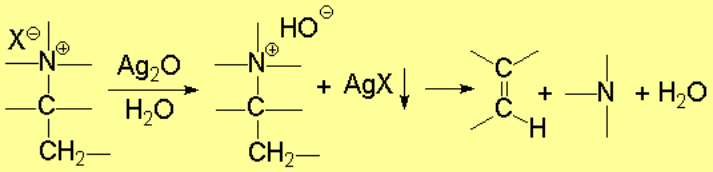
Degradation is one of the most important reactions of amines. It leads to olefins.
 ▶ Watch the video on YouTube
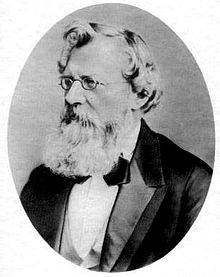
August Wilhelm von Hofmann (8 April 1818 – 5 May 1892) was a German chemist.
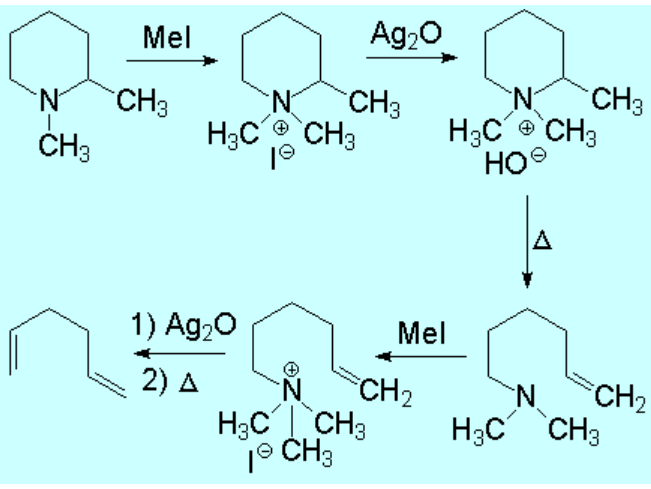
Look at the following example of a "double" degradation:
What is the mechanism of the Hofmann degradation? Let's see whether the following experimental fact gives you a clue!!!
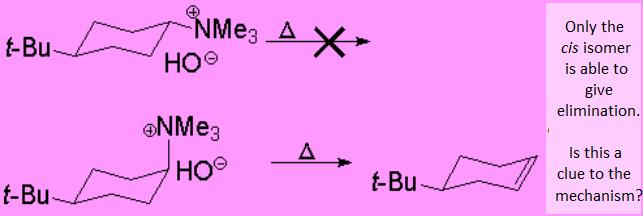
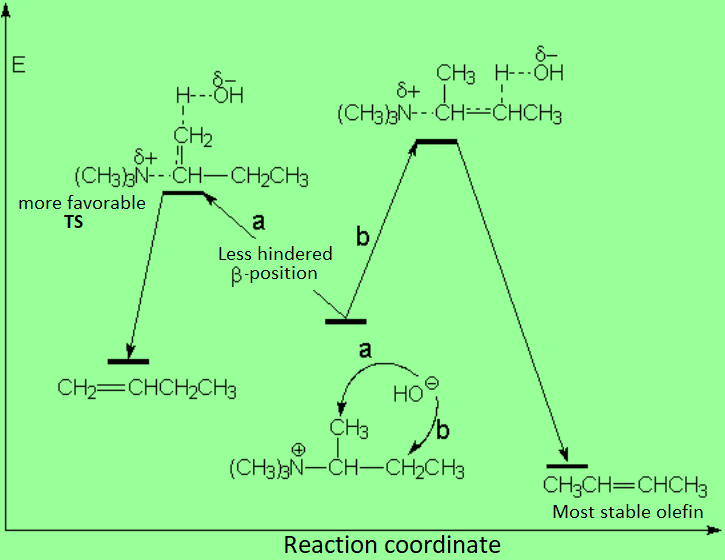
The tert-butyl group locks the conformational equilibrium. In the trans isomer the trimethylammonium group is equatorial and has no hydrogens anti to the nitrogen leaving group; only the cis isomer, with the axial group, has them. The E2 mechanism has this requirement. Therefore, the Hofmann elimination takes place by an E2 mechanism in which the base is hydroxide, which always attacks the least hindered position.
The reaction is kinetically controlled leading to the monosubstituted olefin which is less stable. The more substituted the olefin, the more stable.