
SolutionsHofmann Degradation
1. Hofmann degradation in the decalins
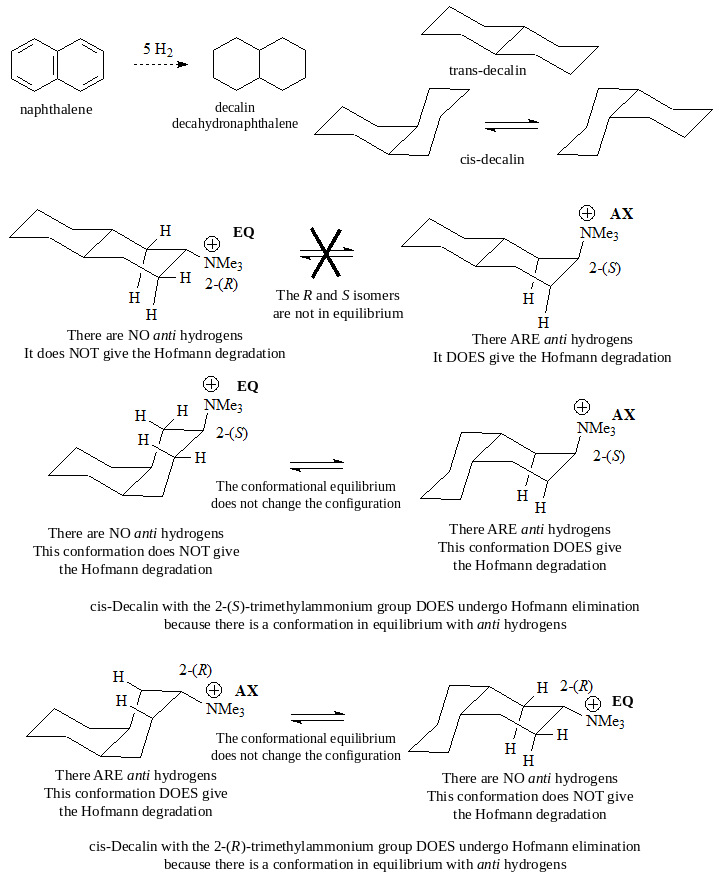
Decalin (C10H18) is a bicycloalkane made of two fused cyclohexane rings that share a bond. It is the compound obtained by complete hydrogenation of naphthalene, which is why it is also called decahydronaphthalene. Consider trans-decalin bearing a trimethylammonium group (NMe3+) at position 2. One of the two isomers, 2-(R) or 2-(S), undergoes Hofmann elimination, whereas the other does not react at all. Explain this fact. Why does the same not happen in cis-decalin, where both the 2-(R) and 2-(S) isomers undergo Hofmann elimination?
Hofmann elimination is an E2 reaction and needs a hydrogen anti (antiperiplanar) to the leaving group, that is, the NMe3+ in an axial position with axial hydrogens on the neighbouring carbons. trans-Decalin is rigid: it cannot flip its chairs. In one isomer the NMe3+ is equatorial and has no anti hydrogens, so it does not react; in the other it is axial and does have them. The two isomers do not interconvert because they differ in configuration.
cis-Decalin can change conformation (simultaneous flip of both chairs). This conformational equilibrium does not change the configuration, but it takes the NMe3+ group from equatorial to axial; in that conformation there are anti hydrogens and both isomers undergo elimination.
2. Halides and ammonium salts
The cis isomer of 1-bromo-4-tert-butylcyclohexane undergoes elimination (E2) about 106 times faster than the trans isomer. However, neither cis- nor trans-N,N-dimethyl-4-tert-butylcyclohexylamine undergoes Hofmann degradation when heated with a base. Explain these facts.
The very bulky tert-butyl group always stays equatorial and locks the conformation. In the cis isomer the Br is axial and has anti hydrogens: E2 is fast. In the trans isomer the Br is equatorial; to react, the ring would have to put the tert-butyl group axial, which is very unfavourable.
The amine does not undergo Hofmann degradation because the dimethylamide group, (CH3)2N−, is a terrible leaving group (the amine has pKa ≈ 35). For elimination to occur, the amine must first be converted into a quaternary ammonium salt (excess CH3I) and this into the hydroxide (Ag2O, H2O). Then the cis isomer, with the axial NMe3+, gives 4-tert-butylcyclohexene on heating, while the trans isomer, with the equatorial group, does not eliminate.
3. Which alkene is formed?
Give the main alkene obtained in the Hofmann degradation of 2-pentylamine (exhaustive methylation, Ag2O and heat). Is it the same as the one given by dehydration of 2-pentanol?
1-Pentene (Hofmann product): the base attacks the hydrogen on the less substituted carbon, which is more accessible and more acidic, since the trimethylammonium group is bulky. Dehydration of 2-pentanol (E1) gives mainly 2-pentene, the more substituted alkene (Zaitsev product).
4. Double degradation
What final product is obtained after two successive Hofmann degradations of N-methylpiperidine?
1,4-Pentadiene. The first degradation opens the ring and gives N,N-dimethyl-4-penten-1-amine, CH2=CHCH2CH2CH2N(CH3)2; after a new methylation, the second one eliminates trimethylamine and gives CH2=CHCH2CH=CH2.