
Addition-cyclization reactions
If the nucleophile that adds to the carbonyl carries a leaving group on the attacking carbon, the alkoxide formed can displace it intramolecularly and close a three-membered ring. This is how epoxides form (Darzens condensation, sulfur ylides) and, with conjugated acceptors, cyclopropanes.
The Darzens condensation
The enolate of an α-halo ester, formed with an alkoxide or a lithium amide, adds to an aldehyde or a ketone as in an aldol reaction. The alkoxide of the halohydrin then displaces the halide by an intramolecular SN2 reaction and forms an α,β-epoxy ester, called a glycidic ester.

Glycidic esters are very useful intermediates: hydrolysis of the ester and decarboxylation of the acid, accompanied by opening of the epoxide, give an aldehyde or a ketone with one more carbon than the starting carbonyl compound. The Darzens condensation is therefore a homologation method.
Sulfur ylides: the Corey–Chaykovsky reaction
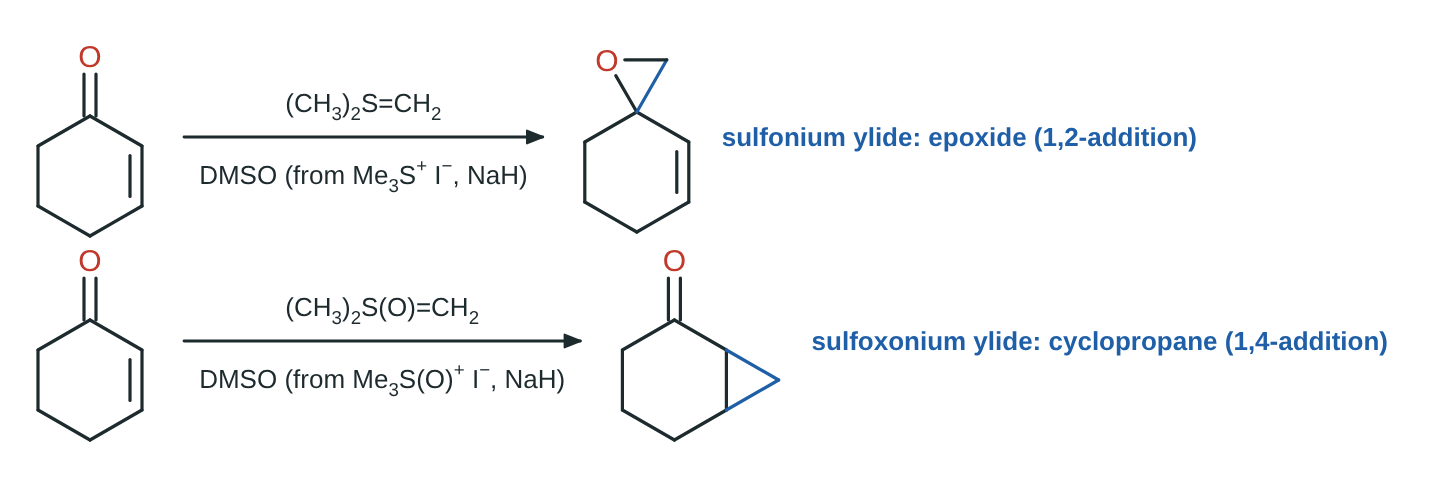
Sulfur ylides add to carbonyl groups just like phosphorus ylides, but the intermediate does not form an S–O bond: the alkoxide displaces the sulfide, which is a good leaving group, and an epoxide is obtained instead of an alkene. Two reagents are used, generated with NaH or BuLi from trimethylsulfonium and trimethylsulfoxonium salts:
- Dimethylsulfonium methylide, (CH3)2S=CH2, is very reactive and adds irreversibly to the carbonyl (1,2-addition), even in enones: it gives epoxides.
- The more stable dimethylsulfoxonium methylide, (CH3)2S(O)=CH2, adds reversibly to the carbonyl; with enones it ends up giving conjugate (1,4) addition, and the enolate then displaces DMSO and closes a cyclopropane.
With 4-tert-butylcyclohexanone the more reactive sulfonium ylide attacks preferentially from the axial face (kinetic control) and the new C–C bond is axial, whereas the sulfoxonium ylide, whose addition is reversible, gives the thermodynamically more stable epoxide, with the new C–C bond equatorial.
The condensation was described by Georges Darzens in 1904; sulfur ylides were introduced by Elias J. Corey and Michael Chaykovsky in 1962–1965. Review alkene epoxidation and epoxide opening in Organic Chemistry made transparent.