
The Julia reaction and related processes
In the Julia olefination the carbanion of a sulfone adds to an aldehyde and the adduct is converted into an alkene with high E selectivity. In its modern version (Julia–Kocienski) everything takes place in a single step.
The Julia–Lythgoe olefination
The sulfonyl group makes the hydrogens on the adjacent carbon acidic (pKa ≈ 29 in DMSO), and n-BuLi forms the α-sulfonyl carbanion, which adds to an aldehyde. The alkoxide is acylated (Ac2O or BzCl) to give a β-acyloxy sulfone, and reduction with sodium amalgam in methanol removes both the sulfonyl and acetate groups and forms the double bond.
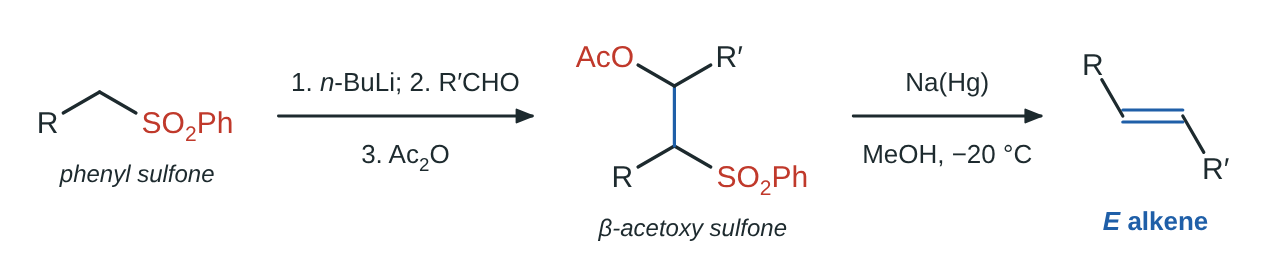
The reduction proceeds through vinyl or alkyl radicals and anions that equilibrate before the double bond forms, so the configuration of the β-acyloxy sulfone does not matter: the mixture of diastereomers gives the more stable E alkene with high selectivity. This is why the Julia–Lythgoe reaction was for many years the method of choice for making disubstituted E alkenes in the synthesis of complex natural products.
The Julia–Kocienski olefination
Sodium amalgam is toxic and the procedure has three steps. In the modified Julia reaction the phenyl group of the sulfone is replaced by an electron-poor heterocycle: first a benzothiazol-2-yl group (Sylvestre Julia, 1991) and then a 1-phenyl-1H-tetrazol-5-yl group (PT, Philip Kocienski, 1998). The alkoxide formed in the addition attacks the heterocycle (an intramolecular nucleophilic aromatic substitution, the Smiles rearrangement), the aryl group migrates from sulfur to oxygen, and the resulting sulfinate loses SO2 and the aryloxide in a spontaneous elimination.
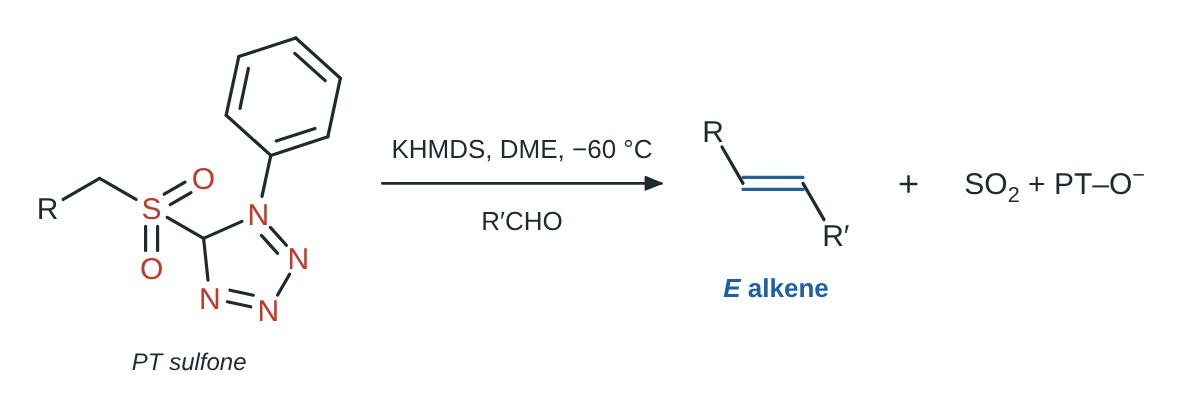
The reaction is carried out in a single step under mild conditions, adding the base (KHMDS or LiHMDS) to the mixture of sulfone and aldehyde to prevent self-condensation of the carbanion. E selectivity is high, especially with potassium bases in polar solvents such as DME; unlike the classic version, here the geometry is decided by the addition, which is irreversible, and not by a subsequent equilibrium.
The original version was published by Marc Julia and Jean-Marc Paris in 1973, and Basil Lythgoe and Philip Kocienski turned it into a general method. His brother Sylvestre Julia introduced the modified version with heteroaryl sulfones.